Legal Insights
Articles and guides on Philippine law and related business and financial topics from MJM Law & Partners.

“No Return, No Exchange”: When Can a Buyer Demand a Refund or Replacement?
A store policy cannot automatically defeat a consumer’s remedies for defective goods. This guide explains the distinction between a genuine defect and a change of mind, the repair and replacement framework under the Consumer Act, and the records and steps that help buyers pursue an appropriate remedy.
Read Full Article“No Return, No Exchange”: When Can a Buyer Demand a Refund or Replacement?
A store policy cannot automatically defeat a consumer’s remedies for defective goods. This guide explains the distinction between a genuine defect and a change of mind, the repair and replacement framework under the Consumer Act, and the records and steps that help buyers pursue an appropriate remedy.
Read More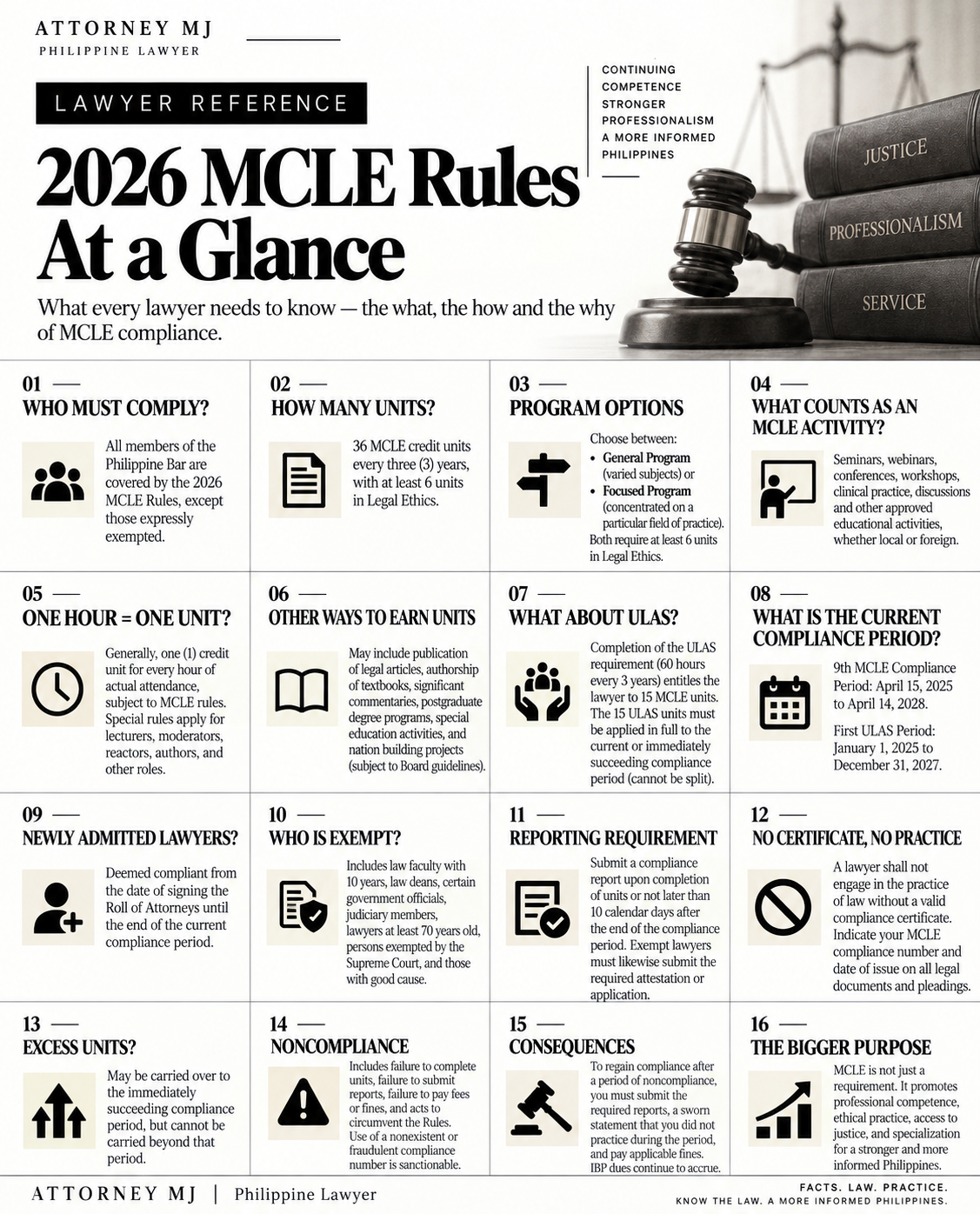
DEMYSTIFYING THE NEW 2026 RULES ON MANDATORY CONTINUING LEGAL EDUCATION
The 2026 Rules on Mandatory Continuing Legal Education introduce a more flexible and practice oriented framework for Philippine lawyers. While the core requirement remains 36 MCLE units every three years, including at least 6 units in Legal Ethics, lawyers may now choose between a General Program and a Focused Program. The Rules also recognize broader educational activities, provide for possible MCLE credit from ULAS, postgraduate studies, legal publications and other qualifying activities, and establish a framework for legal specialization. More importantly, compliance is directly tied to the authority to practice law, making proper completion, documentation, reporting, and maintenance of a valid MCLE compliance certificate essential for every practicing lawyer.
Read More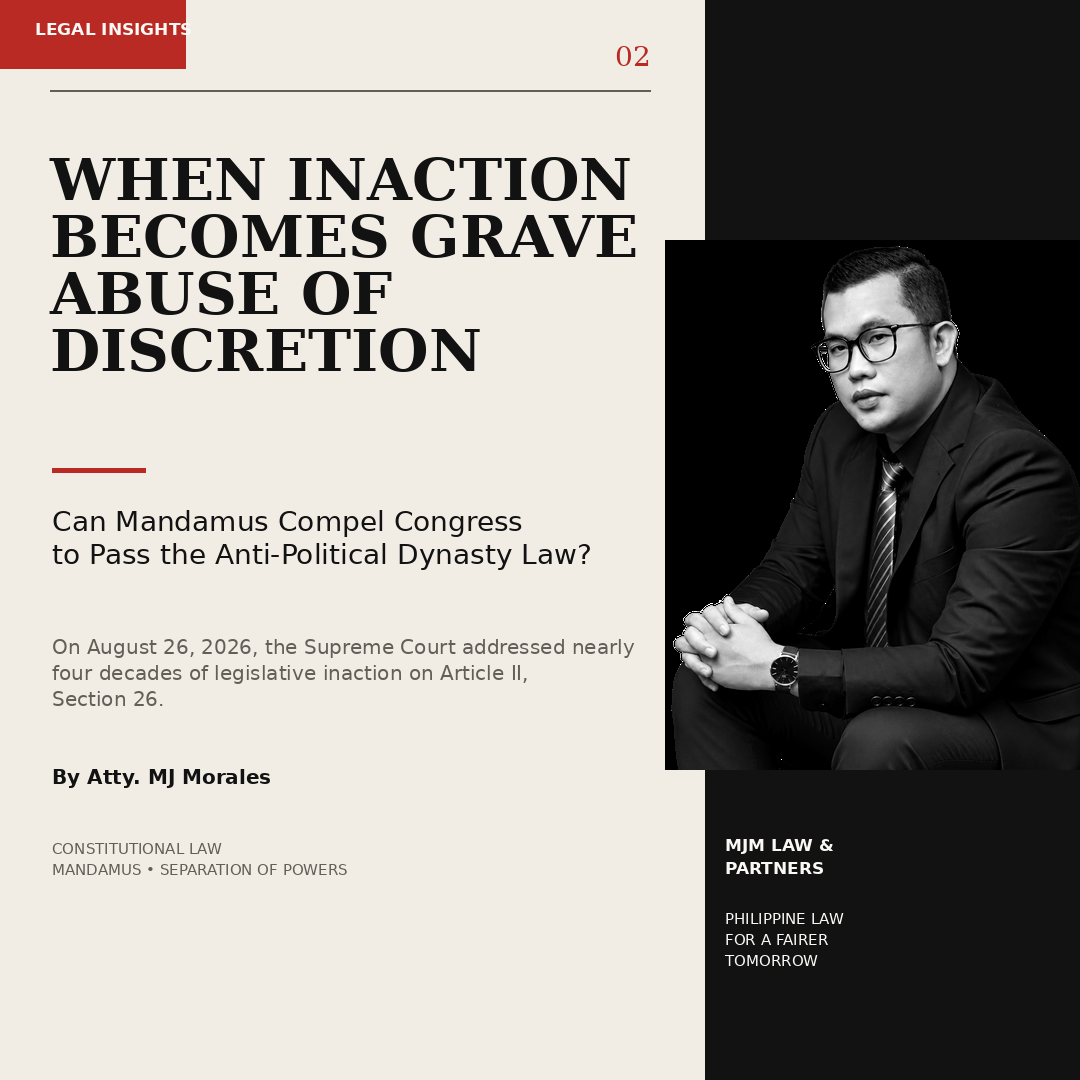
When Inaction Becomes Grave Abuse of Discretion: Can Mandamus Compel Congress to Pass the Anti-Political Dynasty Law?
The article examines whether the Supreme Court may compel Congress through mandamus to fulfill Article II, Section 26 of the 1987 Constitution, which directs the State to prohibit political dynasties “as may be defined by law.” Its central argument is that the Constitution imposes a mandatory duty on Congress to enact the necessary anti-political dynasty law, while Congress retains discretion over the law’s specific content, scope, and enforcement mechanisms. The article weighs this position against the separation of powers concern that legislation is inherently deliberative and discretionary, and therefore may not be a proper subject of mandamus. It ultimately frames the 2026 ruling as part of a broader constitutional question: whether prolonged governmental inaction can itself constitute grave abuse of discretion, while still preserving the Judiciary’s duty to enforce the Constitution without assuming Congress’ legislative function.
Read More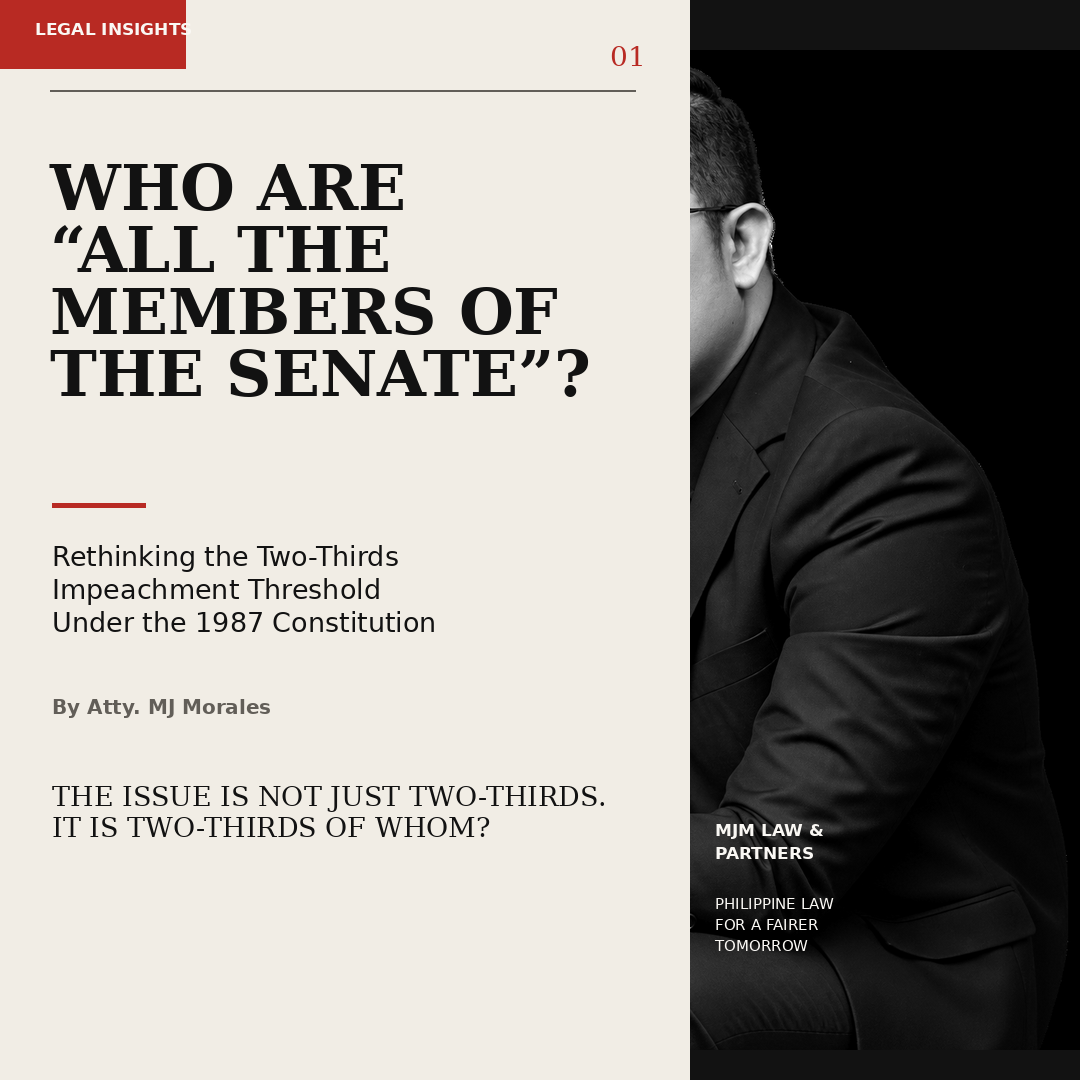
Who Are “All the Members of the Senate”?
The impeachment of a Vice-President presents a constitutional question that appears mathematical on its face but is, in reality, fundamentally a question of constitutional interpretation: What exactly does the Constitution mean when it requires “the concurrence of two-thirds of all the Members of the Senate” for a conviction in an impeachment case?
Read More
Is Your Solar Legal? A Comprehensive Guide to Legal Installations Under RA 9136 and RA 11285
Understanding the legal requirements for home solar power in the Philippines is essential for ensuring both safety and compliance with Republic Act No. 9136 (EPIRA) and Republic Act No. 11285 (Energy Efficiency and Conservation Act). This guide defines the critical differences between legal off-grid and grid-tied systems versus prohibited "guerrilla installations," which can trigger severe criminal and civil penalties, including imprisonment and fines reaching up to millions of pesos. To remain compliant, the law mandates that homeowners follow specific building standards and secure formal interconnection agreements with distribution utilities. By completing necessary steps such as obtaining a Certificate of Final Electrical Inspection and entering a Net-Metering Agreement, you can safely utilize renewable energy while adhering to national policy on energy efficiency and industry reform.
Read More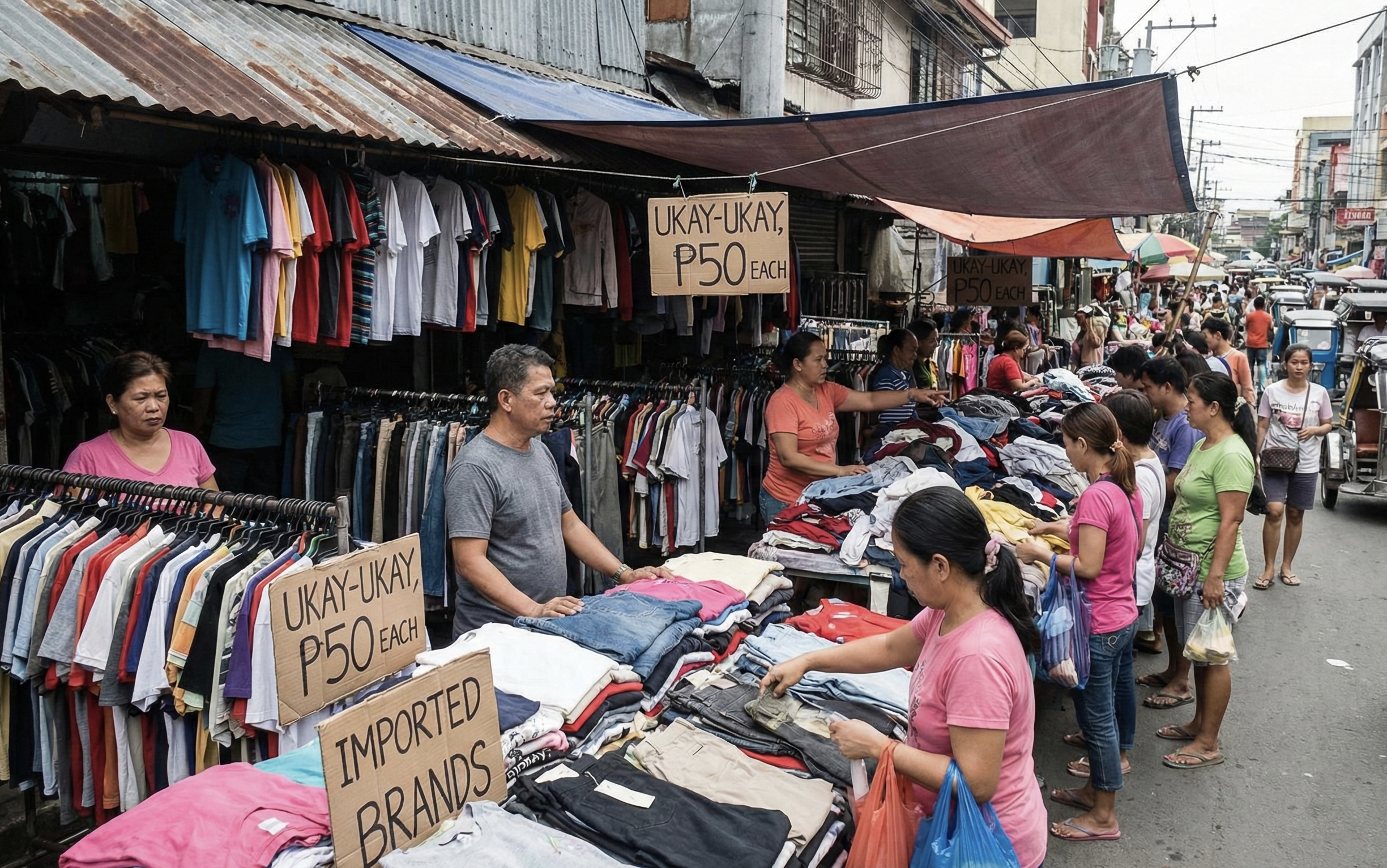
The Law Against Ukay-ukay: Clarified
The legal paradox of the widespread ukay-ukay (second-hand clothing) trade in the Philippines stems from the specific scope of Republic Act No. 4653. This law strictly prohibits and penalizes the commercial importation of used clothing to safeguard public health and dignity, targeting only the importer who introduces the goods into the country. However, R.A. 4653 does not explicitly penalize the domestic retail sale by third-party vendors once the clothes have entered the Philippines. This distinction is protected by the legal principle of Nullum crimen, nulla poena sine lege (no crime without a law), as the statute fails to include "selling" or "possession" as punishable offenses. This gap allows smugglers to circumvent the law, often by fraudulently declaring commercial shipments as tax-exempt charitable donations before diverting them to the retail market. Consequently, while the supply chain is based on illegal imports, the final vendors can operate openly with local business permits, resulting in a multibillion-peso gray market that persists despite the standing prohibition.
Read MoreLatest Updates
“No Return, No Exchange”: When Can a Buyer Demand a Refund or Replacement?
LegalA store policy cannot automatically defeat a consumer’s remedies for defective goods. This guide explains the distinction between a genuine defect and a change of mind, the repair and replacement framework under the Consumer Act, and the records and steps that help buyers pursue an appropriate remedy.
September 23, 2026DEMYSTIFYING THE NEW 2026 RULES ON MANDATORY CONTINUING LEGAL EDUCATION
LegalThe 2026 Rules on Mandatory Continuing Legal Education introduce a more flexible and practice oriented framework for Philippine lawyers. While the core requirement remains 36 MCLE units every three years, including at least 6 units in Legal Ethics, lawyers may now choose between a General Program and a Focused Program. The Rules also recognize broader educational activities, provide for possible MCLE credit from ULAS, postgraduate studies, legal publications and other qualifying activities, and establish a framework for legal specialization. More importantly, compliance is directly tied to the authority to practice law, making proper completion, documentation, reporting, and maintenance of a valid MCLE compliance certificate essential for every practicing lawyer.
September 18, 2026When Inaction Becomes Grave Abuse of Discretion: Can Mandamus Compel Congress to Pass the Anti-Political Dynasty Law?
LegalThe article examines whether the Supreme Court may compel Congress through mandamus to fulfill Article II, Section 26 of the 1987 Constitution, which directs the State to prohibit political dynasties “as may be defined by law.” Its central argument is that the Constitution imposes a mandatory duty on Congress to enact the necessary anti-political dynasty law, while Congress retains discretion over the law’s specific content, scope, and enforcement mechanisms. The article weighs this position against the separation of powers concern that legislation is inherently deliberative and discretionary, and therefore may not be a proper subject of mandamus. It ultimately frames the 2026 ruling as part of a broader constitutional question: whether prolonged governmental inaction can itself constitute grave abuse of discretion, while still preserving the Judiciary’s duty to enforce the Constitution without assuming Congress’ legislative function.
September 17, 2026Who Are “All the Members of the Senate”?
LegalThe impeachment of a Vice-President presents a constitutional question that appears mathematical on its face but is, in reality, fundamentally a question of constitutional interpretation: What exactly does the Constitution mean when it requires “the concurrence of two-thirds of all the Members of the Senate” for a conviction in an impeachment case?
May 8, 2026Is Your Solar Legal? A Comprehensive Guide to Legal Installations Under RA 9136 and RA 11285
LegalUnderstanding the legal requirements for home solar power in the Philippines is essential for ensuring both safety and compliance with Republic Act No. 9136 (EPIRA) and Republic Act No. 11285 (Energy Efficiency and Conservation Act). This guide defines the critical differences between legal off-grid and grid-tied systems versus prohibited "guerrilla installations," which can trigger severe criminal and civil penalties, including imprisonment and fines reaching up to millions of pesos. To remain compliant, the law mandates that homeowners follow specific building standards and secure formal interconnection agreements with distribution utilities. By completing necessary steps such as obtaining a Certificate of Final Electrical Inspection and entering a Net-Metering Agreement, you can safely utilize renewable energy while adhering to national policy on energy efficiency and industry reform.
December 13, 2025The Law Against Ukay-ukay: Clarified
LegalThe legal paradox of the widespread ukay-ukay (second-hand clothing) trade in the Philippines stems from the specific scope of Republic Act No. 4653. This law strictly prohibits and penalizes the commercial importation of used clothing to safeguard public health and dignity, targeting only the importer who introduces the goods into the country. However, R.A. 4653 does not explicitly penalize the domestic retail sale by third-party vendors once the clothes have entered the Philippines. This distinction is protected by the legal principle of Nullum crimen, nulla poena sine lege (no crime without a law), as the statute fails to include "selling" or "possession" as punishable offenses. This gap allows smugglers to circumvent the law, often by fraudulently declaring commercial shipments as tax-exempt charitable donations before diverting them to the retail market. Consequently, while the supply chain is based on illegal imports, the final vendors can operate openly with local business permits, resulting in a multibillion-peso gray market that persists despite the standing prohibition.
August 17, 2025Preliminary Investigation Process in the Philippines: A Step-by-Step Guide
LegalA preliminary investigation in the Philippines is a procedure to determine if there is reasonable certainty to convict a person in court. Governed by Rule 112 of the Rules of Court and handled mainly by DOJ prosecutors, it applies when the offense carries a penalty of more than four years, two months, and one day. The process involves the filing of a complaint, submission of counter-affidavits, possible replies and rejoinders, and sometimes clarificatory hearings. The prosecutor then decides whether to file an information in court or dismiss the case. This safeguard protects the innocent from baseless charges, filters out weak cases, and upholds due process, making it a vital step in the Philippine criminal justice system.
August 1, 2025New Supreme Court Guidelines: Proper Designation of Qualified Rape vs. Statutory Rape in the Philippines
LegalThe Supreme Court of the Philippines has clarified a long-standing legal issue: the term “qualified statutory rape” is not a valid legal term under the Revised Penal Code (RPC). In its landmark ruling in People of the Philippines v. ABC260708 (G.R. No. 260708, January 23, 2024), the Court laid down guidelines to harmonize past conflicting rulings involving rape of minors. This decision clarifies the proper legal designation of crimes when the elements of both statutory rape and qualified rape are present.
July 29, 2025Bail Amount for Attempted Rape and RA 7610 in the Philippines: A Legal Guide
LegalIn the Philippines, understanding how bail works in cases involving Attempted Rape and violations of Republic Act No. 7610 (Special Protection of Children Against Abuse, Exploitation and Discrimination Act) is critical, especially when the victim is a child. These two laws intersect when a sexual offense is committed-or attempted-against a minor. This article provides a comprehensive explanation of the applicable laws, penalties, and how bail is determined in such cases.
July 25, 2025Warrantless Arrests in the Philippines: When Is It Legal?
LegalIn the Philippines, the general rule is that no person shall be arrested without a valid warrant issued by a judge. However, the law provides specific exceptions where a warrantless arrest is considered lawful. Understanding these exceptions is crucial for both citizens and law enforcers to ensure that constitutional rights are upheld and respected.
July 20, 2025Annulment vs. Declaration of Nullity of Marriage in the Philippines: Key Differences and Implications
LegalIn Philippine law, annulment and declaration of nullity are distinct legal remedies to dissolve a marriage. Annulment applies to valid marriages that later become defective due to vitiated consent or incapacity, while a declaration of nullity applies to marriages that were void from the beginning, such as those lacking a marriage license or involving psychological incapacity. Both require court proceedings, but have different legal grounds and effects. Children from annulled marriages remain legitimate, and property division depends on the marriage regime. Understanding these differences helps parties pursue the proper legal remedy for marital dissolution.
July 18, 2025When Does Discipline Become Abuse? A Legal Guide for Public School Teachers in the Philippines
LegalIn a classroom setting, discipline is essential. It helps build character, instills respect, and maintains order. But what happens when that discipline is questioned? When does a teacher's effort to correct a student cross the line and become a violation of the law, particularly child abuse under Republic Act No. 7610? This article aims to clarify the thin but important legal boundary between permissible discipline and punishable abuse within Philippine public schools.
July 17, 2025Barangay Justice System (Katarungang Pambarangay): A Complete Guide to Community-Level Dispute Resolution
LegalIn the Philippines, not every legal dispute requires a trip to the courthouse. For many minor disputes between neighbors, family members, or people in the same community, the law requires that they first be settled at the barangay level through the Katarungang Pambarangay, or Barangay Justice System. This grassroots mechanism fosters amicable settlement, decongests court dockets, and provides affordable access to justice. In this article, we break down the types of cases covered, the conciliation process, and practical tips for navigating the system.
July 15, 2025Small Claims Court Process in the Philippines: A Complete Guide
LegalIf you need to recover a relatively small amount of money without the cost and complexity of a full-blown trial, the Philippine Small Claims Court is for you. Designed to make justice faster and more affordable, this special procedure lets you file, argue, and get a decision quickly, usually without needing a lawyer. In this guide, we’ll explain what small claims are, who can file, how to file, and what to expect in court.
July 12, 2025The Chain of Custody Rule: Ensuring the Integrity of Evidence
LegalThe chain of custody is a fundamental rule in criminal procedure that ensures the integrity, authenticity, and admissibility of physical evidence. It is especially crucial in prosecuting cases involving drugs, firearms, and other physical items, as it establishes that the item presented in court is the very same item seized by authorities, untampered and unaltered.
April 20, 2025Cash Flow Forecasting & Management
FinancialAccurate cash‐flow forecasting is the lifeblood of any growing business. Learn the key techniques, tools, and best practices that fractional CFOs use to keep your cash runway healthy and your operations humming.
April 20, 2025A Step‑by‑Step Guide to Filing a Criminal Complaint in the Philippines
LegalA concise walkthrough of the essential steps for filing a criminal complaint in the Philippines—from gathering admissible evidence and drafting your sworn complaint to navigating preliminary investigations and follow‑through in court.
April 20, 2025Strategic Planning & Business Model Innovation
Business AdvisoryHow forward‑thinking companies use strategic planning and business model innovation to anticipate market shifts, seize new opportunities, and build sustainable competitive advantage.