Is Your Solar Legal? A Comprehensive Guide to Legal Installations Under RA 9136 and RA 11285

1. Off-Grid vs. On-Grid: What’s the Difference?
The legal requirements for your system depend entirely on how it interacts with the national power lines.
Off-Grid Systems: These are independent of the electric grid. They use batteries to store energy for use at night or during outages. Because they are not connected to utility wires, they do not require an agreement with Meralco, though they still require local safety permits.
On-Grid (Grid-Tied) Systems: These are connected to the electrical grid, allowing you to harvest both solar energy and utility power. Excess energy can be sent back to the grid for bill credits through a Net-Metering Agreement.
2. What is a "Guerilla Installation"?
A "guerrilla installation" (or guerrilla solar) refers to an unregistered rooftop system connected in parallel to a home’s electrical system without the utility's approval or the installation of a bi-directional meter.
While these systems often use standard hardware, they operate in a "shadow market" to bypass the costs and delays of formal permitting. The primary danger is "back-feeding," where solar power flows into the grid during a blackout, potentially electrocuting utility linemen working on "dead" lines.
3. When is there a violation under the law?
An installation becomes illegal or non-compliant under the following circumstances:
Unauthorized Grid Connection: Under RA 7832, Section 2(a), it is unlawful to make any connection with overhead lines or service wires without the previous authority or consent of the electric utility.
Meter Tampering: Using solar panels in a way that causes an analog meter to run backward (common in guerrilla setups) is considered a form of meter tampering or "illegal use of electricity".
Lack of CFEI: All installations must have a Certificate of Final Electrical Inspection (CFEI) from the Local Government Unit (LGU). Operating without this violates the National Building Code and utility safety rules.
4. Is it a Criminal or Civil Offense?
Unauthorized solar connections can trigger both types of liability:
Criminal: Violating RA 7832 (Anti-Electricity Pilferage Act) is a criminal offense. It is treated as mala prohibita, meaning the act itself is punishable regardless of the owner's intent.
Civil: Utilities can pursue civil actions for "differential billing" (recovering unbilled electricity) and damages. Under RA 9136, Section 43(u), the Energy Regulatory Commission (ERC) has original jurisdiction over disputes between industry participants and end-users .
5. What are the Possible Penalties?
Penalties are severe and can include:
Imprisonment: Under RA 7832, Section 7, violators can face prision mayor (6 years and 1 day to 12 years).
Fines: Fines for illegal use of electricity typically range from ₱10,000 to ₱20,000 for basic violations, plus the cost of "stolen" power.
Regulatory Fines: Under RA 9136, Section 46, general violations of the Act or its rules can result in fines ranging from ₱50,000 to ₱50 million .
Disconnection: Utilities have the right to disconnect service for unauthorized or dangerous installations.
6. Requirements for a Legal Installation
To ensure your solar system is 100% legal, you must complete these steps:
1. Reputable Provider: Choose a provider knowledgeable in safety standards and interconnection rules.
2. LGU Permits: Secure a Building Permit and Electrical Permit from your City or Municipality.
3. CFEI: Obtain the Certificate of Final Electrical Inspection after the system is installed but before it is turned on.
4. Net-Metering Agreement (NMA): Apply with your utility (Meralco, etc.) for an NMA.
5. Bi-directional Meter: Pay the Difference in Meter Cost (DIMC) fee (capped at ₱3,000 for residents as of 2025) to have your meter replaced by the utility.
FREQUENTLY ASKED QUESTIONS
Q: Can Meralco stop me from installing solar?
A: No. Under RA 9513, utilities are mandated to allow solar installations and provide net-metering services to customers. They only regulate the safety of the connection point
Q: Do I need a new meter for solar?
A: Yes, if you are grid-tied. You need a bi-directional meter to ensure you aren't billed for the energy you produce.
Q: Is "Zero-Export" legal?
A: Yes, but it must still be registered with the utility to ensure your "zero-export" device is functioning correctly to prevent back-feeding.
Atty. Mark Joseph Morales, CPA, MBA, JD
Founder and Managing Partner, MJM Law & Partners
Full professional profileYou Might Also Like

“No Return, No Exchange”: When Can a Buyer Demand a Refund or Replacement?
A store policy cannot automatically defeat a consumer’s remedies for defective goods. This guide explains the distinction between a genuine defect and a change of mind, the repair and replacement framework under the Consumer Act, and the records and steps that help buyers pursue an appropriate remedy.
Read More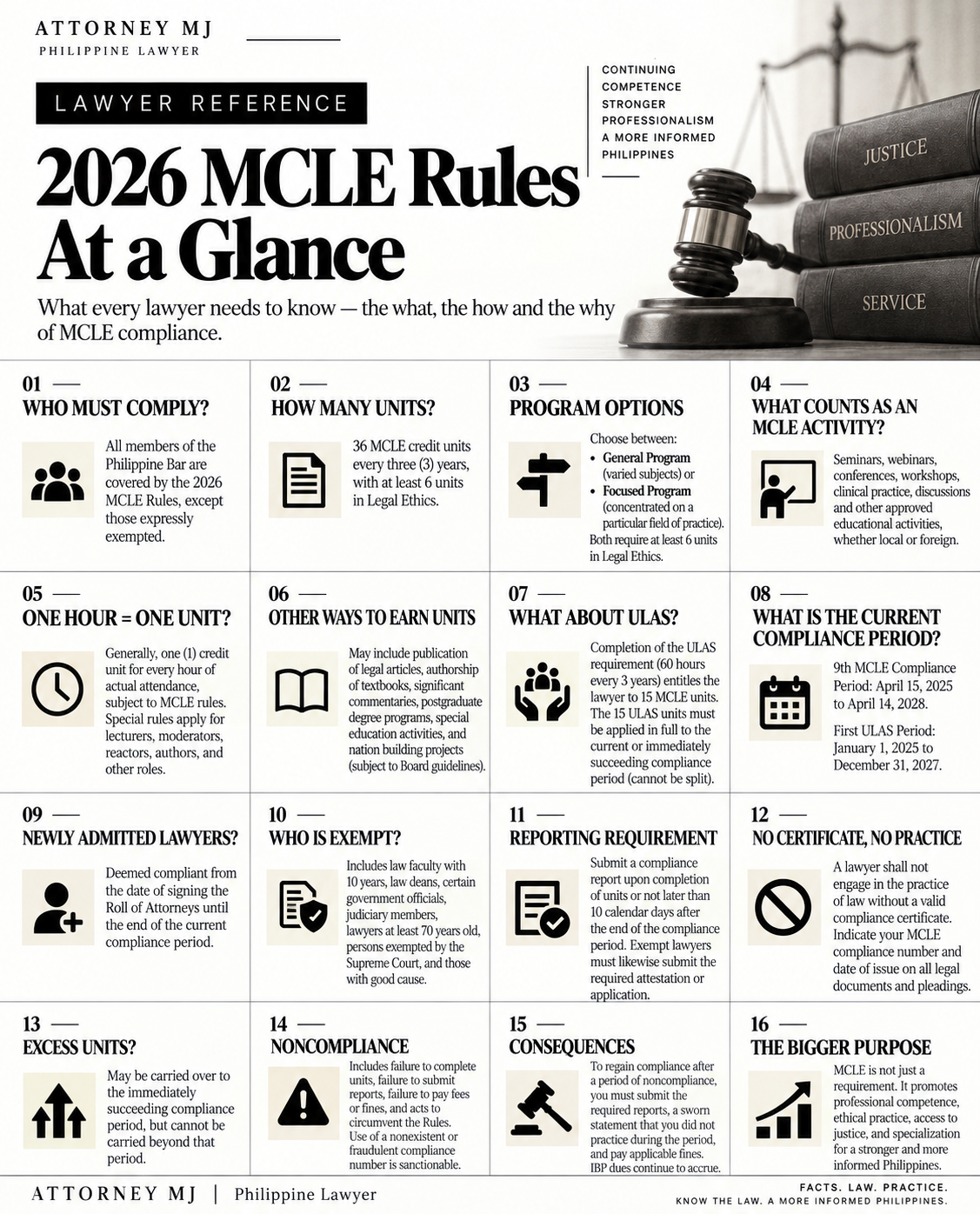
DEMYSTIFYING THE NEW 2026 RULES ON MANDATORY CONTINUING LEGAL EDUCATION
The 2026 Rules on Mandatory Continuing Legal Education introduce a more flexible and practice oriented framework for Philippine lawyers. While the core requirement remains 36 MCLE units every three years, including at least 6 units in Legal Ethics, lawyers may now choose between a General Program and a Focused Program. The Rules also recognize broader educational activities, provide for possible MCLE credit from ULAS, postgraduate studies, legal publications and other qualifying activities, and establish a framework for legal specialization. More importantly, compliance is directly tied to the authority to practice law, making proper completion, documentation, reporting, and maintenance of a valid MCLE compliance certificate essential for every practicing lawyer.
Read More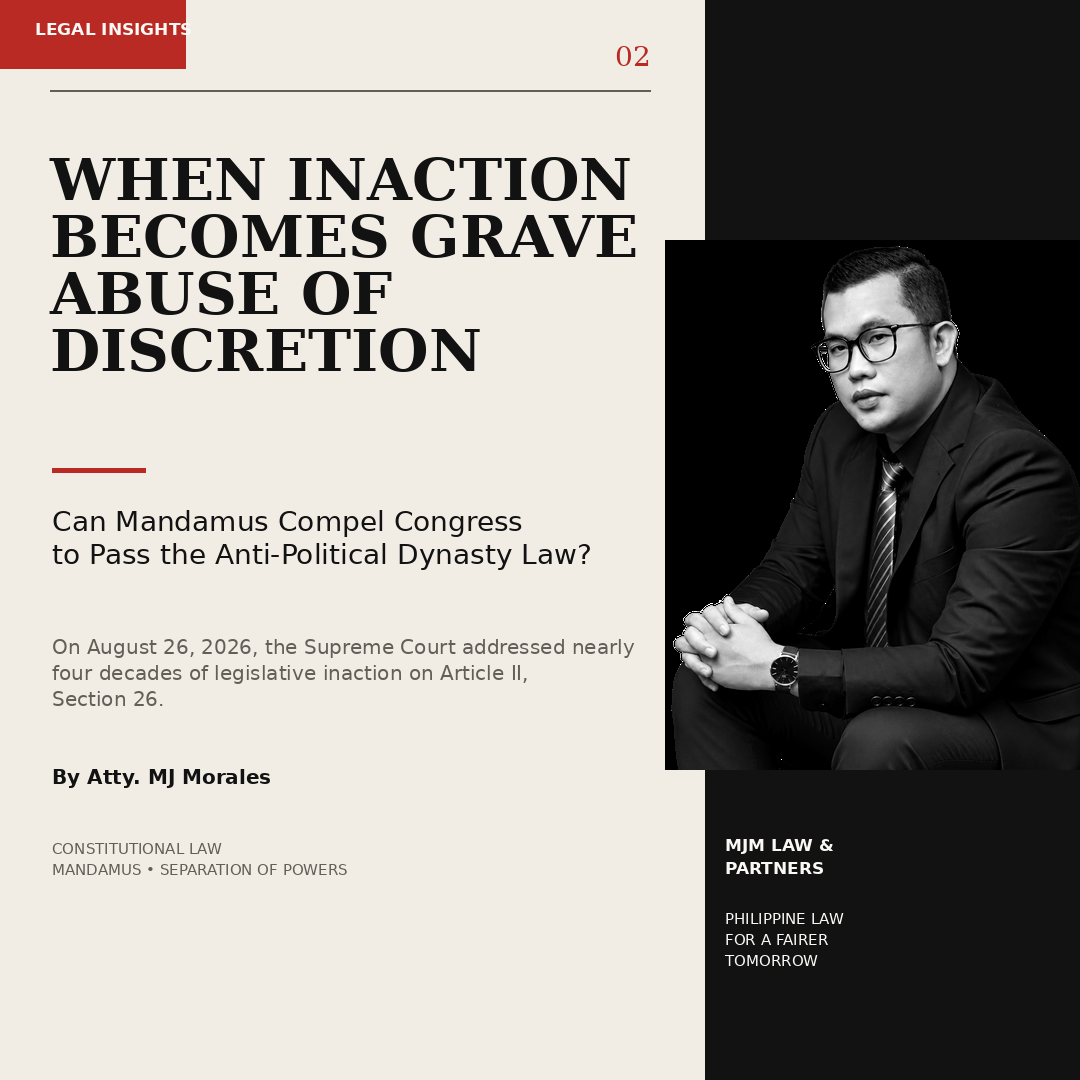
When Inaction Becomes Grave Abuse of Discretion: Can Mandamus Compel Congress to Pass the Anti-Political Dynasty Law?
The article examines whether the Supreme Court may compel Congress through mandamus to fulfill Article II, Section 26 of the 1987 Constitution, which directs the State to prohibit political dynasties “as may be defined by law.” Its central argument is that the Constitution imposes a mandatory duty on Congress to enact the necessary anti-political dynasty law, while Congress retains discretion over the law’s specific content, scope, and enforcement mechanisms. The article weighs this position against the separation of powers concern that legislation is inherently deliberative and discretionary, and therefore may not be a proper subject of mandamus. It ultimately frames the 2026 ruling as part of a broader constitutional question: whether prolonged governmental inaction can itself constitute grave abuse of discretion, while still preserving the Judiciary’s duty to enforce the Constitution without assuming Congress’ legislative function.
Read More