When Does Discipline Become Abuse? A Legal Guide for Public School Teachers in the Philippines
Republic Act No. 7610 defines “child abuse” as the maltreatment of a child, including physical or psychological abuse and any act by deeds or words which debases, degrades or demeans the intrinsic worth and dignity of a child. Under Section 10(a) of RA 7610, “other acts of child abuse” (not covered by the Revised Penal Code) are criminalized – this covers physical or emotional maltreatment of minors and carries higher penalties (prisión correccional, 2–4 years) than ordinary slight physical injuries. In a school setting, teachers exercise special parental authority (in loco parentis), which means any abuse by a teacher is taken very seriously under the law.
Important: Not every instance of discipline or harm to a student automatically amounts to child abuse. Courts examine whether the act of discipline was reasonable or whether it “debased, degraded or demeaned” the child’s dignity. Recent jurisprudence in the past 15 years illustrates the line between permissible discipline and punishable child abuse:
Supreme Court Decisions (2010–2025) on Teacher/Parent Discipline
George Bongalon v. People (G.R. No. 169533, March 20, 2013): This landmark case set the early standard that not all physical harm to a child is child abuse. Bongalon, a father who slapped a 12-year-old boy once in a moment of anger (after the boy hurt his daughter), was acquitted of RA 7610 child abuse. The Supreme Court held that the prosecution failed to prove “beyond reasonable doubt that the laying of hands... had been intended to debase the intrinsic worth and dignity of [the child]”. The act was done “spur of the moment and in anger” without the specific intent to humiliate or degrade the child. Instead, Bongalon was held liable for the lesser offense of slight physical injuries under the Revised Penal Code. This case established that a clear “intent to debase, degrade or demean” the child’s dignity is essential for a conviction under RA 7610 when the act is a one-off disciplinary lapse.
Maria Consuelo Malcampo-Repollo v. People (G.R. No. 246017, Nov. 25, 2020): In contrast to Bongalon, this case involved a public school teacher who repeatedly hit, pinched, and slapped her grade-school student in front of the class as a form of discipline. The teacher was convicted of child abuse under RA 7610 §10(a) by the trial court, and both the Court of Appeals (CA) and Supreme Court upheld the conviction. The courts found that her actions went beyond permissible disciplinary measures – they caused physical harm and embarrassed the child in front of peers. Notably, the CA ruling (affirmed by the SC) emphasized that proof of physical maltreatment alone was “enough to secure a conviction” under RA 7610; the prosecution “need not prove that the acts prejudiced the child’s development” since causing physical injury to a child is already a form of abuse in itself. The Supreme Court stressed that child abuse is even “more despicable if committed by ... one who stands in loco parentis, such as a teacher”. In Malcampo-Repollo, the teacher’s defense – that at most she was only liable for slight physical injuries – was rejected; the pattern of excessive and needless physical chastisement of a pupil squarely fell under RA 7610’s provisions.
Asela Briñas y Del Fierro v. People (G.R. No. 254005, June 23, 2021): This case dealt with verbal abuse in a school setting. Asela Briñas, a school directress, angrily shouted obscene and defamatory insults at two 16-year-old students (calling them “pinakamalalandi, pinakamalilibog... mga putang ina kayo,” among other slurs) in front of their classmates. She was charged and convicted by lower courts of “grave oral defamation in relation to RA 7610.” The Supreme Court, however, reversed the conviction and acquitted Briñas of child abuse, ruling that the prosecution failed to prove the required specific intent to “debase, degrade or demean” the students’ dignity. The High Court noted that while her words were harsh and unbecoming, they were uttered “in the heat of anger” and not as a deliberate degrading punishment. Mere verbal reprimands or insults, absent a clear intent to humiliate the child’s human dignity, do not automatically constitute child abuse under RA 7610. (However, such conduct can still entail other liabilities, e.g. slander or administrative sanctions, even if not prosecuted as child abuse.)
People v. Dado (G.R. No. 209566, June 28, 2021): In this case (involving a parent figure), the Supreme Court adopted a strict stance against even minor physical discipline. The accused had given a 13-year-old child a single slap that caused a bruise. The Court held that “even a single slap causing minimal bruising on a 13-year-old” is punishable as child abuse under RA 7610 §10(a). The parent’s excuse that it was a disciplinary act done without intent to harm was not a defense – “intent to discipline does not exempt” one from liability if the force is unreasonable. This reflects the evolving jurisprudence that any corporal punishment that results in injury, however slight, may be treated as child abuse, on the rationale that such physical violence against a child inherently degrades the child’s dignity and is no longer tolerated by law. (Notably, the Court in recent years views RA 7610 offenses as malum prohibitum, meaning the commission of the prohibited act per se – e.g. undue physical harm to a minor – is punishable even absent a specific malicious intent. This marks a shift from the Bongalon era, aligning with the intent of RA 7610 to provide stronger protection to children.)
Aside from Supreme Court jurisprudence, the Court of Appeals (as well as administrative bodies like the DepEd and Ombudsman) have also reinforced these principles:
People v. Rayos (CA-G.R. CR-HC No. 11021, Nov. 29, 2023): In this recent Court of Appeals case, a public school teacher was found liable under RA 7610 for physically chastising a student, despite a school policy forbidding corporal punishment. The CA categorically declared that “any physical chastisement [of a student] today is per se unreasonable.” In other words, any form of corporal punishment inflicted by a teacher is considered unacceptable and can be deemed child abuse under RA 7610. This CA ruling is consistent with the trend in jurisprudence that even “moderate” physical discipline is no longer defensible when it causes harm or humiliation to the child
Administrative Policies: The Department of Education’s Child Protection Policy (DepEd Order No. 40 s.2012) and related issuances echo these legal standards. Corporal punishment and humiliating or degrading disciplinary measures are strictly prohibited in schools, and teachers who violate this may face administrative sanctions (suspension, termination, or license revocation) under civil service rules and the Professional Teachers’ Code of Ethics. For instance, even in the absence of a criminal conviction, a teacher could be disciplined by DepEd or the PRC for conduct constituting child abuse or gross misconduct. The Special Parental Authority of teachers does not permit cruelty or abusive punishment – Article 59 of P.D. 603 (Child and Youth Welfare Code) in fact prohibits disciplinary measures that cause physical or mental suffering.
Given the scenario described (a public school teacher who asked a non-compliant student to remove accessories and trim long nails, then referred the angry student to the Prefect of Discipline), the critical question is whether the teacher’s conduct crosses the threshold of “child abuse” under RA 7610:
No Physical Harm or Cruelty: The teacher in the scenario did not slap, hit, or physically mistreat the student – he merely enforced school grooming rules (arguably a legitimate disciplinary action) and, when the student’s anger escalated, had him escorted out to prevent further conflict. There was no allegation of excessive force or physical injury. In the absence of any unreasonable force or physical injury, a charge under RA 7610 §10(a) is unlikely to prosper. For comparison, in Bongalon the act of slapping a child was not deemed child abuse because it lacked intent to demean; here, no corporal punishment was even administered by the teacher.
No Degrading or Humiliating Tirade: There is also no indication that the teacher subjected the student to verbal abuse, insults, or public humiliation. He asked the student to step out and comply with rules – a action that might upset or embarrass the student, but routine enforcement of school policy, done in a calm manner, is a far cry from the outrageous verbal maltreatment seen in cases like Briñas. In Briñas, the directress’s profane insults were uttered publicly and explicitly aimed to shame the students, yet the SC still acquitted her for lack of proven intent to truly debase the children. In the given scenario, the teacher’s words (as described) were not abusive or personalized attacks, but focused on the student’s accessories and hygiene (long nails) which are legitimate concerns in a Health class context. Mere strict language or stern demeanor by a teacher is not equivalent to the “debasement” envisioned by RA 7610.
Disproportionate Reaction by Student: The student’s emotional reaction (crying at the prefect’s office) does not automatically mean the teacher committed abuse. What matters is the nature of the teacher’s act, not just the student’s feelings. Probable cause for child abuse would require evidence that the teacher’s conduct was cruel, excessive, or intended to humiliate the student. Here, the teacher’s intent appears to have been to enforce discipline and de-escalate a situation, not to embarrass or hurt the student. As the Supreme Court noted, disciplining children is within a teacher’s authority, so long as it is exercised reasonably and not in a manner that harms the child’s dignity or safety. There is no clear showing of malice or abuse of punishment in this case.
Probable Cause Assessment: To file a criminal case under RA 7610, the prosecution must show prima facie that the teacher’s acts constitute “child abuse” – i.e., that he maltreated the student either physically or emotionally. Based on similar jurisprudence, asking a student to remove prohibited accessories and sending him to the guidance office would not be viewed by courts as child abuse per se. It resembles normal disciplinary procedure, not “inherent cruelty”. Unless additional facts reveal that the teacher, for example, shouted derogatory names at the student, used unreasonable force, or imposed a truly degrading punishment, there would likely be no probable cause to charge the teacher with violation of RA 7610. This aligns with the principle from Bongalon and Briñas – without a clear intent to harm, degrade, or physically injure the child, the harsh child-abuse law should not be triggered.
In sum, Philippine jurisprudence in the last 15 years draws a crucial distinction between permissible discipline and punishable abuse. Teachers may enforce rules and discipline students, but they must do so without violence or humiliation. If a teacher crosses into physical or psychological abuse – such as beating a student or berating them with obscene insults – the courts have not hesitated to uphold child abuse charges (as in Malcampo-Repollo and related cases). However, where the teacher’s actions are moderate, corrective, and devoid of any intent to demean the child’s dignity, a RA 7610 charge will not likely prosper, as seen in cases like Bongalon and Briñas. Each case ultimately depends on its facts, but the overarching rule is that discipline “crosses the line” and becomes child abuse only if it “harms the child’s dignity or safety in a manner that is clearly abusive or excessive”
Atty. Mark Joseph Morales, CPA, MBA, JD
Founder and Managing Partner, MJM Law & Partners
Full professional profileYou Might Also Like

“No Return, No Exchange”: When Can a Buyer Demand a Refund or Replacement?
A store policy cannot automatically defeat a consumer’s remedies for defective goods. This guide explains the distinction between a genuine defect and a change of mind, the repair and replacement framework under the Consumer Act, and the records and steps that help buyers pursue an appropriate remedy.
Read More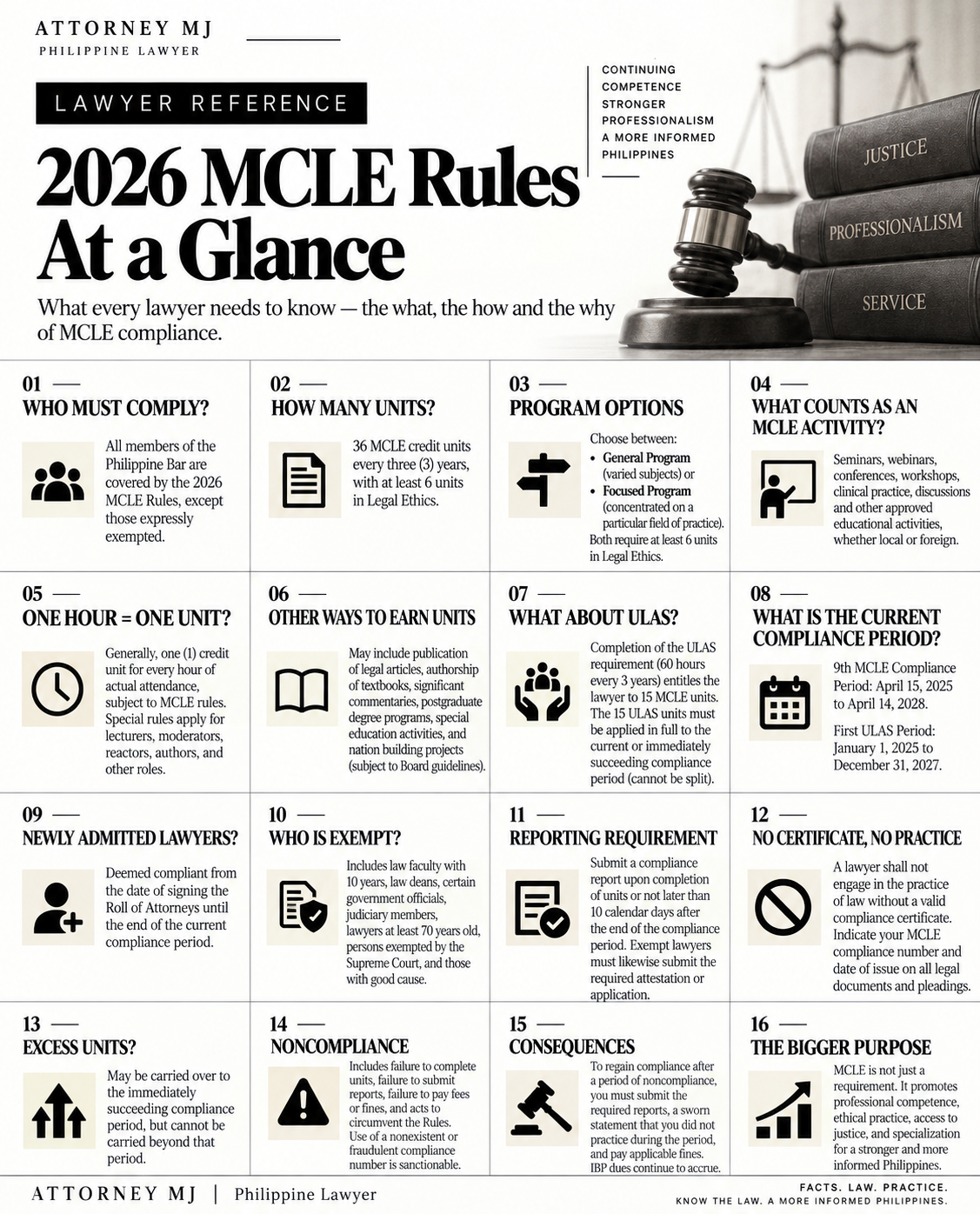
DEMYSTIFYING THE NEW 2026 RULES ON MANDATORY CONTINUING LEGAL EDUCATION
The 2026 Rules on Mandatory Continuing Legal Education introduce a more flexible and practice oriented framework for Philippine lawyers. While the core requirement remains 36 MCLE units every three years, including at least 6 units in Legal Ethics, lawyers may now choose between a General Program and a Focused Program. The Rules also recognize broader educational activities, provide for possible MCLE credit from ULAS, postgraduate studies, legal publications and other qualifying activities, and establish a framework for legal specialization. More importantly, compliance is directly tied to the authority to practice law, making proper completion, documentation, reporting, and maintenance of a valid MCLE compliance certificate essential for every practicing lawyer.
Read More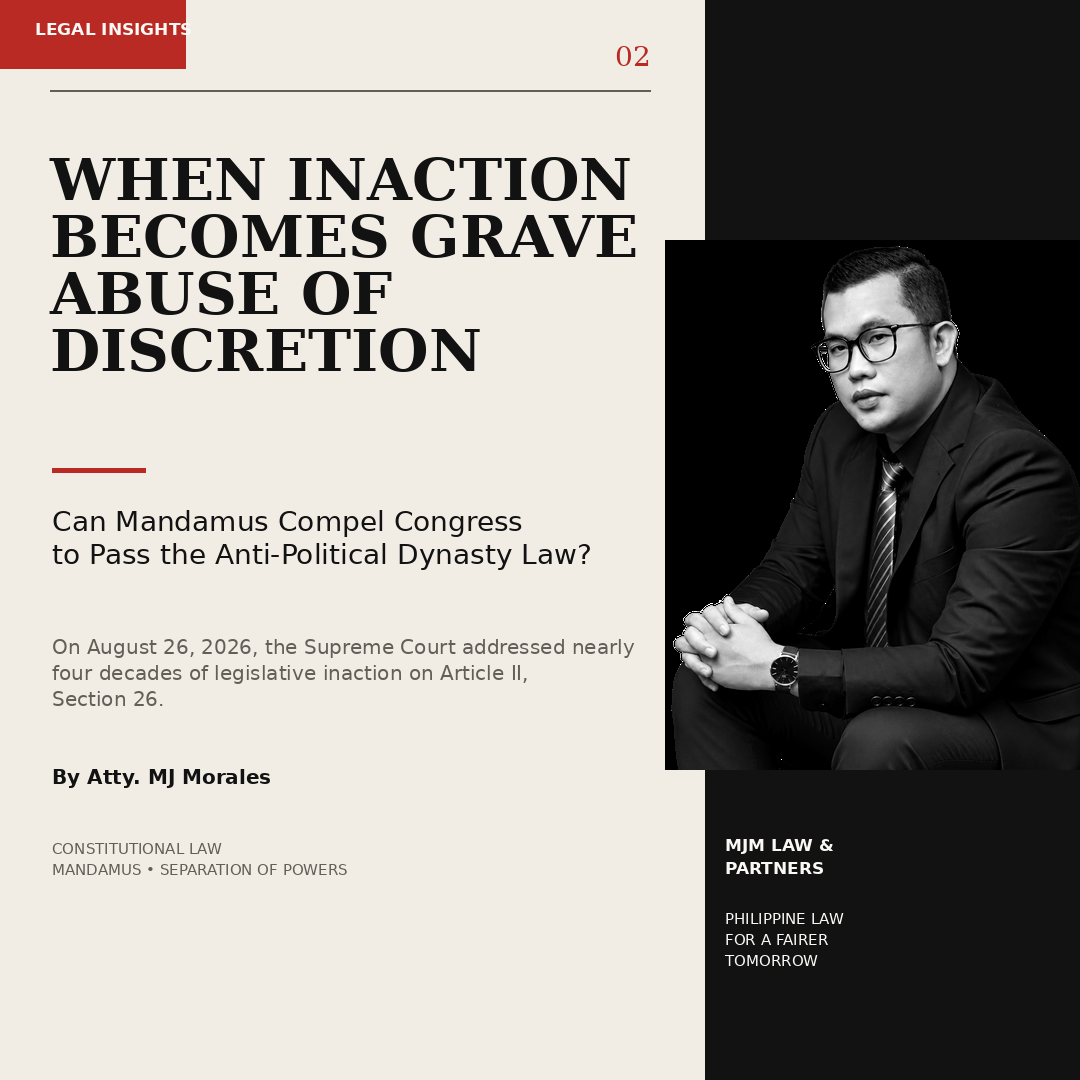
When Inaction Becomes Grave Abuse of Discretion: Can Mandamus Compel Congress to Pass the Anti-Political Dynasty Law?
The article examines whether the Supreme Court may compel Congress through mandamus to fulfill Article II, Section 26 of the 1987 Constitution, which directs the State to prohibit political dynasties “as may be defined by law.” Its central argument is that the Constitution imposes a mandatory duty on Congress to enact the necessary anti-political dynasty law, while Congress retains discretion over the law’s specific content, scope, and enforcement mechanisms. The article weighs this position against the separation of powers concern that legislation is inherently deliberative and discretionary, and therefore may not be a proper subject of mandamus. It ultimately frames the 2026 ruling as part of a broader constitutional question: whether prolonged governmental inaction can itself constitute grave abuse of discretion, while still preserving the Judiciary’s duty to enforce the Constitution without assuming Congress’ legislative function.
Read More