Annulment vs. Declaration of Nullity of Marriage in the Philippines: Key Differences and Implications
Legal Definitions and Distinctions
In the Philippines, annulment of marriage and declaration of nullity of marriage are two distinct legal remedies for ending a marital union, each with different premises and effects under the Family Code. A declaration of nullity of marriage applies to marriages that are void ab initio – meaning the marriage is considered invalid from the very beginning, as if it never legally existed. Common reasons for a void ab initio marriage include a fundamental lack of the legal requirements or capacity to marry (for example, one party was already married to someone else, or a crucial ceremony requirement was absent). In contrast, an annulment of marriage applies to a marriage that is voidable – the marriage is initially valid and existing, but due to specific defects existing at the time of its celebration, it may be declared null through court action. Until a court annuls a voidable marriage, it is regarded as legally valid.
In simpler terms, a void marriage (nullity) is treated as if it never happened in the eyes of the law, whereas a voidable marriage (annulment) is treated as valid until annulled by a court. Both remedies differ from legal separation, which merely authorizes spouses to live apart without dissolving the marriage bond (thus legally separated spouses cannot remarry). Notably, the Philippines (aside from limited exceptions) does not allow absolute divorce, so annulment and nullity are the primary legal avenues for those seeking to end a marriage under Philippine law.
Grounds for Declaration of Nullity of Marriage (Void Marriages)
Under the Family Code of the Philippines, a petition for declaration of absolute nullity of marriage can be filed when the marriage suffers from defects that render it void from the start. These grounds, which are based on circumstances existing at the time of the marriage, include:
1. Lack of Legal Capacity – If either bride or groom was below 18 years of age at the time of marriage, even with parental consent, the marriage is void. In fact, Republic Act No. 11596, passed in 2021, explicitly declares child marriages void ab initio and criminalizes their facilitation, underscoring that marriages involving minors have no legal effect from inception. Likewise, a marriage is void if either party lacks the essential or formal requisites for marriage, such as if there was no valid marriage license or no authority of a qualified solemnizing officer (except in situations where the law deems a license unnecessary, such as marriages of exceptional character).
2. Bigamous or Polygamous Marriage – A subsequent marriage contracted by a person who is still legally married to someone else is generally void, unless it falls under the narrow exception of a judicial declaration of presumptive death of the absent spouse (as provided in Article 41 of the Family Code). In all other cases, a bigamous or polygamous union is considered null from the start.
3. Incestuous Marriages – Marriages between close relatives (within prohibited degrees of consanguinity) are void. The Family Code (Art. 37) specifies that marriages between ascendants and descendants, or between siblings (whether full or half-blood), are incestuous and void ab initio. Marriages falling under other public policy prohibitions (Art. 38, such as between step-parent and step-child, etc.) are likewise void.
4. Psychological Incapacity (Art. 36) – A marriage can be declared void if either spouse was psychologically incapacitated to comply with the essential marital obligations at the time of the marriage. This refers to a serious inability to understand or perform basic marital duties (love, respect, fidelity, support) due to a psychological condition. Notably, the Supreme Court in Tan-Andal vs. Andal (2021) recalibrated this concept: psychological incapacity is now deemed a legal (not medical) condition, which need not be rooted in a clinical mental disorder nor be clinically permanent or incurable. This marked a departure from earlier strict interpretations – the Court emphasized that what matters is the gravity and permanence of the inability to fulfill marital obligations, proven by clear and convincing evidence of behavior that shows an enduring incapacity. Moreover, expert testimony (from a psychologist or psychiatrist) is no longer mandatory to prove Article 36 cases, as firsthand testimonies of family and friends and other evidence may suffice to establish the condition. This development aims to make nullity cases on this ground more accessible, reducing dependence on costly psychiatric evaluations.
5. Other Void Marriages – There are other technical grounds that can render a marriage void. For instance, if a spouse remarries without complying with legal requirements after a prior marriage was annulled or declared void, the subsequent marriage is invalid. The Family Code requires proper recording of the final decree of annulment/nullity and distribution of properties and presumptive legitimes of children from the previous marriage (Art. 52). Non-compliance will make the new marriage void (Art. 53), although any children from such void subsequent marriage are given protection as to their status (discussed below).
In all the above cases of void marriages, the law treats the marriage as having never taken effect. However, a court case is still required to officially declare the nullity of the marriage. One cannot simply assume a marriage is void even if a ground exists; a judicial decree of nullity is necessary before the parties can remarry (Family Code, Art. 40)
Grounds for Annulment of Marriage (Voidable Marriages)
An annulment case applies to a voidable marriage, which is valid until annulled. The Family Code (Art. 45) enumerates specific grounds for annulment, all of which must have existed at the time of the marriage. These causes make the marriage defective from inception, but unlike void marriages, the law treats the marriage as valid unless and until a court annuls it. The grounds for annulment are:
1. Lack of Parental Consent (for certain underage marriages) – If one of the parties was 18 or older but below 21 at the time of marriage and married without the required parental consent, the marriage is voidable. The petition in this case must be brought by the party who was under 21 (or their parent/guardian) and must be filed within five years after reaching the age of 21; otherwise, the ground is deemed waived.
2. Psychological Incapacity of a Party – (Note: Psychological incapacity actually makes a marriage void, not voidable, under Article 36. It is often informally referred to as an “annulment” ground by laypersons, but legally it falls under nullity. Thus, it is discussed under void marriages above.)
3. Insanity or Unsound Mind – If either party was mentally ill or incapacitated at the time of the marriage (such that they could not understand the nature of marriage), the marriage can be annulled. A petition on this ground can be filed by the sane spouse, or by a relative or guardian of the insane spouse, and if the insanity was concealed, there are specific timeframes for filing. If the mentally ill spouse regains sanity and freely cohabits with the other, the ground can be deemed condoned.
4. Fraudulent Consent – If consent of one party was obtained by fraud, the marriage is voidable. The law strictly defines which circumstances constitute fraud (Family Code, Art. 46), such as nondisclosure of a prior conviction, concealment of a pregnancy by another man, sexually transmissible disease, or serious dishonesty about identity, etc. The injured party must file for annulment within five years after discovering the fraud. Importantly, if the spouses freely cohabited after the discovery of the fraud, the ground can no longer be invoked (as cohabitation is deemed forgiveness of the deceit).
5. Force, Intimidation, or Undue Influence – If one party only consented to marry because of force or intimidation (duress) or undue pressure exerted by the other or by third parties, the marriage can be annulled. The petition must be filed within five years from the time the force or intimidation ceased or the influence was removed. Again, continued cohabitation after the force has ceased would bar an annulment on this ground (since the coerced party effectively consented freely thereafter).
6. Impotence or Physical Incapacity to Consummate – If one spouse was physically incapable of consummating the marriage (impotent) at the time of marriage, and such incapacity continues and appears to be incurable, this is a ground for annulment. The petitioning spouse must not be aware of the impotence at the time of marriage, and it must be permanent. A case must be filed within five years after the marriage. Unlike fraud or force, cohabitation does not cure this ground (since consummation never occurs).
7. Sexually Transmissible Disease (STD) – If either party was afflicted with a serious and incurable sexually transmissible disease at the time of marriage, the other party may seek annulment. The petition must be filed within five years after the marriage. As with impotence, continuing cohabitation does not waive this ground if the disease remains incurable.
It is important to note that only the injured or disadvantaged spouse (or certain legally authorized representatives) may file for annulment, and each ground has specific prescriptive periods (deadlines) and conditions for filing. If the timeframe lapses or the couple voluntarily continues living together despite the defect (for those grounds where cohabitation extinguishes the cause), the right to annul can be lost. Unlike void marriages which can be attacked even collaterally or at any time, voidable marriages require timely action by the proper party to be annulled.
Procedure for Filing and Litigating Annulment vs. Nullity Cases
Where to File and Who May File: Petitions for annulment or for declaration of nullity of marriage must be filed in court. Specifically, these cases are filed with the Regional Trial Court (Family Court) of the province or city where either spouse resides. Only concerned parties can initiate the case: for nullity or annulment, typically one of the spouses files the petition (in annulment cases it usually must be the aggrieved spouse, depending on the ground, or a legal guardian in cases of insanity). Unlike in some jurisdictions, there is no “mutual consent” divorce in the Philippines – even if both spouses agree to end the marriage, they cannot simply file an uncontested joint petition without stating a legal ground. They must allege and prove a valid ground under the law. Mutual agreement may, however, make the case uncontested, but the State still scrutinizes the evidence.
Filing the Petition: The petition is a written pleading that states the facts, the ground(s) relied upon (e.g. details of the fraud, or the circumstances of psychological incapacity, etc.), and the relief of declaring the marriage void or annulled. Along with the petition, certain documents are required, such as the marriage certificate, birth certificates of children, and any evidence supporting the ground (for example, medical or psychological reports). If the ground is psychological incapacity, lawyers often advise the petitioner to undergo a psychological evaluation and include the psychologist’s report or an affidavit in the petition, although recent Supreme Court rulings have made it clear this expert evidence is not mandatory.
After Filing – Summons and Response: Once the case is filed and raffled to a branch of the Family Court, the court will issue a summons to the other spouse (the respondent). The respondent is given the opportunity to file an answer to the petition, admitting or denying the allegations. If the respondent does not file an answer or cannot be located, the case can proceed in default or via publication of summons, but the court will still require the petitioner to present evidence to prove the grounds.
Role of the State (OSG and Prosecutor): Because of the state’s interest in preserving marriage, Philippine law requires the participation of the government in these cases. The Office of the Solicitor General (OSG), often through the public prosecutor, must be notified of the petition and is tasked to investigate potential collusion between the spouses. Early in the proceedings, the court will order a collusion investigation or hearing, where the prosecutor checks that the spouses are not simply agreeing to fabricate grounds or evidence just to end the marriage. If the prosecutor reports evidence of collusion or that the evidence was merely concocted, the petition will be dismissed (Family Code, Art. 48). Assuming no collusion, the case proceeds to pre-trial and trial.
Pre-Trial and Trial: The court will conduct a pre-trial where issues are narrowed and, if possible, settlements on ancillary matters (like property, custody, support) are explored. However, since the status of the marriage itself is at issue, no compromise on the existence of the ground is allowed. If the case is uncontested (respondent does not oppose), it usually moves straight to trial on the merits of the petition. During the trial, the petitioner must present evidence (witness testimony, documents, expert findings if applicable) to prove the ground alleged. Even in an uncontested case, the judge, prosecutor, or OSG can cross-examine the petitioner’s witnesses and scrutinize the evidence to ensure it satisfies the legal requirements.
For example, in a typical psychological incapacity nullity case, the petitioner often testifies to the spouse’s behavior, a psychologist or psychiatrist may testify on the spouse’s psychological condition, and a corroborating witness (like a family member or friend) might testify to observed facts. In an uncontested nullity case, usually two to three witnesses (the petitioner, an expert, and one other witness) are presented, which the State’s lawyer will cross-examine. In an annulment case based on fraud or force, the petitioner would testify to the circumstances of deceit or intimidation, possibly supported by other witnesses or evidence (like letters, medical records, etc., depending on the ground). The standard of proof is typically “preponderance of evidence” for most annulment grounds, but for psychological incapacity the Supreme Court requires “clear and convincing evidence” given its seriousness.
After the petitioner’s side presents its case, if the respondent contests, they can present counter-evidence. In many annulment/nullity cases, however, the respondent either defaults or does not actively contest, leaving the State (prosecutor/OSG) as the main adversarial party ensuring the evidence is sufficient.
Decision and Finality: Once evidence is concluded, the court may ask the OSG to submit a memorandum or recommendation (sometimes called an OSG certification) indicating whether it finds grounds to agree or object to the petition. Thereafter, the judge will issue a decision either granting or denying the petition. If the petition is granted, the marriage is declared null and void (for a nullity case) or annulled (for a voidable marriage), and the decision will detail the dissolution of the marital union and typically address ancillary matters like custody of children, division of properties, and child/spousal support. If the petition is denied, the marriage remains valid and subsisting.
The decision becomes final after 15 days if no appeal is made. Only upon finality of the judgment of nullity or annulment can the spouses obtain a Certificate of Finality and have the marriage status officially recorded as null/annulled with the civil registry. At that point, they are legally capacitated to remarry if they wish.
Timeline: The entire process can be lengthy. The duration varies widely depending on the court’s caseload, the complexity of the case, and whether the respondent contests the petition. Simple uncontested cases might be concluded in under a year, but many cases take several years. Delays can occur due to requirements like the collusion investigation, the scheduling of expert witnesses, or appeals. The parties should be prepared for a potentially protracted proceeding, and ensure they have legal counsel to navigate the technical requirements.
Legal Effects on Children (Legitimacy and Custody)
One of the most important concerns for spouses considering annulment or nullity is how it will affect their children’s status and custody. Philippine law provides safeguards to protect the rights and welfare of children in these cases.
Legitimacy Status: A key distinction lies in whether the marriage is considered never to have existed (void) or merely ended after being valid (voidable). Generally, children born or conceived within a valid marriage are legitimate, while those born to parents whose union is not recognized as valid (e.g., an invalid marriage or out of wedlock) are considered illegitimate. However, the law carves out exceptions to protect children of void marriages in certain cases:
- If a marriage is declared void due to psychological incapacity (Article 36), any children conceived or born before the nullity judgment became final retain their legitimate status. The rationale is that the marriage, though void, was entered into in good faith by at least one party under the semblance of validity, and it would be unjust to punish the offspring for the marital defect. In a recent 2025 Supreme Court ruling, the Court reiterated that a declaration of nullity on the ground of psychological incapacity “should not affect the status of the children”, confirming that such children remain legitimate despite the marriage being void. This is codified in Article 54 of the Family Code.
- Similarly, if a marriage is void under Article 53 (which involves a technical voiding of a subsequent marriage due to failure to comply with legal requirements after a prior marriage was terminated), the children of that void marriage are considered legitimate. The Supreme Court noted that Article 54 provides that children of a void marriage under Article 53 (where the parents simply neglected some formal requirements) will not suffer illegitimacy.
- In cases of annulment of voidable marriages, since the marriage was considered valid until the annulment, all children conceived or born before the judgment of annulment becomes final are by law deemed legitimate as well. In fact, the Family Code explicitly states that children born before the finality of an annulment decree remain legitimate, and this provision ensures that an annulment (which recognizes the marriage’s initial validity) does not retroactively bastardize the children.
In summary, children of an annulled marriage or a void marriage under Article 36 or 53 are protected as legitimate. The general rule is that for other void marriages (e.g., bigamous marriage, underage marriage without meeting exceptions, etc.), children are considered illegitimate unless one or both parents were in good faith and unaware of the defect – in which case those children may be treated as “putative” children entitled to certain rights. (For example, a child born of a bigamous marriage where one parent innocently thought they were legally married may still inherit from the innocent parent's estate, etc., though the technical status is illegitimate.) Each situation can have nuances, so legal advice is crucial. But the Family Code’s Article 54 and subsequent jurisprudence clearly strive to preserve legitimacy for children whenever possible, despite the nullification of their parents’ marriage.
Child Custody and Support: During the pendency of an annulment or nullity case and after its conclusion, the welfare of minor children is the paramount consideration. While the case is ongoing (pendente lite), the court may issue temporary orders for custody, support, and visitation. Often, spouses can agree on interim arrangements; if not, the court will decide based on the best interest of the child. Philippine law generally provides that children under seven years old should not be separated from the mother, unless the mother is unfit (e.g., proven to be abusive, neglectful, etc.). This “tender-age” presumption means that in annulment/nullity cases, if the couple has very young children, the mother usually retains custody unless there are compelling reasons otherwise.
After the marriage is declared void or annulled, the court’s final decision will include a permanent custody order. Typically, custody is awarded to the “innocent” spouse (the one who did not cause the ground for annulment/nullity) if that is applicable and in the child’s best interest. For example, if a marriage is annulled due to one spouse’s fraud or abuse, the innocent spouse is likely to be given sole custody. That said, the overarching standard remains the child’s welfare – courts may award joint custody or another arrangement if circumstances warrant. The non-custodial parent is usually given visitation rights, and both parents are obligated to provide financial support to the children.
The nullity or annulment decree does not extinguish the parents’ obligations toward their children. Legitimate children (and even illegitimate children) are entitled to support. The court can order child support, and it typically will in the final judgment, requiring one or both parents to contribute to the children’s living and educational expenses in proportion to their means. The decree will also usually affirm that the children shall remain under the parental authority of the custodial parent, with the other parent retaining visitation rights and joint decision-making in major issues unless the court finds serious reasons to limit such rights.
It’s important to emphasize that the children are not on trial in these cases – the parents’ marital issues should, as much as possible, not negatively affect the children’s rights. The court can even appoint a guardian ad litem or seek the opinion of social workers to ensure children’s interests are protected during the proceedings.
Legal Effects on Conjugal or Community Property
The dissolution of the marriage through annulment or nullity has significant consequences on the spouses’ property relations. The rules differ depending on whether the marriage was void from the start or only annulled after being valid.
Property Regime in Void Marriages: If a marriage is declared void ab initio, it means there was no legal marital partnership to begin with – consequently, there is technically no conjugal partnership or absolute community of property to divide as such. However, the law recognizes that the couple may have acquired properties while living together, and it provides a mechanism to divide those assets to prevent unjust enrichment of one party. The Family Code (Articles 147 and 148) sets out rules for “union without marriage” property relations, which apply to void marriages (as well as to unmarried cohabitations).
- If both parties were in good faith (i.e. both believed they were validly married, as might be the case in a void marriage due to a hidden impediment), or if the parties were not legally impeded from marrying each other, their property relations are governed by Article 147. Under Article 147, essentially the law treats them as co-owners of the properties they acquired during their cohabitation, with a presumption of equal shares in properties acquired by their joint efforts or funds. Property acquired by either one before or outside the cohabitation remains with each, but anything acquired by their work or industry during the union is generally split equally (unless proof shows one contributed more than the other). Even a spouse who did not earn income can be considered as contributing by managing the household and caring for the family. This typically applies, for example, to void marriages under Article 36 (psychological incapacity) where usually both spouses entered the marriage in good faith not knowing it was void.
- If either or both parties were in bad faith (for instance, one knew there was a barrier to the marriage, like one was already married to someone else), or if they had a legal impediment to marry each other from the start, the stricter Article 148 applies. Under Article 148, there is no presumption of joint or equal ownership of properties. Each party gets only the portion of the property proportionate to their actual financial contribution to its acquisition. If evidence of the exact contributions is lacking, and the property was acquired jointly, the law may presume equal shares only for that jointly acquired property, but generally, the rule prevents a wrongdoer from profiting. For example, in a bigamous marriage voided by the court, a spouse who was aware of their existing marriage (bad faith) would not be entitled to share in the properties earned by the innocent partner. In fact, any share that would have gone to the guilty party can be forfeited in favor of the children or the innocent party, as a matter of policy.
In void marriages, therefore, the property is divided according to co-ownership rules rather than marital property rules. This is done at the time of the court’s final decision. The nullity decree will often direct the parties to undergo liquidation of properties acquired during the cohabitation, applying Articles 147 or 148 as appropriate. If there is a dispute on property, the court may appoint commissioners or require an accounting to ensure each party (and the children, who may be entitled to shares as well) receive what is due. Creditors are paid from the estate first, then the remainder is split per the law.
Property Regime in Annulled Marriages: In a voidable marriage that is annulled by the court, the marriage was considered valid up to the point of annulment. Therefore, the marital property regime (whether absolute community of property or conjugal partnership of gains, depending on when the marriage was celebrated or any prenuptial agreement) is considered to have existed. Once an annulment decree becomes final, that property regime is dissolved and liquidated in much the same way as it would be for a divorce or for legal separation.
Practically, this means:
- If the spouses were married after 1988 without a marriage settlement, they were under Absolute Community of Property (ACP). Upon annulment, all properties (except those excluded by law, like inheritances or gifts to one spouse) that were acquired during the marriage are pooled, and after paying off debts, each spouse generally gets half. However, if one spouse is found to be “at fault” or the cause of the annulment (for instance, the one who committed fraud or forced the other into marriage), there can be some financial repercussions. For example, that spouse might be disqualified from receiving a share of the net profits or forfeits benefits in favor of the common children, in accordance with Articles 43 and 50 of the Family Code. The law provides that the innocent spouse in an annulment can be in a more favorable position in the partition of properties. (This is analogous to how, in legal separation, the offending spouse can have their share forfeited to the children.)
- If the spouses had a Conjugal Partnership of Gains (CPG) (the default for marriages under the old Civil Code, or if they agreed to it), the process is similar: the partnership is wound up. Each spouse gets back their exclusive properties, and the remaining conjugal assets or “gains” accumulated during marriage are divided equally, unless there’s a legal reason to forfeit a portion due to one spouse’s wrongdoing.
In both ACP and CPG, the court will usually oversee or approve the liquidation and distribution of assets. Article 50 of the Family Code also requires that after an annulment or nullity, the court will order delivery of the presumptive legitime of the common children. This means the children’s shares in the parents’ estate (as if the parents were to die) are set aside to ensure the children’s inheritance rights are protected. This step is required before either party can remarry (to avoid prejudicing the children’s successional rights in case the parents contract new marriages).
Debts and Third Parties: Creditors are protected in these proceedings – any obligations contracted by the spouses during the marriage or cohabitation can be enforced against the community or conjugal property (if annulled) or against the co-owned properties (if void). The liquidation process will pay out debts first, before the division. Transactions done in good faith on the assumption of a valid marriage (like purchases, sales, mortgages) are generally respected as long as the third parties were in good faith.
To summarize, annulment gives rise to a property settlement akin to a divorce, while nullity results in a co-ownership split. In either case, the parties will end up owning property separately after the process. It is advisable to have legal guidance during the property liquidation, as it can become complex—especially when determining good or bad faith, contributions, and handling property acquired while the case is pending.
Recent Supreme Court Rulings and Updates
Philippine jurisprudence on nullity and annulment is continually evolving as the Supreme Court interprets the Family Code. Here are some notable recent developments and rulings that those considering these remedies should know:
1. Tan-Andal vs. Andal (G.R. No. 196359, May 11, 2021) – Psychological Incapacity Redefined. This landmark En Banc decision softened the stringent requirements for proving psychological incapacity under Article 36. The Court acknowledged that psychological incapacity is a legal concept, not a medical illness. It expressly overturned earlier doctrines that required identifying a root cause that is medically incurable or requiring clinical diagnosis. Now, it is enough to show a persistent inability to perform marital obligations that is grave and rooted in the failing spouse’s personality structure, even if the exact psychological illness is not pinpointed. Additionally, expert testimony is no longer a strict necessity – while expert opinion can still be very helpful, the testimony of the spouse and other witnesses can suffice to establish the pattern of behavior and incapacity. This ruling has made it relatively more accessible to prove cases like chronic irresponsibility, abandonment, or abuse as manifestations of psychological incapacity. In fact, subsequent cases have applied Tan-Andal to scenarios that would likely have been denied before. For example, in De la Cruz-Lanuza vs. Lanuza Jr. (April 2024), the Supreme Court nullified a marriage on psychological incapacity grounds where the husband’s infidelity, failure to support his family, and decades-long abandonment were considered clear indications of an incapacity to fulfill marital duties – a turnaround from older cases that deemed such behavior as mere refusal. The Tan-Andal doctrine thus provides hope that spouses trapped in truly dysfunctional marriages (even if the spouse’s condition isn’t clinically categorized as mental illness) can find relief through nullity.
2. Child Legitimacy in Nullity Cases (J. Lopez Decision, Feb 2025) – Affirmation of Article 54. In a recent Supreme Court decision promulgated in 2025, the Court addressed the status of a child whose parents’ marriage was nullified on grounds of psychological incapacity. The trial court had erroneously declared the child illegitimate after voiding the marriage. The Supreme Court reversed this, emphatically stating that under Article 54 of the Family Code, the child of a void marriage due to Article 36 remains legitimate. The ruling clarified that a declaration of nullity “does not affect the legitimacy status of children born during the marriage”, except in cases not covered by Article 54. It also reiterated that for void marriages in general, while the default consequence is children are illegitimate, the law’s exceptions (psychological incapacity and Article 53 scenarios) reflect a policy of preserving legitimacy when the void marriage had semblance of validity. This ruling, coming out in news reports in May 2025, reassures parents that seeking a nullity on Article 36 grounds will not disadvantage their children’s legitimacy or rights.
3. Recognition of Foreign Divorces and Other Updates: While not directly about annulment vs nullity, it’s worth noting a 2018 Supreme Court case, Morales v. Suniga (and the earlier Manalo v. Republic, 2018), where the Court allowed recognition of a foreign divorce obtained by a Filipino’s foreign spouse, which indirectly expanded remedies for Filipinos in certain mixed-nationality marriages. Moreover, Republic Act No. 11596 (2021) as mentioned, criminalized and voided child marriages, reflecting an updated legal stance on protecting minors. There are also pending bills in Congress that periodically seek to introduce absolute divorce in the Philippines, but as of this writing (2025) no general divorce law has been passed. Therefore, annulment and nullity (and legal separation) remain the only recourses for troubled marriages.
4. Jurisprudence on Other Grounds: The Supreme Court has also decided cases clarifying other annulment grounds. For instance, cases have discussed what constitutes “fraud” (e.g. concealment of important facts like conviction or serious disease prior to marriage), and the Court tends to interpret the grounds in Article 45 strictly. In one case, the Court held that concealment of homosexuality can qualify as fraud if it was not disclosed and is manifest only after marriage (falling under “fraud about sexuality” as a ground). In another, the Court ruled that sterility (inability to have children) is not the same as impotence and is not a ground by itself. These illustrate that not every marital problem is a ground for annulment; it must fit the specific provisions of the law.
Given the evolving nature of family law jurisprudence, anyone considering these remedies should consult up-to-date legal sources or a lawyer, as Supreme Court rulings can refine how the law is applied (especially in Article 36 cases, which heavily rely on jurisprudence).
In summary, annulment and declaration of nullity of marriage in the Philippines serve similar ends – to have a marriage declared invalid – but they arise from very different conditions and have distinct legal implications. An annulment voids a marriage that was initially valid due to specific vitiating factors at the time of wedding, whereas a nullity petition targets marriages that were flawed from the start and considered nonexistent in law. The grounds for each are strictly defined by the Family Code and related laws, and the proper ground must be chosen carefully based on the situation of the spouses. The procedures, while time-consuming and procedural, are there to ensure that the integrity of marriage as an institution is respected and that no collusion or shortcut dissolves a marriage that the law would otherwise deem valid.
For those with children and shared property, the outcomes of these cases are designed to be fair: children’s rights are protected (with legitimacy largely preserved except in truly void unions) and property is allocated in accordance with each party’s contributions and good faith. After an annulment or nullity decree, both parties revert to the status of single persons, free to remarry (once the judgment is final and properly registered), giving them a chance to start anew.
Considering the complexity of pursuing an annulment or nullity case – from evidentiary requirements to emotional and financial costs – it is crucial for individuals to seek competent legal advice before embarking on this process. Each case is unique, and a lawyer can help determine the appropriate remedy (annulment vs nullity), the viable ground, and guide the client through the procedural maze. Despite the challenges, these legal remedies exist to provide a way out of untenable marriages, while balancing the need to protect the family, children, and the sanctity of marriage. The Philippine courts, guided by law and recent jurisprudence, continue to fine-tune this balance, ensuring that justice and compassion are served in matters of the heart and home.
Atty. Mark Joseph Morales, CPA, MBA, JD
Founder and Managing Partner, MJM Law & Partners
Full professional profileYou Might Also Like

“No Return, No Exchange”: When Can a Buyer Demand a Refund or Replacement?
A store policy cannot automatically defeat a consumer’s remedies for defective goods. This guide explains the distinction between a genuine defect and a change of mind, the repair and replacement framework under the Consumer Act, and the records and steps that help buyers pursue an appropriate remedy.
Read More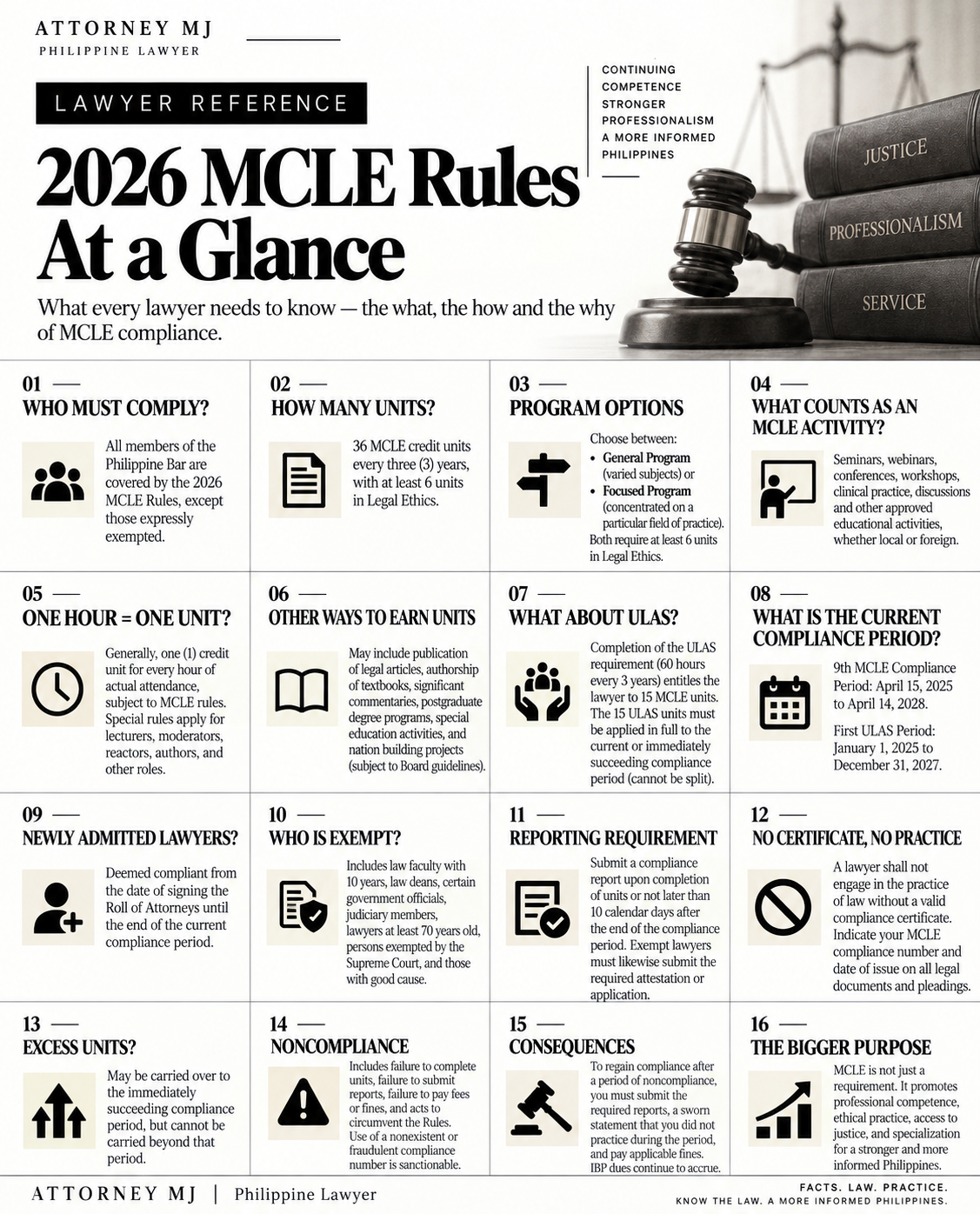
DEMYSTIFYING THE NEW 2026 RULES ON MANDATORY CONTINUING LEGAL EDUCATION
The 2026 Rules on Mandatory Continuing Legal Education introduce a more flexible and practice oriented framework for Philippine lawyers. While the core requirement remains 36 MCLE units every three years, including at least 6 units in Legal Ethics, lawyers may now choose between a General Program and a Focused Program. The Rules also recognize broader educational activities, provide for possible MCLE credit from ULAS, postgraduate studies, legal publications and other qualifying activities, and establish a framework for legal specialization. More importantly, compliance is directly tied to the authority to practice law, making proper completion, documentation, reporting, and maintenance of a valid MCLE compliance certificate essential for every practicing lawyer.
Read More
When Inaction Becomes Grave Abuse of Discretion: Can Mandamus Compel Congress to Pass the Anti-Political Dynasty Law?
The article examines whether the Supreme Court may compel Congress through mandamus to fulfill Article II, Section 26 of the 1987 Constitution, which directs the State to prohibit political dynasties “as may be defined by law.” Its central argument is that the Constitution imposes a mandatory duty on Congress to enact the necessary anti-political dynasty law, while Congress retains discretion over the law’s specific content, scope, and enforcement mechanisms. The article weighs this position against the separation of powers concern that legislation is inherently deliberative and discretionary, and therefore may not be a proper subject of mandamus. It ultimately frames the 2026 ruling as part of a broader constitutional question: whether prolonged governmental inaction can itself constitute grave abuse of discretion, while still preserving the Judiciary’s duty to enforce the Constitution without assuming Congress’ legislative function.
Read More