When Inaction Becomes Grave Abuse of Discretion: Can Mandamus Compel Congress to Pass the Anti-Political Dynasty Law?
Few constitutional provisions have generated a more persistent question of legislative inaction than Article II, Section 26 of the 1987 Constitution.
For nearly four decades, the Constitution has declared that the State shall guarantee equal access to opportunities for public service, and prohibit political dynasties as may be defined by law. Yet, for 39 years, Congress did not enact a comprehensive law defining and prohibiting political dynasties.
On August 26, 2026, the Supreme Court directly confronted that constitutional silence in a ruling published on September 16, 2026. In resolving the consolidated petitions in Kapatiran Party v. Congress of the Philippines, Trinidad v. Congress of the Philippines, Bishop Alminaza v. COMELEC, and 1Sambayan Coalition v. Senate of the Philippines, the Court unanimously declared that Article II, Section 26 imposes a mandatory constitutional duty upon Congress to enact an anti-political dynasty law.
The ruling raises a much larger constitutional question:
When the Constitution commands the State to accomplish something through legislation, can the Supreme Court compel Congress to enact that legislation?
The answer requires us to examine not only what Article II, Section 26 says, but also what it does not say, the historical circumstances surrounding its adoption, the nature of legislative power, and the extraordinary remedy of mandamus.
I. The constitutional text
Article II, Section 26 of the 1987 Constitution provides:
“The State shall guarantee equal access to opportunities for public service, and prohibit political dynasties as may be defined by law.”
The provision contains two commands.
First, the State shall guarantee equal access to opportunities for public service.
Second, the State shall prohibit political dynasties as may be defined by law.
Grammatically, the word “shall” governs both “guarantee” and “prohibit.”
The Constitution therefore does not merely say that political dynasties are undesirable.
It says that the State shall prohibit them.
But another phrase immediately follows:
“as may be defined by law.”
That phrase is the source of much of the controversy.
The Constitution does not itself define what constitutes a political dynasty. It does not specify whether the prohibition applies to spouses, siblings, parents and children, relatives within a particular degree, simultaneous occupation of offices, successive occupation of offices, or some combination of these circumstances.
Those matters were deliberately left to legislation.
The constitutional question, therefore, is not simply whether the Constitution contains a command.
It does.
The deeper question is whether that command creates a duty that the judiciary may enforce through mandamus against Congress.
II. Why was the provision written this way?
The historical record is important because the phrase “as may be defined by law” was not accidental.
During the deliberations of the 1986 Constitutional Commission, the commissioners discussed whether political dynasties should be defined directly in the Constitution. Commissioner Teofisto Guingona proposed language referring to what may be provided by law, while Commissioner Jose Davide explained that Congress, in the exercise of its plenary power, could provide the necessary guidelines for implementing the prohibition. The formulation ultimately adopted was “as may be defined by law.”
The final formulation was approved by the Constitutional Commission with the prohibition expressly left to legislative definition.
This history produces two competing interpretations.
One interpretation is that the framers deliberately reserved only the definition and scope to Congress because they had already decided, at the constitutional level, that political dynasties must be prohibited.
The other interpretation is that because the constitutional prohibition requires legislative definition before it can operate, the actual decision to create an enforceable prohibition necessarily requires the exercise of legislative judgment.
The distinction appears subtle, but it is constitutionally profound.
III. What exactly is the issue?
The dispute should not be framed simply as:
“Does the Constitution prohibit political dynasties?”
Article II, Section 26 answers that question.
The more difficult question is:
“Who determines whether the constitutional command has been sufficiently implemented, and what judicial remedy exists when Congress does not act?”
Three propositions must therefore be separated.
First, there is a constitutional command.
Second, Congress possesses legislative authority to define the prohibited political relationships and determine the scope and mechanics of the prohibition.
Third, the Judiciary must determine whether Congress' prolonged inaction may be judicially characterized as grave abuse of discretion and remedied through mandamus.
The third proposition is the real battleground.
IV. Why mandamus must be granted
The strongest argument for the majority begins with the constitutional word “shall.”
The Constitution does not say the State “may” prohibit political dynasties.
It does not say the State “should endeavor to” prohibit them.
It says the State “shall” prohibit them.
The Supreme Court therefore reasoned that the Constitution has already settled the fundamental policy question. Congress is not being asked to decide whether political dynasties should be prohibited. That decision was made by the Constitution itself. Congress is being asked to perform the legislative work necessary to give effect to that command.
The phrase “as may be defined by law,” under this interpretation, gives Congress discretion as to the content of the legislation, but not discretion as to whether legislation should exist at all.
In other words:
The Constitution determines the “whether.”
Congress determines the “how.”
That distinction is central to the majority's reasoning.
The Court also rejected the argument that the absence of a specific constitutional deadline permits indefinite inaction. Although Article II, Section 26 does not state that Congress must enact the law within one year, five years, or any other defined period, the Court concluded that constitutional silence as to a deadline cannot mean that Congress possesses an unlimited power to postpone compliance indefinitely. After 39 years, the Court found that the delay had exceeded a reasonable period and had become a continuing constitutional violation.
The majority's argument therefore rests on a simple constitutional principle:
A constitutional command cannot be defeated merely because Congress refuses to implement it.
Otherwise, a branch of government could effectively nullify a constitutional provision through inaction.
That would create an unusual result.
The Constitution would command something.
The legislature would simply decline to act.
And the constitutional command would, in practice, become meaningless.
From this perspective, mandamus does not make the Court a legislature.
The Court does not define the political dynasty.
It does not determine the prohibited degree of relationship.
It does not prescribe which offices may not simultaneously be held by members of one family.
It does not enact penalties.
It merely orders Congress to perform the constitutional task that the Constitution itself has assigned to the State and that the Court has determined Congress has an obligation to perform.
The Supreme Court emphasized precisely this limitation. The Court declared the duty but left the definition, scope, and substance of the eventual legislation to Congress.
V. The problem of indefinite constitutional inaction
The majority's position becomes stronger when considered from the perspective of constitutional supremacy.
Congress is undoubtedly a co-equal branch of government.
But Congress is not superior to the Constitution.
The Constitution is the source of legislative authority itself.
Article VI, Section 1 vests legislative power in Congress, but Congress exercises that power within constitutional limits.
If Article II, Section 26 creates a mandatory constitutional duty, then prolonged refusal to perform that duty may itself become subject to judicial review.
The Supreme Court's conclusion that 39 years is beyond a reasonable period is therefore not based merely on the passage of time. It is based upon the combination of several circumstances identified in the Court's ruling, including the repeated introduction of anti dynasty bills, the continued absence of a comprehensive law, and the continuing effect of the constitutional nonimplementation.
The majority thus treats legislative inaction not as a single political decision, but as a continuing constitutional condition.
That distinction matters.
A legislature may decide not to pass a particular bill.
But when the Constitution itself commands legislative action, the question becomes whether Congress may refuse to act indefinitely simply because the Constitution did not specify a deadline.
The majority answered no.
VI. Why mandamus must not be granted
The opposing argument begins with a different constitutional principle:
Mandatory does not necessarily mean ministerial.
This is perhaps the strongest point against the issuance of mandamus.
Mandamus ordinarily lies to compel the performance of a clear legal duty, particularly where the act required is ministerial rather than discretionary.
Law making, however, is fundamentally deliberative.
Even if Congress is constitutionally required to enact a law prohibiting political dynasties, Congress must still determine what that law will say.
It must determine the definition.
It must determine the scope.
It must decide which familial relationships will be covered.
It must decide whether the prohibition applies simultaneously, successively, or both.
It must determine the positions covered, exemptions, enforcement mechanisms, penalties, transition rules, and other legislative details.
These are not mechanical acts.
They involve constitutional judgment, policy choices, factual assessments, public consultation, compromise, and the legislative process itself.
The dissenting position, therefore, need not deny that Article II, Section 26 contains a constitutional obligation.
It can accept the obligation while questioning the remedy.
That distinction is important.
The argument is not:
“Congress has no constitutional duty.”
The argument is:
“Even if Congress has a constitutional duty, the performance of that duty is still legislative in character, and therefore cannot simply be transformed into a ministerial act subject to mandamus.”
This is the central concern expressed by Associate Justice Maria Filomena D. Singh.
Justice Singh agreed that Congress' prolonged failure to enact an anti-political dynasty law constitutes a breach of constitutional duty amounting to grave abuse of discretion, but dissented from the grant of mandamus. In her view, the Court could declare the constitutional breach, but should not issue a coercive directive requiring Congress to enact an “appropriate” law at the “earliest opportunity.”
That position preserves an important distinction:
The Judiciary may determine what the Constitution requires.
But that does not necessarily mean that the Judiciary may command the legislature to enact legislation.
VII. The separation of powers problem
The constitutional structure deliberately distributes governmental power.
Article VI places legislative power in Congress.
Article VIII vests judicial power in the Supreme Court and the other courts established by law.
The Judiciary therefore has authority to review governmental action, including claims of grave abuse of discretion. But judicial review does not necessarily authorize the Court to assume every function that another branch has failed to perform.
This creates the central tension in the anti dynasty case.
One side says:
“Constitutional review is meaningless if a branch can evade the Constitution simply by doing nothing.”
The other says:
“Separation of powers is meaningless if the Judiciary can compel a co-equal branch to exercise legislative power.”
Both arguments begin from constitutional principles.
The difficulty is determining where constitutional enforcement ends and judicial intrusion into legislative power begins.
There is also a practical question.
Suppose the Court orders Congress to enact an anti dynasty law.
Congress subsequently passes a statute.
What happens if the law is so narrow that it barely addresses the constitutional problem?
What if Congress defines political dynasty to cover only one very limited category of relatives?
What if Congress excludes certain offices?
What if Congress adopts a definition that other parties believe defeats the purpose of Article II, Section 26?
At that point, the Judiciary may once again be asked to determine whether Congress has complied with its mandamus order.
The concern is that an initial order to legislate could eventually become continuing judicial supervision over the substance of legislation.
That is the danger the dissent seeks to avoid.
VIII. The importance of Biraogo and Guingona
The 2026 ruling is also significant because it departed from earlier Supreme Court pronouncements concerning Article II, Section 26.
In Biraogo v. COMELEC and Guingona, Jr. v. House of Representatives, earlier resolutions had treated the constitutional provision as requiring legislative action before the prohibition could be judicially enforced. Biraogo concerned an effort to compel COMELEC to enforce the constitutional prohibition, while Guingona involved a petition seeking to compel Congress itself to enact an anti dynasty law.
The 2026 Court expressly abandoned those earlier pronouncements, emphasizing that they were contained in unsigned resolutions and that, in the Court's view, they no longer reflected the intent of the framers or the constitutional realities surrounding political dynasties.
This reversal is itself constitutionally significant.
The case is therefore not merely about political dynasties.
It is also about the Supreme Court's ability to revisit its own prior understanding of constitutional provisions when a later Court determines that an earlier interpretation was incorrect.
At the same time, the earlier cases remain important to the dissent because they represent an established judicial principle concerning the limits of mandamus against legislative bodies.
The disagreement is consequently not simply about political dynasties.
It is about the proper understanding of the constitutional relationship among Congress, the Judiciary, and the Constitution itself.
IX. The Court's restraint concerning COMELEC
Interestingly, the Court's treatment of COMELEC illustrates the limits of the 2026 ruling.
The Court denied the petition seeking to compel COMELEC to declare particular candidates disqualified on the ground that they belong to political dynasties and to issue implementing regulations.
The reason is straightforward.
There is still no statute defining political dynasties and establishing the corresponding legal consequences.
COMELEC cannot create substantive candidate qualifications or disqualifications that Congress has not legislated.
This aspect of the ruling supports, at least to some extent, the principle of institutional restraint.
The Court said, in effect:
Congress must perform the constitutional legislative task.
But until Congress does so, COMELEC cannot simply invent the missing statutory standards.
That distinction demonstrates that the Court did not declare Article II, Section 26 completely self-executing for every practical purpose.
Instead, it held that Congress has a mandatory duty to enact the law necessary to define and implement the prohibition.
X. The constitutional line between duty and discretion
Perhaps the most useful way to understand the controversy is to distinguish between constitutional duty and legislative discretion.
Congress may have no discretion whether to comply with the constitutional command.
But Congress retains discretion regarding how the command is implemented.
That is precisely why several members of the Court who agreed with the result nevertheless emphasized that the Judiciary cannot dictate the substance of the legislation.
Justice Rodil Zalameda, for example, agreed that Congress has a mandatory constitutional duty, but emphasized that the Court cannot compel Congress to pass a law in a particular form or within a judicially prescribed period. The authority to determine the definition, scope, coverage, sanctions, and enforcement remains with Congress.
This distinction may ultimately prove to be the most important safeguard in implementing the ruling.
The Court can declare:
“You must legislate.”
But Congress must still determine:
“What shall the legislation provide?”
That preserves a measure of separation of powers while recognizing constitutional supremacy.
XI. What does “mandamus” actually compel?
The answer may therefore be narrower than it first appears.
The Supreme Court did not itself enact an anti dynasty law.
It did not identify a prohibited degree of consanguinity or affinity.
It did not determine how many members of one family may simultaneously hold office.
It did not prescribe criminal or administrative sanctions.
It did not create a new ground for disqualifying candidates.
It ordered Congress to perform the legislative task contemplated by Article II, Section 26.
That limitation is important because the validity of the decision may ultimately depend upon whether courts can maintain this distinction.
If mandamus means only:
“Congress must exercise its constitutional legislative function concerning the subject,”
the argument for judicial restraint remains comparatively strong.
If mandamus eventually develops into:
“Congress must enact a statute containing particular definitions, prohibitions, penalties, or political arrangements,”
then the separation of powers concern becomes considerably more serious.
The constitutional boundary therefore may not be determined by the issuance of mandamus alone.
It may be determined by what happens after the writ is issued.
XII. The deeper question: Can constitutional inaction itself become unconstitutional?
This may be the most important principle emerging from the 2026 ruling.
Constitutional law traditionally focuses on governmental action.
A statute is passed.
An executive order is issued.
A regulation is promulgated.
A governmental decision is made.
But this case deals with something different:
the government did nothing.
And the Court held that doing nothing for 39 years, in the face of a mandatory constitutional command, can itself amount to grave abuse of discretion.
That principle could have implications beyond political dynasties.
If constitutional provisions impose affirmative duties upon government, prolonged and unreasonable inaction may, in appropriate circumstances, become subject to constitutional review.
But that does not mean every unimplemented constitutional policy automatically becomes enforceable through mandamus.
The crucial questions remain:
Is the constitutional command sufficiently clear?
Is there a specific governmental duty?
Has the period of inaction become constitutionally unreasonable?
Is the act truly ministerial, or does it require substantial policy discretion?
And most importantly:
Can judicial enforcement occur without the Judiciary assuming the constitutional function of another branch?
Those questions will likely determine the future scope of the doctrine.
XIII. A balanced constitutional approach
There is a legitimate constitutional argument on both sides.
The majority is persuasive in emphasizing that Congress cannot effectively nullify a constitutional command through indefinite inaction. The word “shall” matters. The Constitution expressly contemplates a prohibition on political dynasties. And after 39 years without a comprehensive enabling law, the Court was entitled to confront whether constitutional supremacy had been undermined by legislative inaction.
The dissent, however, identifies a different constitutional danger.
Law making is not simply the execution of an already completed command. It requires the legislature to exercise judgment. Even where the Constitution mandates legislative action, transforming that legislative function into a ministerial duty potentially expands judicial authority into an area constitutionally assigned to Congress.
The better constitutional framework may therefore be one of carefully defined boundaries.
The Judiciary may declare what the Constitution requires.
The Judiciary may determine whether prolonged governmental inaction amounts to grave abuse of discretion.
But Congress must retain control over the substance of legislation that the Constitution has entrusted to it.
In this sense, constitutional supremacy and separation of powers should not be treated as competing values in which one must completely defeat the other.
They are both constitutional commands.
XIV. Conclusion
The 2026 anti-political dynasty ruling presents a constitutional question far larger than the political dynasty issue itself.
Article II, Section 26 says that the State shall prohibit political dynasties as may be defined by law. The Supreme Court has now interpreted that language as imposing a mandatory constitutional duty upon Congress to enact the necessary law. After 39 years of legislative inaction, the Court found grave abuse of discretion and, by majority, issued mandamus directing Congress to act.
The constitutional debate does not end there.
For the majority, a constitutional mandate cannot be rendered ineffective by indefinite legislative inaction. Congress has discretion over the content of the law, but not over whether the constitutional command will ever be implemented.
For the dissent, however, the existence of a mandatory duty does not automatically transform legislation into a ministerial act. The Judiciary may identify a constitutional violation, but compelling the legislative branch to enact a statute raises a fundamentally different separation of powers concern.
Ultimately, the most important question may not be whether the Constitution requires an anti dynasty law.
It plainly contemplates one.
The harder question is how the Constitution may be enforced when the branch charged with implementing a constitutional command fails to act.
The answer must preserve two principles at the same time:
The Constitution cannot be defeated by governmental inaction.
And the Judiciary cannot become the legislature.
Between those two principles lies the constitutional boundary that the 2026 decision has now placed squarely before the nation.
The enduring question is therefore not simply:
“Can the Supreme Court compel Congress to pass an anti-political dynasty law?”
It is:
“When a constitutional command remains unfulfilled for decades, where does judicial enforcement end and legislative power begin?”
That is the question that the 2026 ruling has left for constitutional law to examine long after the anti dynasty legislation itself is finally debated, enacted, or challenged in court.
#LegalInsights #LegalInsights02 #PhilippineConstitution #1987Constitution #ConstitutionalLaw #ConstitutionalInterpretation #ConstitutionalConstruction #PoliticalLaw #PublicLaw #Impeachment #Mandamus #WritOfMandamus #GraveAbuseOfDiscretion #SeparationOfPowers #ConstitutionalSupremacy #JudicialReview #LegislativePower #Congress #SupremeCourtPH #SupremeCourt #PhilippineJurisprudence #Jurisprudence #PoliticalDynasty #AntiPoliticalDynastyLaw #RA9208 #RuleOfLaw #ChecksAndBalances #ConstitutionalRights #DueProcess #LegalDoctrine #LegalEducation #LawStudents #LawStudentPH #BarReview #BarCandidates #PhilippineBar #LawyersPH #PhilippineLawyers #LegalResearch #LegalProfession #PublicOffice #GovernmentAccountability #MJMlaw #MJMlawAndPartners
Atty. Mark Joseph Morales, CPA, MBA, JD
Founder and Managing Partner, MJM Law & Partners
Full professional profileYou Might Also Like

“No Return, No Exchange”: When Can a Buyer Demand a Refund or Replacement?
A store policy cannot automatically defeat a consumer’s remedies for defective goods. This guide explains the distinction between a genuine defect and a change of mind, the repair and replacement framework under the Consumer Act, and the records and steps that help buyers pursue an appropriate remedy.
Read More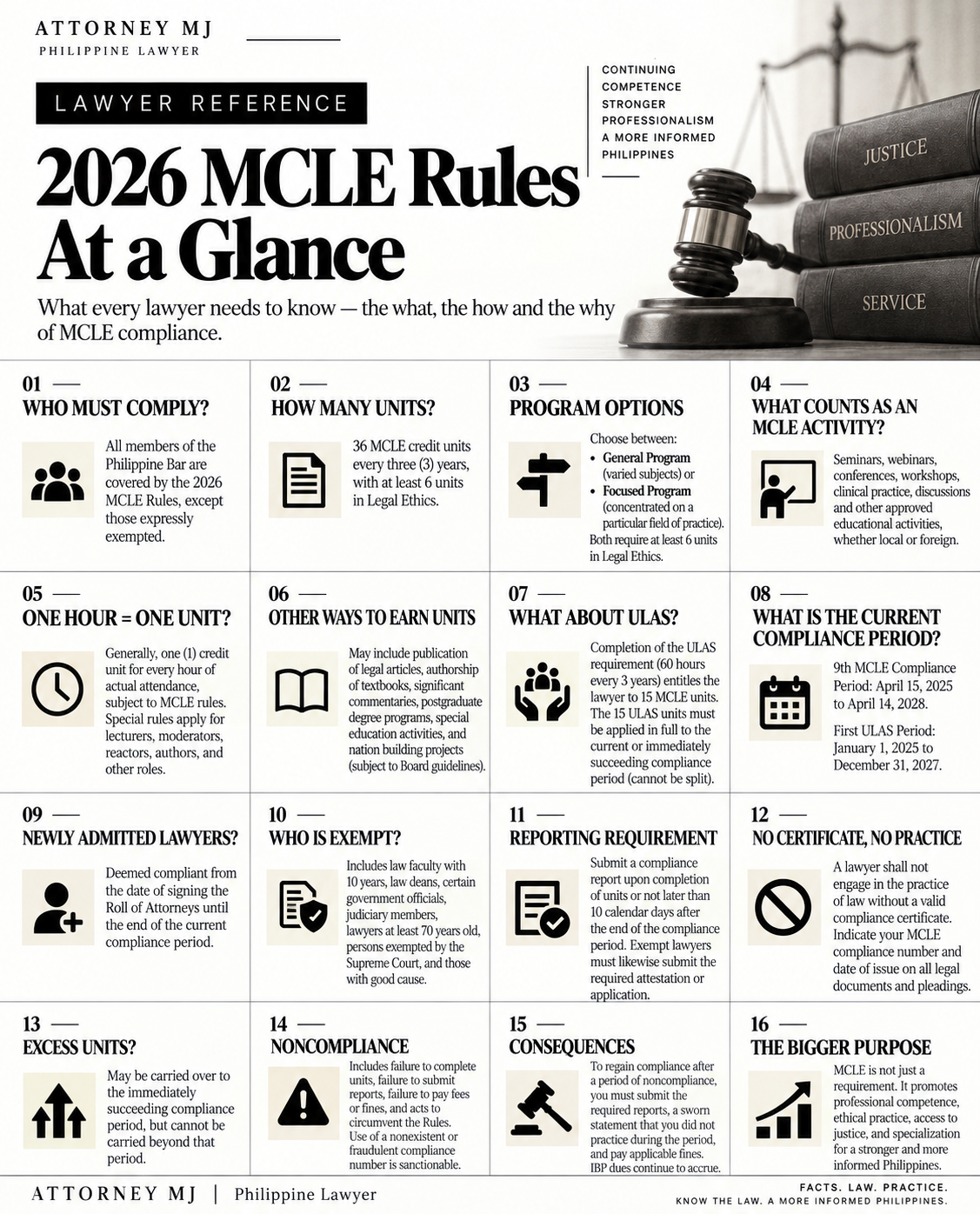
DEMYSTIFYING THE NEW 2026 RULES ON MANDATORY CONTINUING LEGAL EDUCATION
The 2026 Rules on Mandatory Continuing Legal Education introduce a more flexible and practice oriented framework for Philippine lawyers. While the core requirement remains 36 MCLE units every three years, including at least 6 units in Legal Ethics, lawyers may now choose between a General Program and a Focused Program. The Rules also recognize broader educational activities, provide for possible MCLE credit from ULAS, postgraduate studies, legal publications and other qualifying activities, and establish a framework for legal specialization. More importantly, compliance is directly tied to the authority to practice law, making proper completion, documentation, reporting, and maintenance of a valid MCLE compliance certificate essential for every practicing lawyer.
Read More
Who Are “All the Members of the Senate”?
The impeachment of a Vice-President presents a constitutional question that appears mathematical on its face but is, in reality, fundamentally a question of constitutional interpretation: What exactly does the Constitution mean when it requires “the concurrence of two-thirds of all the Members of the Senate” for a conviction in an impeachment case?
Read More