Small Claims Court Process in the Philippines: A Complete Guide
What is a Small Claim?
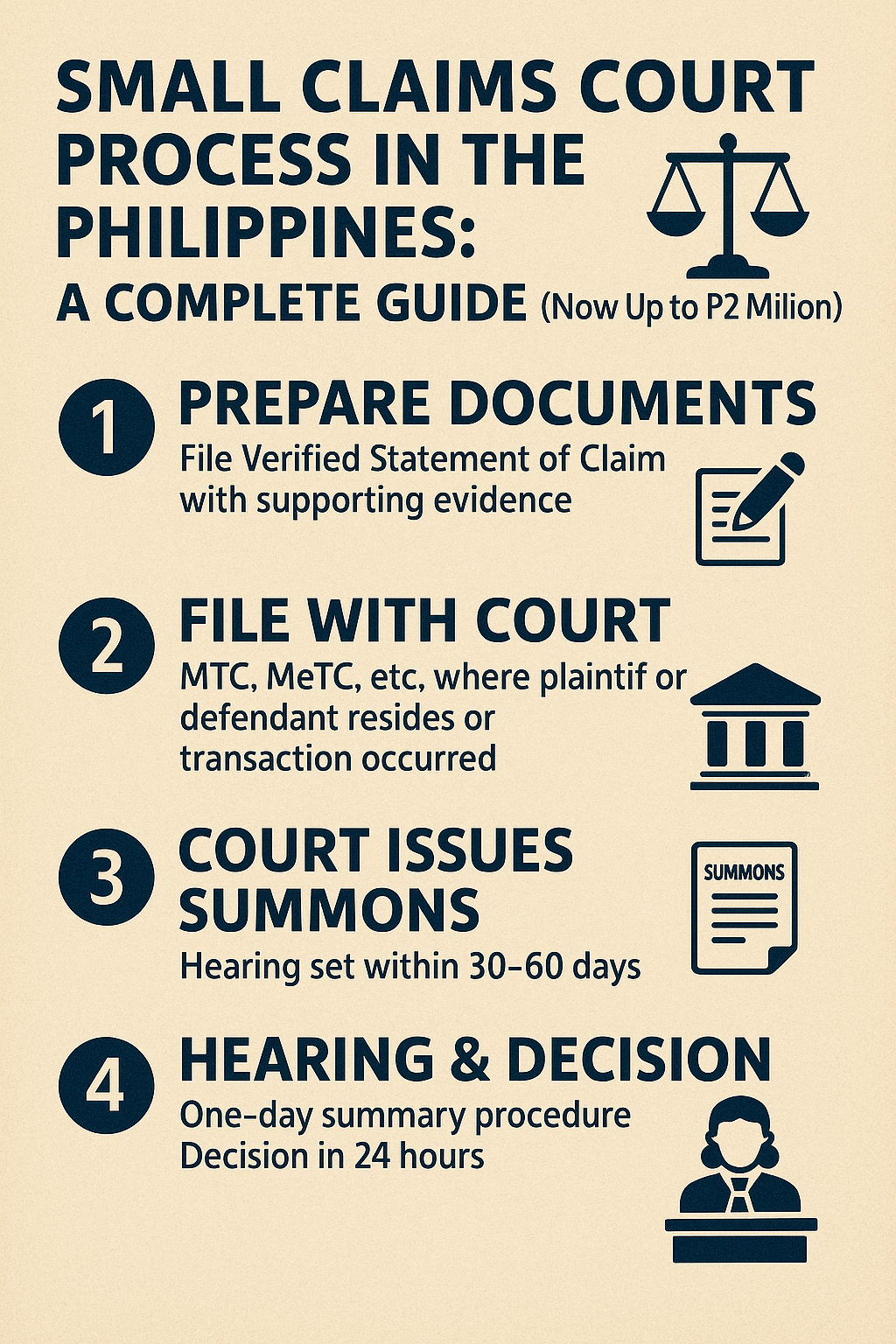
Under the Revised Rules on Expedited Procedures in the First Level Courts (A.M. No. 08‑8‑7‑SC), a small claim is a purely monetary claim not exceeding ₱2,000,000, inclusive of interest, penalties, and costs.
Examples of small claims:
- Unpaid debts or personal loans
- Unpaid rentals
- Fees for services rendered
- Damages from minor property damage
- Enforcement of barangay settlements or arbitration awards
- Bounced checks
Not included:
- Claims involving marriage, family relations, wills, or estates
- Criminal liability
- Claims solely for moral, exemplary, or attorney’s fees (unless part of the principal claim)
Who Can File?
Individuals (natural persons)
Corporations, partnerships, sole proprietorships – via authorized non-lawyer representatives (e.g., owners, officers with board resolution)
Real party in interest – you must be the person who actually stands to benefit
Do You Need a Lawyer?
No. In Small Claims Court, lawyers are barred from appearing at the hearing (except if the lawyer is the party themselves). This rule keeps the process simple, fast, and affordable. But, you can hire a lawyer before the hearing to help prepare your claim, organize evidence, and plan strategy.
Step-by-Step Small Claims Process
1. Prepare Your Documents
Complete the Verified Statement of Claim (Form 1-SCC)—available at the court or online.
Include all evidence:
Contracts, receipts, promissory notes
Demand letters
Checks, photos, affidavits if relevant
Attach Certification Against Forum Shopping
2. File with the Court
File at the Municipal Trial Court (MTC), Metropolitan Trial Court (MeTC), MTCC, or MCTC where: Plaintiff or defendant resides, or the transaction happened.
Pay minimal filing fees (significantly lower than regular civil cases)
3. Court Issues Summons
Clerk of Court reviews your documents.
Summons is issued to the defendant with a set hearing date (usually within 30–60 days of filing).
Defendant must file a verified response within 10 days of receiving the summons.
4. Hearing
Informal, summary procedure:
No formal pleadings or motions
Judge directly questions both parties
Both sides present evidence without legal jargon
No lawyers in court (except if the party is the lawyer)
The judge may encourage amicable settlement
5. Decision
Court renders a decision on the same day, or at most within 24 hours of the hearing.
Final and executory: No appeal. The decision is immediately enforceable.
Court issues writ of execution if payment is not made voluntarily.
Advantages of Small Claims Court
- Quick resolution: Avoid years of litigation—get a decision in days or weeks.
- Low cost: Minimal filing fees, no lawyer required at hearing.
- Accessible: Designed for ordinary citizens and small businesses.
- Finality: No appeal, ensuring closure and certainty.
⚖️ Need Help?
Even though you don’t need a lawyer in court, professional help in preparing your claim can significantly improve your chances of success. Our firm can:
✅ Draft your Statement of Claim
✅ Review and organize your evidence
✅ Advise you on best strategies
📞 Contact us today for a consultation!
Atty. Mark Joseph Morales, CPA, MBA, JD
Founder and Managing Partner, MJM Law & Partners
Full professional profileYou Might Also Like
“No Return, No Exchange”: When Can a Buyer Demand a Refund or Replacement?
A store policy cannot automatically defeat a consumer’s remedies for defective goods. This guide explains the distinction between a genuine defect and a change of mind, the repair and replacement framework under the Consumer Act, and the records and steps that help buyers pursue an appropriate remedy.
Read More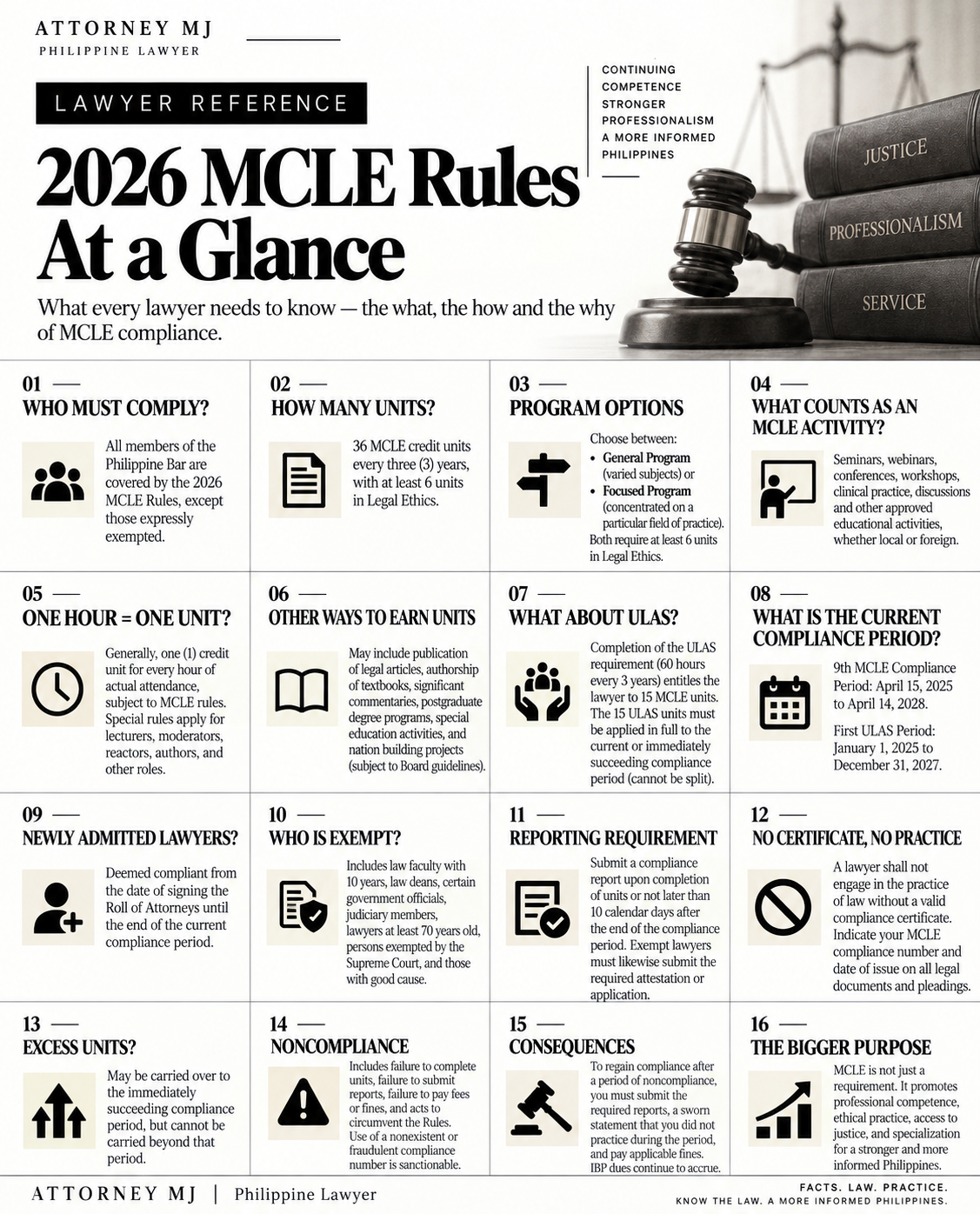
DEMYSTIFYING THE NEW 2026 RULES ON MANDATORY CONTINUING LEGAL EDUCATION
The 2026 Rules on Mandatory Continuing Legal Education introduce a more flexible and practice oriented framework for Philippine lawyers. While the core requirement remains 36 MCLE units every three years, including at least 6 units in Legal Ethics, lawyers may now choose between a General Program and a Focused Program. The Rules also recognize broader educational activities, provide for possible MCLE credit from ULAS, postgraduate studies, legal publications and other qualifying activities, and establish a framework for legal specialization. More importantly, compliance is directly tied to the authority to practice law, making proper completion, documentation, reporting, and maintenance of a valid MCLE compliance certificate essential for every practicing lawyer.
Read More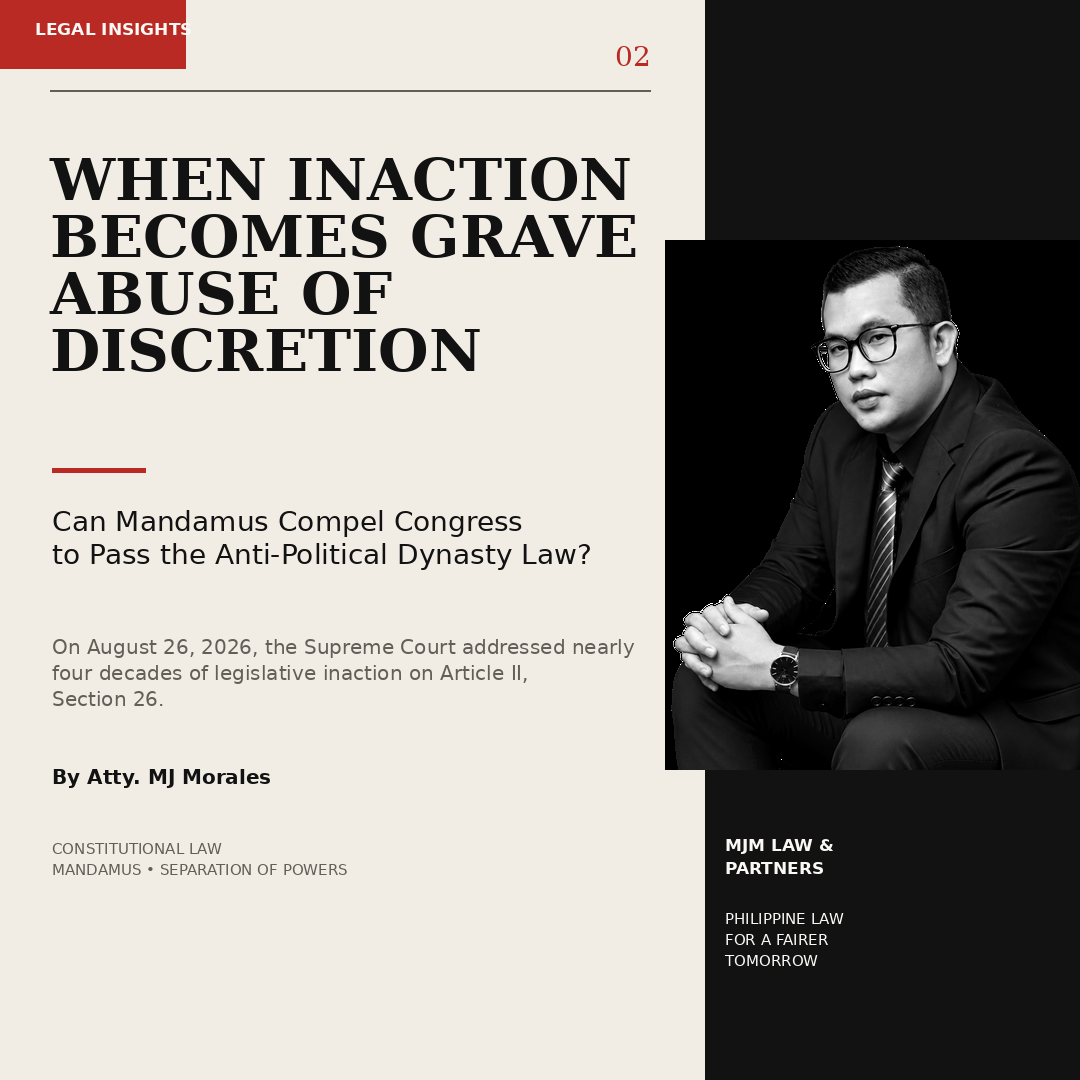
When Inaction Becomes Grave Abuse of Discretion: Can Mandamus Compel Congress to Pass the Anti-Political Dynasty Law?
The article examines whether the Supreme Court may compel Congress through mandamus to fulfill Article II, Section 26 of the 1987 Constitution, which directs the State to prohibit political dynasties “as may be defined by law.” Its central argument is that the Constitution imposes a mandatory duty on Congress to enact the necessary anti-political dynasty law, while Congress retains discretion over the law’s specific content, scope, and enforcement mechanisms. The article weighs this position against the separation of powers concern that legislation is inherently deliberative and discretionary, and therefore may not be a proper subject of mandamus. It ultimately frames the 2026 ruling as part of a broader constitutional question: whether prolonged governmental inaction can itself constitute grave abuse of discretion, while still preserving the Judiciary’s duty to enforce the Constitution without assuming Congress’ legislative function.
Read More