Warrantless Arrests in the Philippines: When Is It Legal?

Legal Basis
Article III, Section 2 of the 1987 Constitution guarantees the right against unreasonable searches and seizures, including arrests. Rule 113, Section 5 of the Revised Rules of Criminal Procedure outlines the instances when a warrantless arrest is allowed:
When Is a Warrantless Arrest Legal?
In Flagrante Delicto (Caught in the Act)
When the person is caught committing, attempting to commit, or has just committed a crime in the presence of a law enforcer.
Example: A person is seen stealing in a store and is immediately apprehended.
Hot Pursuit Arrest
When an offense has just been committed and the arresting officer has personal knowledge of facts indicating that the person to be arrested committed it.
"Personal knowledge" means firsthand awareness of facts or circumstances linking the suspect to the crime.
Escapee Arrest
When a prisoner has escaped from a penal establishment or place where they are serving a sentence, or is temporarily confined.
This also covers those who escape while being transferred or while under temporary custody.
Recent Jurisprudence
The Supreme Court has clarified the limits of warrantless arrests:
People v. Enriquez (2021): A warrantless arrest based solely on an informant's tip, without any corroboration or overt act of crime witnessed by the police, is illegal.
People v. Doria (1999): Police officers must not rely solely on intelligence reports. There must be actual overt acts observed by the officers themselves.
Veridiano v. People (2022): The Court stressed that hot pursuit arrests require immediate action following the crime and personal knowledge of the suspect's identity and involvement.
Consequences of Illegal Arrest
If an arrest is made without a valid warrant and none of the exceptions apply:
The arrest is illegal.
Any evidence obtained as a result of such arrest is inadmissible in court under the exclusionary rule.
The accused may be released, and the arresting officers may face administrative or criminal liability
Practical Tips for Citizens
Stay calm and ask if you are being arrested or merely invited for questioning.
Ask for the warrant. If they don’t have one, ask what exception applies.
Observe the manner of the arrest: Was there a visible act of a crime? Did the officer witness something?
Consult a lawyer immediately if you feel your rights were violated.
Conclusion
Warrantless arrests are legal only under specific, narrow circumstances. Law enforcers must strictly comply with these exceptions to avoid abuse and uphold the rights of citizens. As a rule of thumb, no arrest is valid unless clearly justified by law.
Need help with criminal charges or illegal arrest?
Contact MJM Law & Partners today.
Clarity. Strategy. Results.
Atty. Mark Joseph Morales, CPA, MBA, JD
Founder and Managing Partner, MJM Law & Partners
Full professional profileYou Might Also Like

“No Return, No Exchange”: When Can a Buyer Demand a Refund or Replacement?
A store policy cannot automatically defeat a consumer’s remedies for defective goods. This guide explains the distinction between a genuine defect and a change of mind, the repair and replacement framework under the Consumer Act, and the records and steps that help buyers pursue an appropriate remedy.
Read More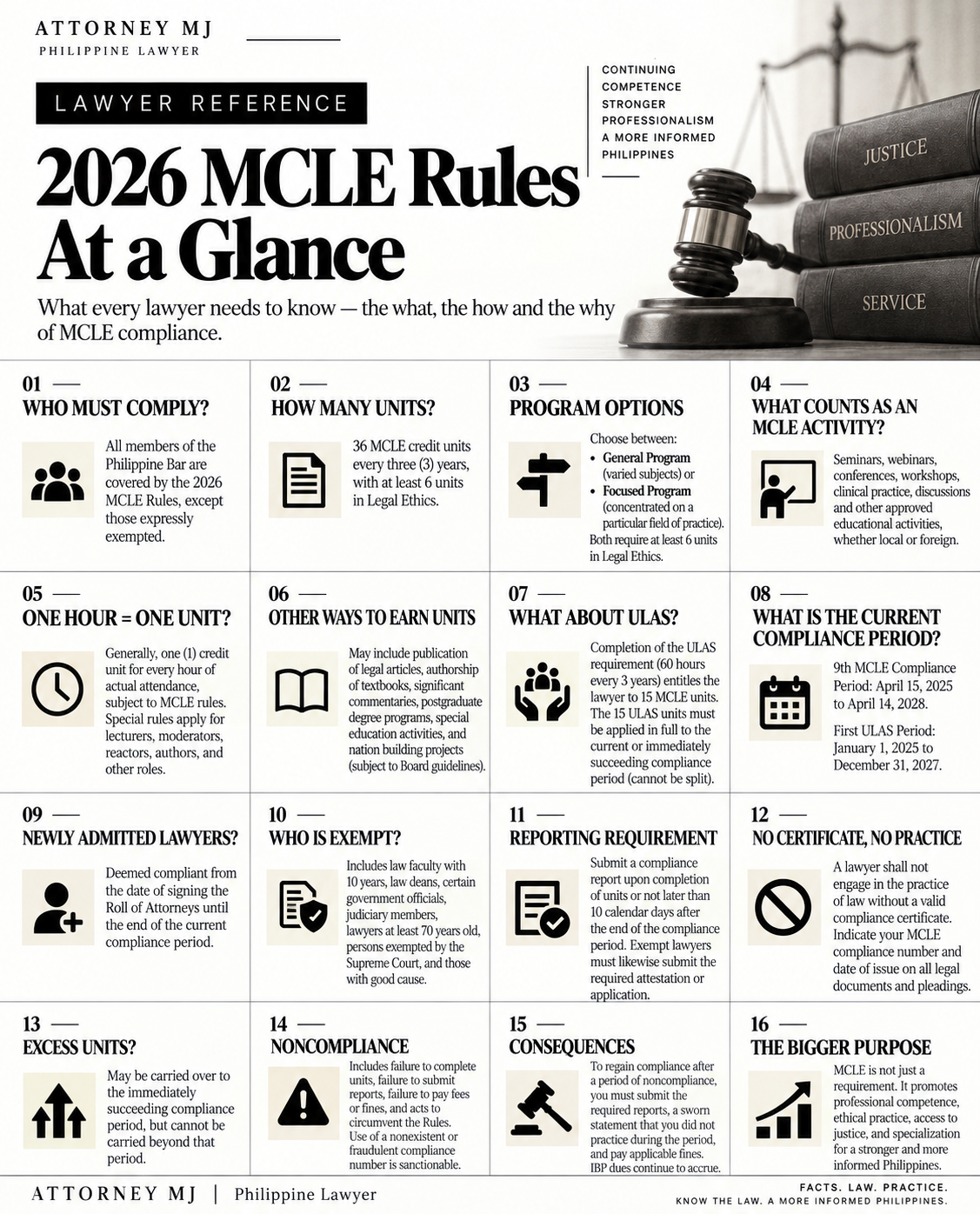
DEMYSTIFYING THE NEW 2026 RULES ON MANDATORY CONTINUING LEGAL EDUCATION
The 2026 Rules on Mandatory Continuing Legal Education introduce a more flexible and practice oriented framework for Philippine lawyers. While the core requirement remains 36 MCLE units every three years, including at least 6 units in Legal Ethics, lawyers may now choose between a General Program and a Focused Program. The Rules also recognize broader educational activities, provide for possible MCLE credit from ULAS, postgraduate studies, legal publications and other qualifying activities, and establish a framework for legal specialization. More importantly, compliance is directly tied to the authority to practice law, making proper completion, documentation, reporting, and maintenance of a valid MCLE compliance certificate essential for every practicing lawyer.
Read More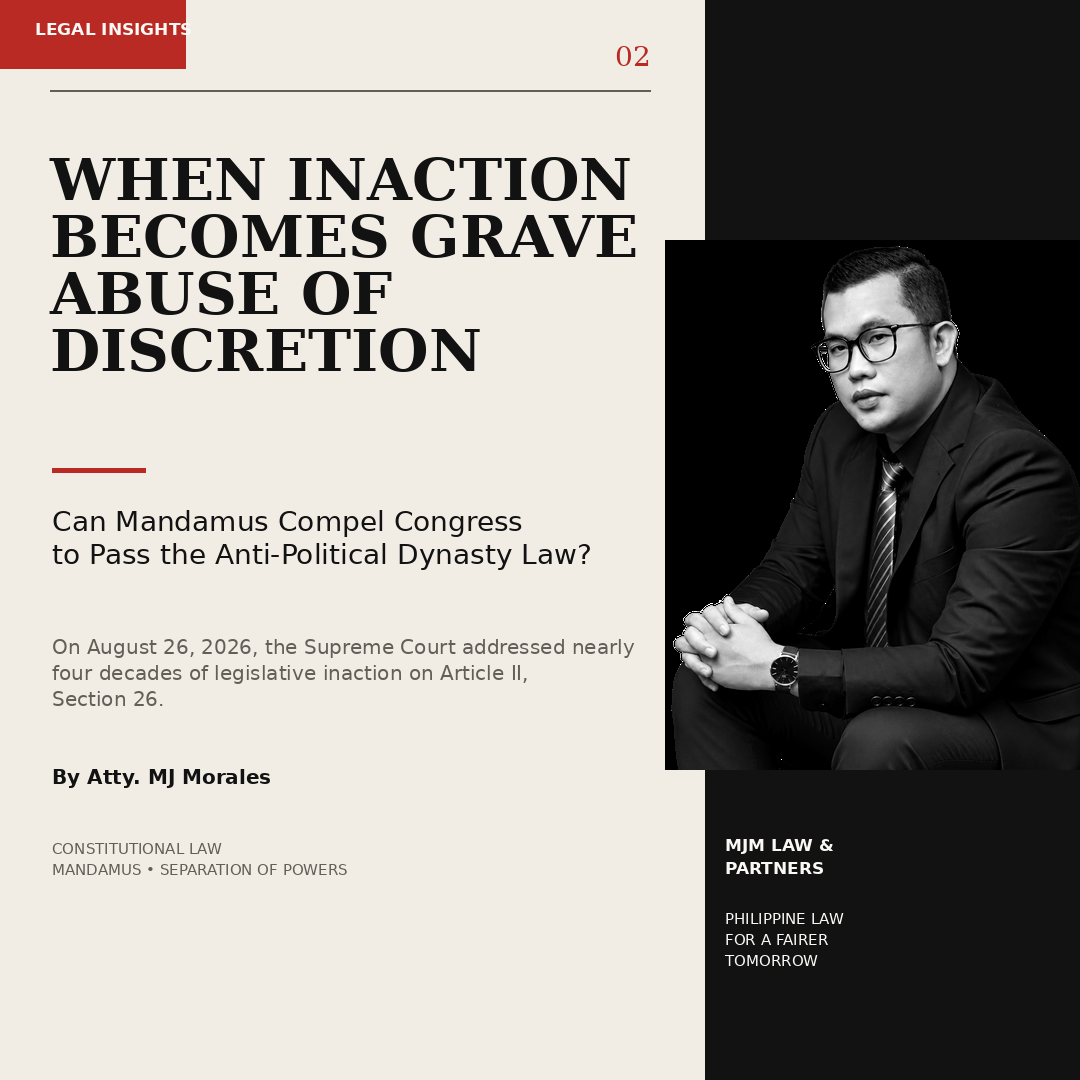
When Inaction Becomes Grave Abuse of Discretion: Can Mandamus Compel Congress to Pass the Anti-Political Dynasty Law?
The article examines whether the Supreme Court may compel Congress through mandamus to fulfill Article II, Section 26 of the 1987 Constitution, which directs the State to prohibit political dynasties “as may be defined by law.” Its central argument is that the Constitution imposes a mandatory duty on Congress to enact the necessary anti-political dynasty law, while Congress retains discretion over the law’s specific content, scope, and enforcement mechanisms. The article weighs this position against the separation of powers concern that legislation is inherently deliberative and discretionary, and therefore may not be a proper subject of mandamus. It ultimately frames the 2026 ruling as part of a broader constitutional question: whether prolonged governmental inaction can itself constitute grave abuse of discretion, while still preserving the Judiciary’s duty to enforce the Constitution without assuming Congress’ legislative function.
Read More