Barangay Justice System (Katarungang Pambarangay): A Complete Guide to Community-Level Dispute Resolution

What Is the Barangay Justice System?
The Barangay Justice System is a mandatory dispute resolution process established by the Local Government Code (Republic Act No. 7160), specifically Articles 399–422.
It provides a venue for resolving civil disputes and certain criminal offenses at the community level without the need for immediate court intervention.
This system operates under the supervision of:
- The Punong Barangay (Barangay Captain) as the initial mediator
- The Lupon Tagapamayapa, a group of respected residents
- The Pangkat ng Tagapagkasundo, a conciliation panel formed when mediation fails
What Cases Are Covered?
Barangay conciliation is required if the following conditions are met:
- Parties are natural persons, not corporations
- Parties reside in the same city or municipality
- The dispute involves certain civil matters or minor criminal offenses
Examples of covered disputes include:
- Non-payment of debts or loans
- Collection of unpaid rentals or service fees
- Minor property damage (e.g. boundary disputes)
- Slight physical injuries
- Simple slander (oral defamation)
- Threats, unjust vexation, or other minor offenses
- Enforcement of amicable settlements or arbitration awards previously made at the barangay level
NOTE: Criminal cases are only covered if the penalty does not exceed 1 year of imprisonment or ₱5,000 fine.
What Cases Are Exempt?
Not all cases require barangay conciliation. The following are exempted from the process:
1. One party is the government or an official acting in an official capacity
2. The offense has no private offended party (e.g. illegal possession of firearms, gambling)
3. Cases involving serious crimes (penalty exceeds 1 year or ₱5,000 fine)
4. Real property disputes where properties are in different cities or municipalities, unless parties agree in writing
5. Labor and agrarian disputes handled by DOLE or DAR
6. Disputes where parties are corporations, partnerships, or juridical entities
7. Urgent cases that require immediate legal relief (e.g. TRO, injunction, habeas corpus)
Step-by-Step Process of Barangay Conciliation
1. Filing the Complaint
The complainant files a written complaint with the Punong Barangay of the respondent’s barangay.
2. Mediation by Barangay Captain
The Barangay Captain calls both parties for mediation within 15 days.
3. Formation of Pangkat ng Tagapagkasundo
If mediation fails, a three-person conciliation panel (Pangkat) is formed. This group has another 15 days (extendable for valid reasons) to facilitate conciliation.
4. Settlement or Certification to File Action
- If parties settle, they sign a written agreement equivalent to a court judgment.
- If no settlement is reached, the barangay issues a Certificate to File Action, a mandatory requirement before filing a case in court.
Are Settlements Final?
Yes. A settlement agreement signed at the barangay level has the same legal effect as a final judgment by a court. It becomes binding and enforceable.
Failure to comply may lead to:
- Execution of judgment by the barangay
- Filing of the case in regular courts for enforcement
Why This Process Matters
🏛️ Mandatory pre-condition to filing in court for many disputes
💸 Cost-effective and requires no legal fees
🤝 Preserves relationships through dialogue
📉 Reduces court congestion and legal delays
Barangay conciliation is not just a procedural requirement, it embodies the Filipino spirit of bayanihan and community harmony.
Legal Help Before and After Barangay Proceedings
Lawyers cannot appear during barangay conciliation, but you can still get legal guidance before the hearings. Our firm can assist you with:
✅ Legal evaluation of your dispute
✅ Drafting your complaint or defense
✅ Reviewing any settlement offers
✅ Filing the proper case in court after barangay proceedings, if necessary
📞 Contact MJM Law & Partners today to avoid mistakes and protect your rights.
💼 MJM Law & Partners
Clarity. Strategy. Results.
Committed to accessible justice and community legal empowerment.
Atty. Mark Joseph Morales, CPA, MBA, JD
Founder and Managing Partner, MJM Law & Partners
Full professional profileYou Might Also Like

“No Return, No Exchange”: When Can a Buyer Demand a Refund or Replacement?
A store policy cannot automatically defeat a consumer’s remedies for defective goods. This guide explains the distinction between a genuine defect and a change of mind, the repair and replacement framework under the Consumer Act, and the records and steps that help buyers pursue an appropriate remedy.
Read More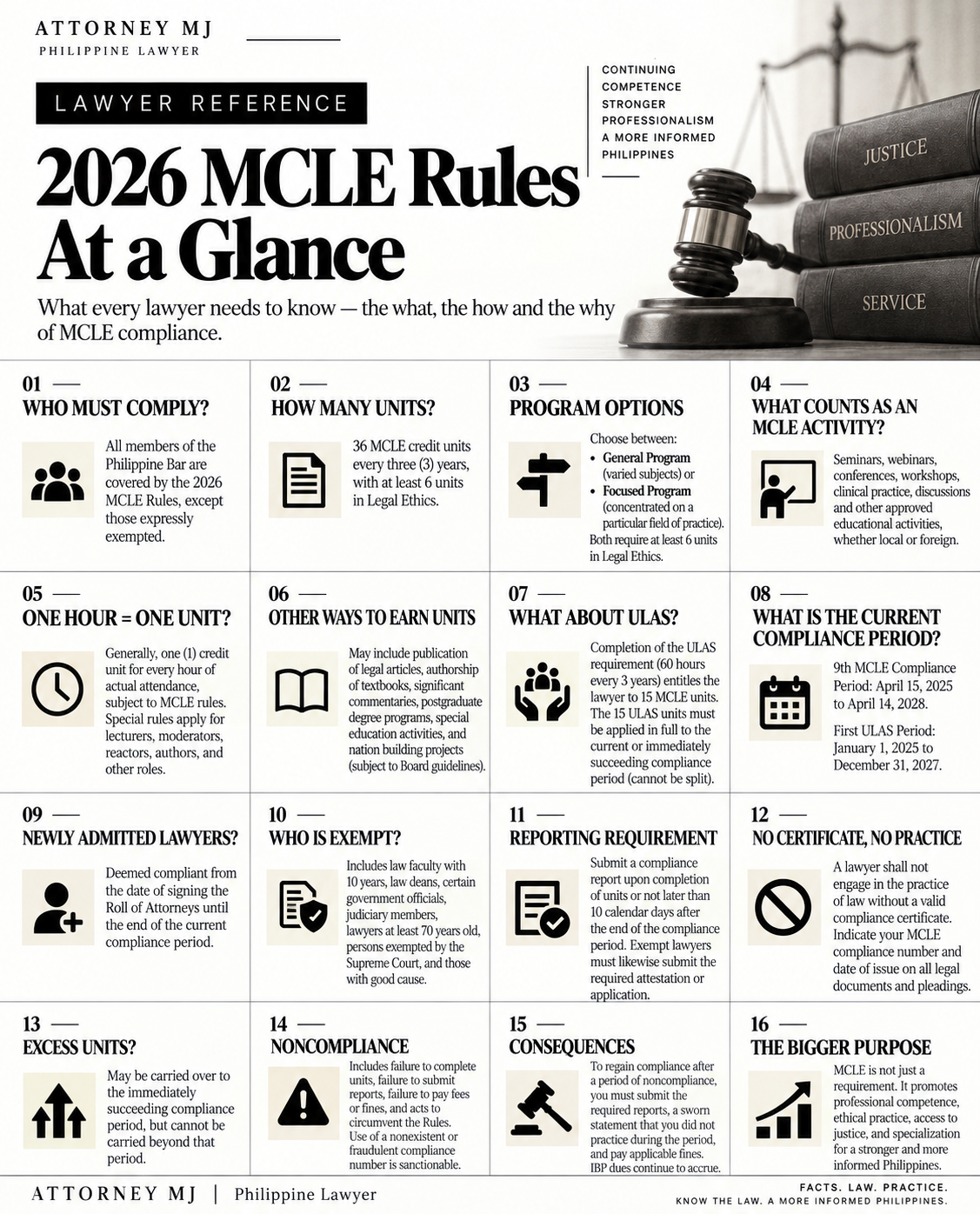
DEMYSTIFYING THE NEW 2026 RULES ON MANDATORY CONTINUING LEGAL EDUCATION
The 2026 Rules on Mandatory Continuing Legal Education introduce a more flexible and practice oriented framework for Philippine lawyers. While the core requirement remains 36 MCLE units every three years, including at least 6 units in Legal Ethics, lawyers may now choose between a General Program and a Focused Program. The Rules also recognize broader educational activities, provide for possible MCLE credit from ULAS, postgraduate studies, legal publications and other qualifying activities, and establish a framework for legal specialization. More importantly, compliance is directly tied to the authority to practice law, making proper completion, documentation, reporting, and maintenance of a valid MCLE compliance certificate essential for every practicing lawyer.
Read More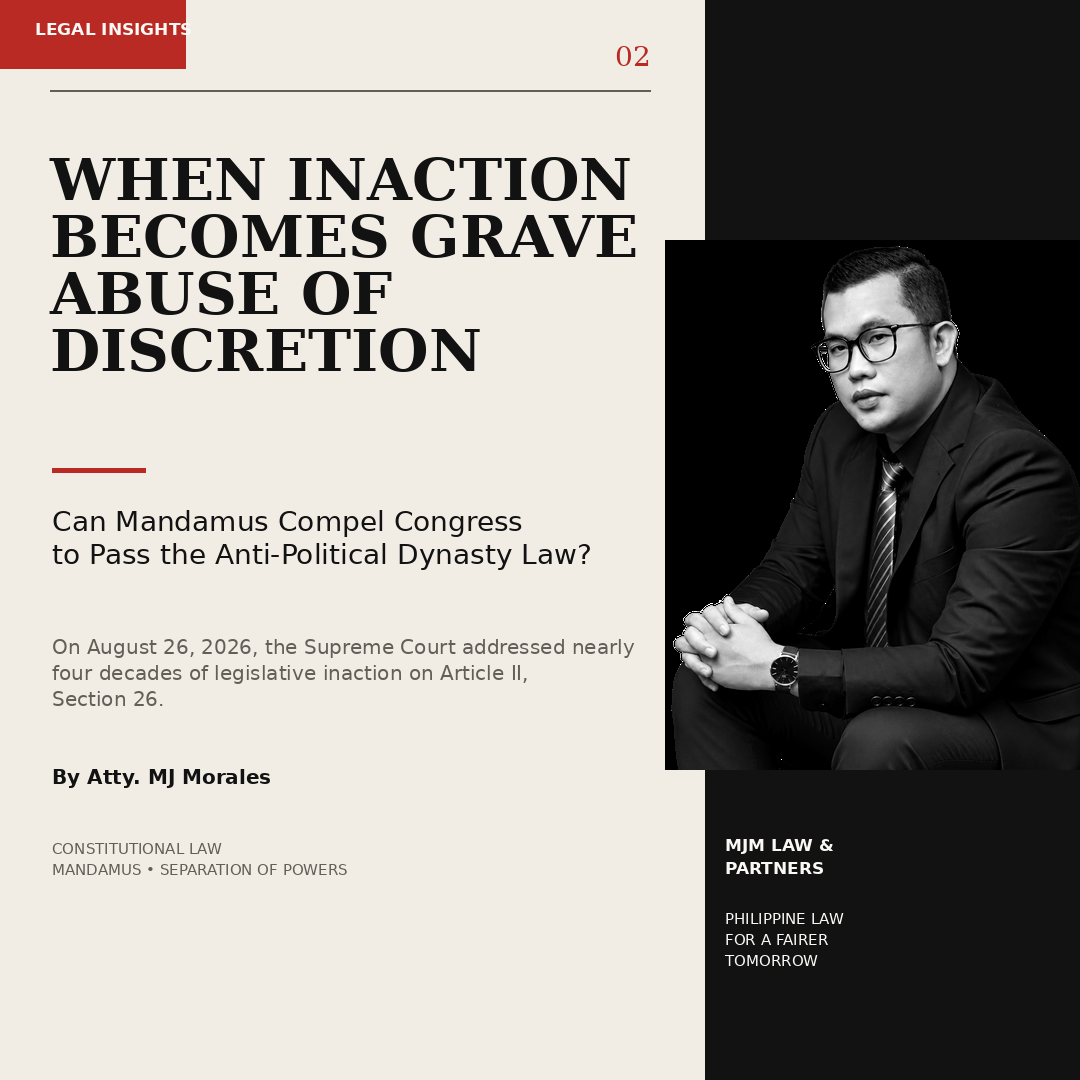
When Inaction Becomes Grave Abuse of Discretion: Can Mandamus Compel Congress to Pass the Anti-Political Dynasty Law?
The article examines whether the Supreme Court may compel Congress through mandamus to fulfill Article II, Section 26 of the 1987 Constitution, which directs the State to prohibit political dynasties “as may be defined by law.” Its central argument is that the Constitution imposes a mandatory duty on Congress to enact the necessary anti-political dynasty law, while Congress retains discretion over the law’s specific content, scope, and enforcement mechanisms. The article weighs this position against the separation of powers concern that legislation is inherently deliberative and discretionary, and therefore may not be a proper subject of mandamus. It ultimately frames the 2026 ruling as part of a broader constitutional question: whether prolonged governmental inaction can itself constitute grave abuse of discretion, while still preserving the Judiciary’s duty to enforce the Constitution without assuming Congress’ legislative function.
Read More