Cash Flow Forecasting & Management

Introduction
Cash is king—and running out of it is every founder’s nightmare. A reliable forecast not only tells you if you’ll have enough to cover payroll, suppliers, and debt service, it also guides strategic decisions like hiring, new product launches, or securing outside financing.
1. Why Cash‐Flow Forecasting Matters
- Liquidity Visibility: Know in advance whether you’ll hit critical shortfalls.
- Informed Decision‑Making: Time capital raises, hiring pushes, or capex investments when your cash runway looks strong.
- Stakeholder Confidence: Lenders and investors expect to see a disciplined cash‐management plan.
2. Key Components of a Cash‐Flow Model
- Opening Cash Balance – Starting point drawn from your bank statements.
- Operating Cash Inflows – Customer receipts by invoice date or projected collections.
- Operating Cash Outflows – Payroll, rent, vendor payments, taxes.
- Investing & Financing Activities – Capex, loan draws/repayments, equity infusions.
- Closing Balance – The critical “cash on hand” at the end of each period.
3. Techniques & Best Practices
- Driver‑Based Forecasting: Link revenues to key volume metrics (e.g., billable hours × rate) rather than flat growth assumptions.
- Rolling 13‑Week Model: Update weekly, always looking out three months, to surface short‑term gaps.
- Scenario Analysis: Build “base,” “best,” and “worst” cases to understand leverage points.
- Automated Data Feeds: Integrate your ERP or accounting system (QuickBooks, Xero) to minimize manual data entry errors.
- Monthly Reconciliation: Compare actuals vs. forecast to refine assumptions and improve accuracy over time.
4. Tools & Dashboards
- Spreadsheet Templates: Flexible and fully transparent—ideal for early‑stage companies.
- Dedicated SaaS Platforms: Float, CashflowTool, and Fathom offer built‑in scenario‑planning and real‑time syncing.
- Dashboard Visuals: Use line charts and heat‑maps to highlight upcoming cash shortages or surpluses at a glance.
5. Role of the Fractional CFO
- Model Design & Governance: Build and maintain the forecast, ensuring it aligns with your strategic plan.
- Insight & Advice: Interpret variance trends and recommend corrective actions (e.g., accelerate receivables).
- Stakeholder Reporting: Package forecasts into concise updates for your board, investors, or bank.
Conclusion
Mastering cash‐flow forecasting transforms uncertainty into clarity. By implementing a driver‑based, rolling model—updated with real data and stress‑tested under multiple scenarios—you’ll safeguard your runway, earn stakeholder trust, and have the agility to seize growth opportunities as they arise.
Atty. Mark Joseph Morales, CPA, MBA, JD
Founder and Managing Partner, MJM Law & Partners
Full professional profileYou Might Also Like

“No Return, No Exchange”: When Can a Buyer Demand a Refund or Replacement?
A store policy cannot automatically defeat a consumer’s remedies for defective goods. This guide explains the distinction between a genuine defect and a change of mind, the repair and replacement framework under the Consumer Act, and the records and steps that help buyers pursue an appropriate remedy.
Read More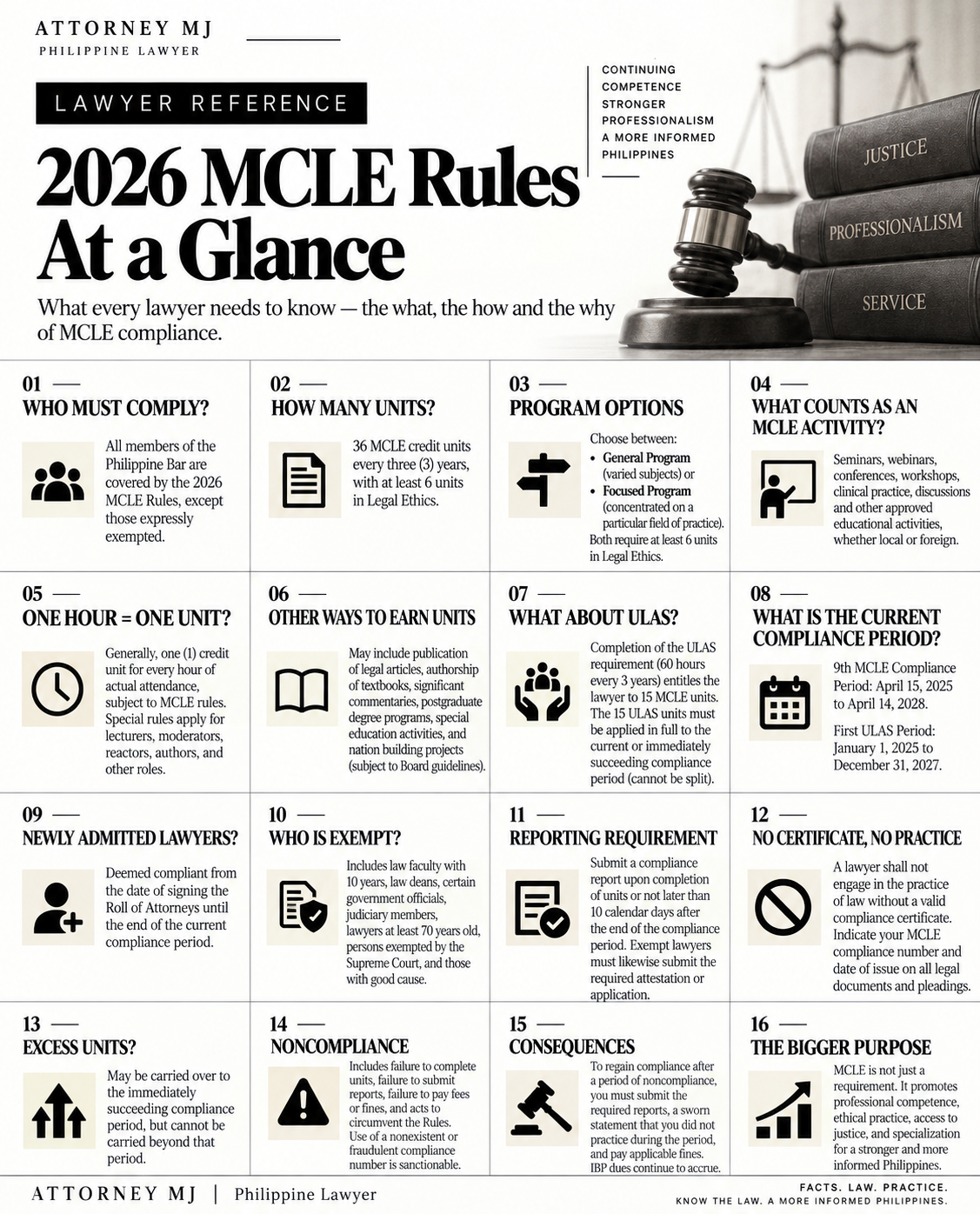
DEMYSTIFYING THE NEW 2026 RULES ON MANDATORY CONTINUING LEGAL EDUCATION
The 2026 Rules on Mandatory Continuing Legal Education introduce a more flexible and practice oriented framework for Philippine lawyers. While the core requirement remains 36 MCLE units every three years, including at least 6 units in Legal Ethics, lawyers may now choose between a General Program and a Focused Program. The Rules also recognize broader educational activities, provide for possible MCLE credit from ULAS, postgraduate studies, legal publications and other qualifying activities, and establish a framework for legal specialization. More importantly, compliance is directly tied to the authority to practice law, making proper completion, documentation, reporting, and maintenance of a valid MCLE compliance certificate essential for every practicing lawyer.
Read More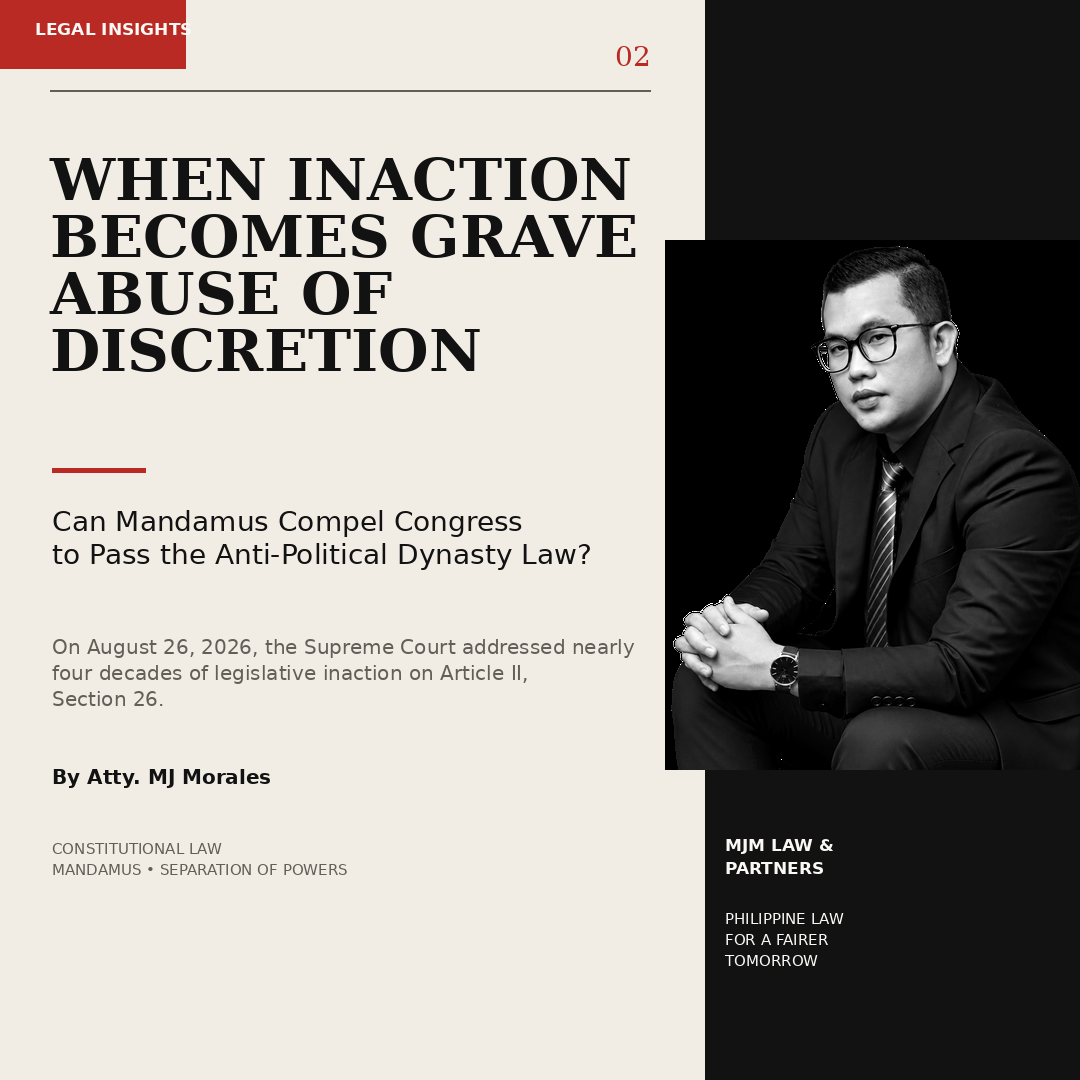
When Inaction Becomes Grave Abuse of Discretion: Can Mandamus Compel Congress to Pass the Anti-Political Dynasty Law?
The article examines whether the Supreme Court may compel Congress through mandamus to fulfill Article II, Section 26 of the 1987 Constitution, which directs the State to prohibit political dynasties “as may be defined by law.” Its central argument is that the Constitution imposes a mandatory duty on Congress to enact the necessary anti-political dynasty law, while Congress retains discretion over the law’s specific content, scope, and enforcement mechanisms. The article weighs this position against the separation of powers concern that legislation is inherently deliberative and discretionary, and therefore may not be a proper subject of mandamus. It ultimately frames the 2026 ruling as part of a broader constitutional question: whether prolonged governmental inaction can itself constitute grave abuse of discretion, while still preserving the Judiciary’s duty to enforce the Constitution without assuming Congress’ legislative function.
Read More