“No Return, No Exchange”: When Can a Buyer Demand a Refund or Replacement?

You buy an appliance, bring it home, and discover that it does not work. When you return to the store, the cashier points to a familiar sign: “No Return, No Exchange.” Does that end the matter?
A store’s policy is not the final word on your legal rights. Philippine consumer law protects buyers against defective products, but it also distinguishes a genuine defect from a buyer simply deciding that a purchase was a mistake. The remedy depends on what happened, the product involved, and the applicable warranty and statutory provisions.
I. Start with the reason for the return
A defective item and an unwanted item present different questions. An appliance that cannot perform its ordinary function, a product that does not match the advertised model, and an item damaged by the buyer should not be treated as though they are the same transaction.
The Department of Trade and Industry explains that the prohibition against a blanket “No Return, No Exchange” policy protects the remedies of repair, replacement, and refund for defective purchases. Its guidance also identifies situations such as a change of mind and buyer mishandling in which a seller may refuse the requested return.
The useful question is therefore: What exactly is wrong with the item, and when did the problem arise? A clear description is more effective than a general statement that the product is unsatisfactory.
II. What the Consumer Act actually provides
Republic Act No. 7394, the Consumer Act of the Philippines, contains rules on warranties and product quality. Article 100 addresses imperfections that make a consumer product unfit or inadequate for its intended use, reduce its value, or make it inconsistent with information supplied on packaging or in advertisements.
The provision establishes a framework for correcting the imperfection. If it is not corrected within the statutory thirty-day period, the consumer may choose among replacement with a suitable product of the same kind, reimbursement, or a proportionate reduction in price. The law permits an agreed adjustment of the correction period within stated limits, and recognizes circumstances in which the alternatives may be used immediately.
This is why it is inaccurate to say that every defective purchase automatically entitles the buyer to an immediate cash refund in every situation. The right exists within a legal framework; the applicable sequence and conditions still matter.
III. Read the warranty, but do not stop there
Keep the warranty card, purchase record, and seller’s written representations. Article 68 contains additional rules for express warranties, including clear identification of the warrantor, what is covered, and what the consumer must do to claim a remedy.
A written warranty can help identify the service process. It should not be read as though a short store policy necessarily extinguishes every statutory right. Equally, a warranty does not ordinarily require a seller to repair damage caused solely by misuse as though it were a manufacturing defect.
For second-hand goods, disclosed defects, and “as-is” purchases, examine the specific representations and terms rather than assuming the same answer applies. Concealment or misleading advertising may raise separate issues even where the item was not sold as new.
IV. Document the defect before surrendering the item
Prepare a simple evidence file:
- Proof of purchase: the invoice, receipt, order confirmation, and payment record.
- Product identification: brand, model, serial number, and accessories supplied.
- Representations: advertisements, product descriptions, and warranty terms.
- Problem records: dated photos or videos showing the malfunction, where safe to obtain.
- Communications: messages, service reports, and the dates of requests for assistance.
If the store takes the item for inspection, request an acknowledgment describing its condition and the accessories received. This helps prevent a later disagreement about what was handed over. Avoid unsafe tests or unauthorized alterations that could damage the product or complicate the evidence.
V. A practical way to request a remedy
1. Notify the seller promptly. Identify the purchase and describe the defect accurately.
2. Ask for the applicable remedy and process in writing. Include relevant purchase and warranty records.
3. Record the service timeline. Note when the item was received, inspected, repaired, or returned.
4. Follow up with specific facts. Explain whether the defect remains and what response you have received.
5. Escalate through the appropriate channel if unresolved. DTI’s Consumer CARe system provides a consumer complaint channel for matters within its jurisdiction.
Different products and services may fall within the authority of different regulators. An online purchase may also involve the platform’s internal redress mechanism under the Internet Transactions Act. Filing in the correct channel is part of pursuing the right remedy.
VI. Common questions
What if I simply prefer a different color?
If the supplied item is correct and has no defect, a return may depend on the seller’s voluntary exchange policy. A change of preference is different from receiving the wrong product.
Does a missing paper receipt automatically end the claim?
The buyer still needs credible proof of the transaction. Order records, payment confirmations, and other documents may help establish the purchase; the sufficiency of the records depends on the dispute.
Can I demand damages beyond the purchase price?
Additional losses require an appropriate legal basis and evidence. They should not be treated as an automatic amount added to every refund request.
VII. The practical takeaway
The strongest consumer complaint begins with a precise account of the transaction, the defect, and the attempted resolution. Do not let a sign replace an examination of the law—but do not confuse consumer protection with an unconditional right to undo every purchase.
Sources and further reading
- Consumer Act, particularly Articles 68 and 100: https://lexiquire.com/laws/RA%207394
- DTI guidance on “No Return, No Exchange”: https://fairtrade.dti.gov.ph/faq/is-no-return-no-exchange-policy-allowed/
- DTI Consumer CARe: https://consumercare.dti.gov.ph/
This article provides general information on Philippine law. The appropriate advice and remedy depend on the facts, documents, and applicable rules.
For assistance reviewing your documents and legal options, contact MJM Law & Partners: https://www.mjmlawpartners.com/contact.
Clarity. Strategy. Results.
#ConsumerRights #PhilippineLaw #ConsumerAct #Refunds #MJMLawPartners
Atty. Mark Joseph Morales, CPA, MBA, JD
Founder and Managing Partner, MJM Law & Partners
Full professional profileYou Might Also Like
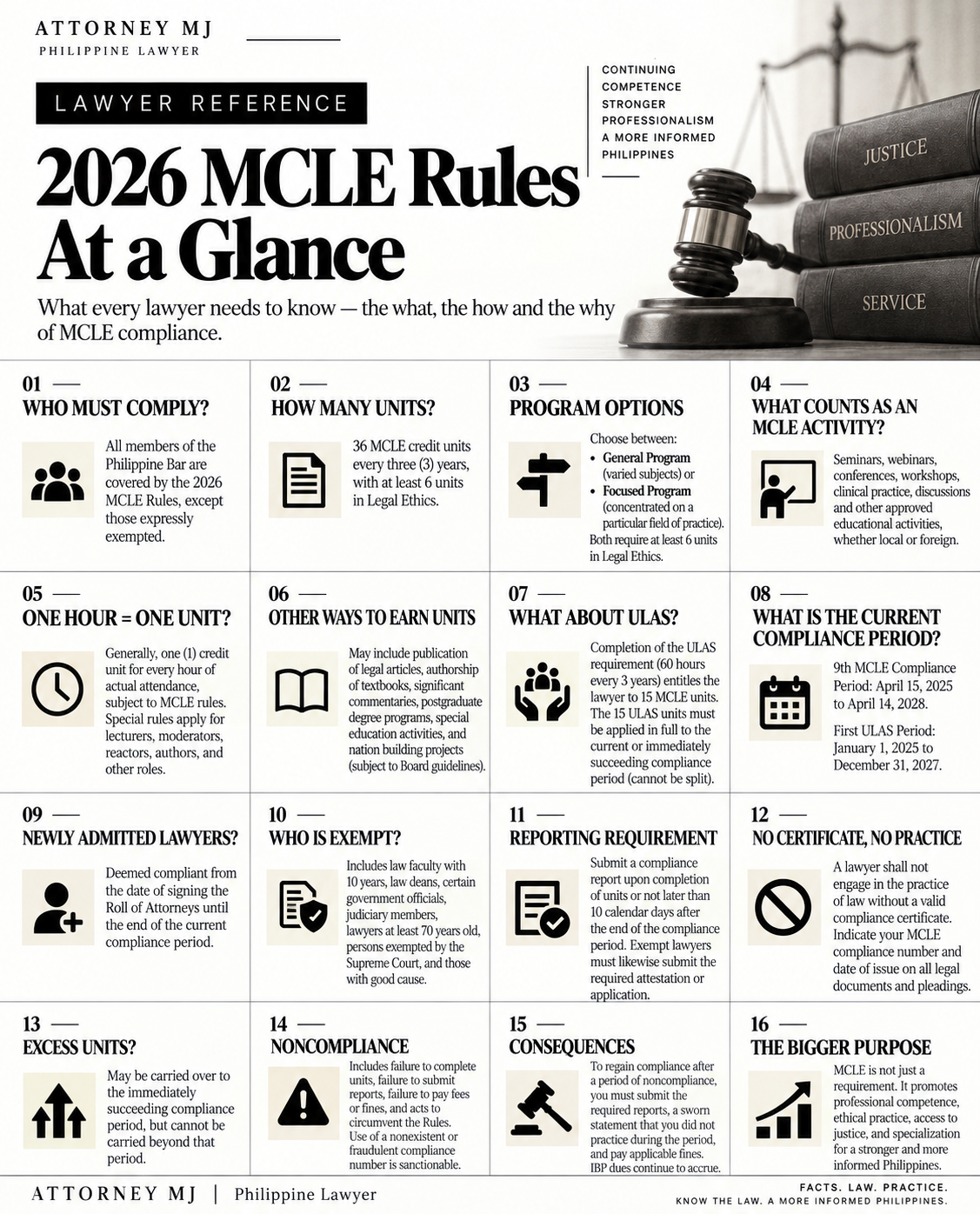
DEMYSTIFYING THE NEW 2026 RULES ON MANDATORY CONTINUING LEGAL EDUCATION
The 2026 Rules on Mandatory Continuing Legal Education introduce a more flexible and practice oriented framework for Philippine lawyers. While the core requirement remains 36 MCLE units every three years, including at least 6 units in Legal Ethics, lawyers may now choose between a General Program and a Focused Program. The Rules also recognize broader educational activities, provide for possible MCLE credit from ULAS, postgraduate studies, legal publications and other qualifying activities, and establish a framework for legal specialization. More importantly, compliance is directly tied to the authority to practice law, making proper completion, documentation, reporting, and maintenance of a valid MCLE compliance certificate essential for every practicing lawyer.
Read More
When Inaction Becomes Grave Abuse of Discretion: Can Mandamus Compel Congress to Pass the Anti-Political Dynasty Law?
The article examines whether the Supreme Court may compel Congress through mandamus to fulfill Article II, Section 26 of the 1987 Constitution, which directs the State to prohibit political dynasties “as may be defined by law.” Its central argument is that the Constitution imposes a mandatory duty on Congress to enact the necessary anti-political dynasty law, while Congress retains discretion over the law’s specific content, scope, and enforcement mechanisms. The article weighs this position against the separation of powers concern that legislation is inherently deliberative and discretionary, and therefore may not be a proper subject of mandamus. It ultimately frames the 2026 ruling as part of a broader constitutional question: whether prolonged governmental inaction can itself constitute grave abuse of discretion, while still preserving the Judiciary’s duty to enforce the Constitution without assuming Congress’ legislative function.
Read More
Who Are “All the Members of the Senate”?
The impeachment of a Vice-President presents a constitutional question that appears mathematical on its face but is, in reality, fundamentally a question of constitutional interpretation: What exactly does the Constitution mean when it requires “the concurrence of two-thirds of all the Members of the Senate” for a conviction in an impeachment case?
Read More