New Supreme Court Guidelines: Proper Designation of Qualified Rape vs. Statutory Rape in the Philippines

Key Guidelines from the Supreme Court
1. The proper crime is "Qualified Rape of a Minor"
If any of the special qualifying aggravating circumstances are present:
Minor is related to the accused (e.g., parent, step-parent, guardian)
Victim is below 7 years old
Accused knew of the victim's mental disability
2. Avoid using the term “qualified statutory rape”
The Court emphasized that this term is not doctrinally sound, even if the victim is below statutory age.
3. If multiple special qualifying aggravating circumstances exist:
One shall be used to qualify the crime as qualified rape.
Others may be treated as generic aggravating circumstances (affecting penalties only, not crime designation).
4. Definition of "statutory age" depends on when the rape occurred:
If before RA 11648 took effect → statutory age = below 12 years old
If after RA 11648 → statutory age = under 16 years old
Why the Court Issued These Guidelines
The Court found inconsistency in recent jurisprudence. Between pre-2014 rulings, which consistently used the term "qualified rape," and post-2014 cases that coined "qualified statutory rape" without explanation, doctrinal clarity was needed.
The decision is rooted in criminal law principles that require:
Precise classification of crimes
Proper application of aggravating circumstances
Avoidance of redundancy or prejudice in penalty computation
Legal Definitions Refresher
Statutory Rape:
- Defined under Article 266-A(1)(d) of the RPC
- Involves carnal knowledge of a child below the statutory age
- Consent, force, or intimidation are irrelevant
- Penalty: Reclusion perpetua
Qualified Rape:
- Relationship
- Moral ascendancy
- Abuse of authority
- Victim’s age below 7
- Victim’s mental disability
Penalty: Death penalty (converted to reclusion perpetua after abolition of death penalty)
Special Qualifying Aggravating Circumstances alter the nature of rape and increase penalties.
On the Use of Aggravating Circumstances
The Court classified aggravating circumstances into:
- Generic – Applies to all crimes (e.g., recidivism, evident premeditation)
- Specific – Applies to specific crimes (e.g., treachery in murder)
- Qualifying – Changes the nature of the offense
- Inherent – Elements of the crime itself
- Special – Created by law for specific penalty enhancements
In the context of rape:
Being under statutory age is an inherent element of statutory rape.
But minority + relationship or knowledge of mental disability are special qualifying circumstances in qualified rape.
Thus, using both to enhance the crime would result in double appreciation, which is prohibited.
Case Impact: People v. ABC260708
In this case, the accused was found guilty of raping his 8-year-old daughter. While the Court of Appeals designated the crime as "qualified statutory rape," the Supreme Court corrected this and ruled it should be:
"Qualified Rape of a Minor"
He was also found guilty of sexual assault under Article 266-A(2) of the RPC, in relation to Section 5(b) of RA 7610 (Anti-Child Abuse Law).
What This Means for Legal Practice
Prosecutors, judges, and lawyers must avoid using “qualified statutory rape” in indictments, decisions, or pleadings.
Cases involving minors must be carefully evaluated for presence of special qualifying aggravating circumstances.
Proper crime designation is essential to ensure fairness and due process for both the accused and the victim.
The Supreme Court has settled a critical issue in rape jurisprudence. From now on, where aggravating circumstances are present, the crime should be properly labeled as Qualified Rape of a Minor, not "qualified statutory rape."
Legal practitioners must apply this designation to maintain consistency with jurisprudence and the fundamental principles of criminal law.
Atty. Mark Joseph Morales, CPA, MBA, JD
Founder and Managing Partner, MJM Law & Partners
Full professional profileYou Might Also Like

“No Return, No Exchange”: When Can a Buyer Demand a Refund or Replacement?
A store policy cannot automatically defeat a consumer’s remedies for defective goods. This guide explains the distinction between a genuine defect and a change of mind, the repair and replacement framework under the Consumer Act, and the records and steps that help buyers pursue an appropriate remedy.
Read More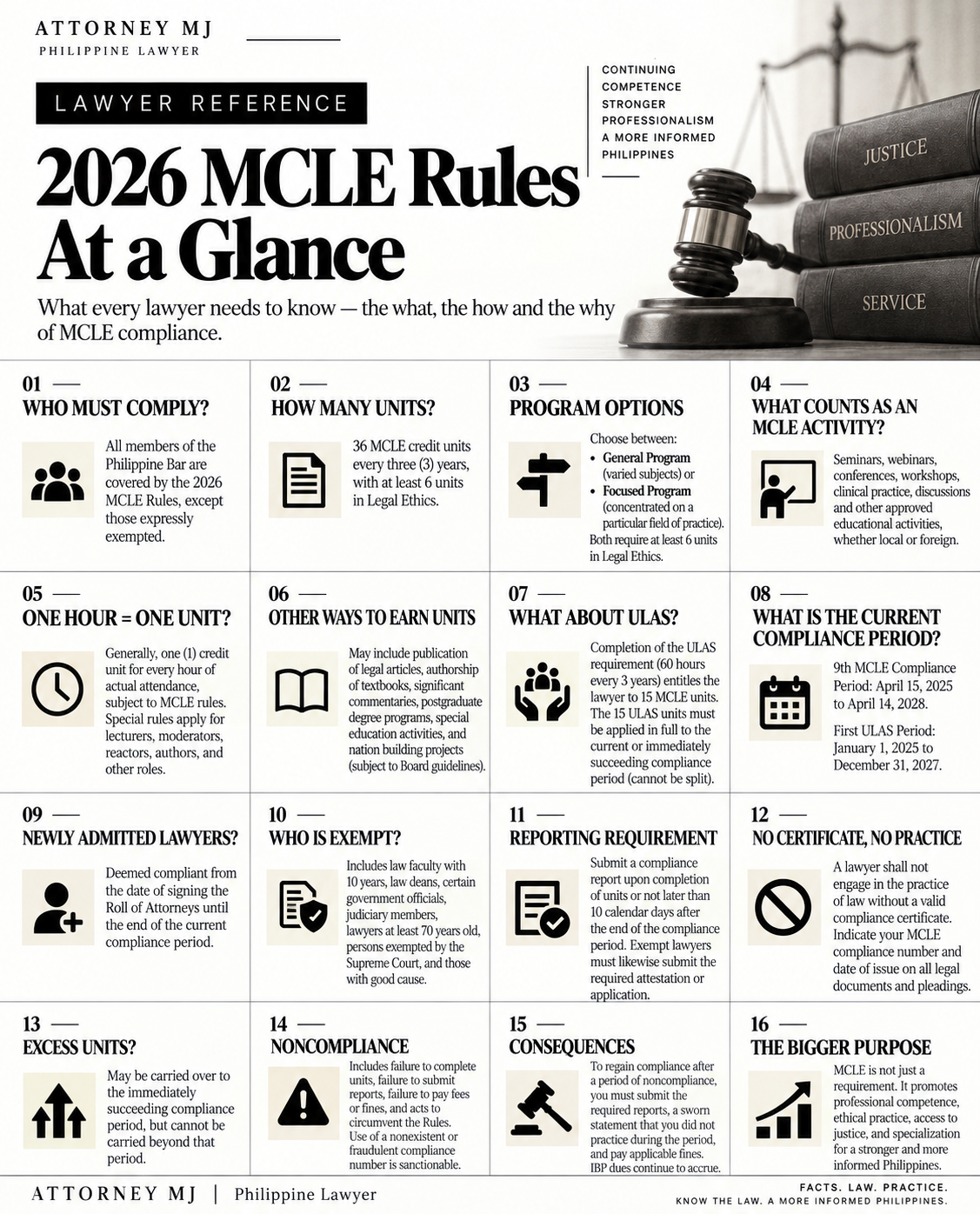
DEMYSTIFYING THE NEW 2026 RULES ON MANDATORY CONTINUING LEGAL EDUCATION
The 2026 Rules on Mandatory Continuing Legal Education introduce a more flexible and practice oriented framework for Philippine lawyers. While the core requirement remains 36 MCLE units every three years, including at least 6 units in Legal Ethics, lawyers may now choose between a General Program and a Focused Program. The Rules also recognize broader educational activities, provide for possible MCLE credit from ULAS, postgraduate studies, legal publications and other qualifying activities, and establish a framework for legal specialization. More importantly, compliance is directly tied to the authority to practice law, making proper completion, documentation, reporting, and maintenance of a valid MCLE compliance certificate essential for every practicing lawyer.
Read More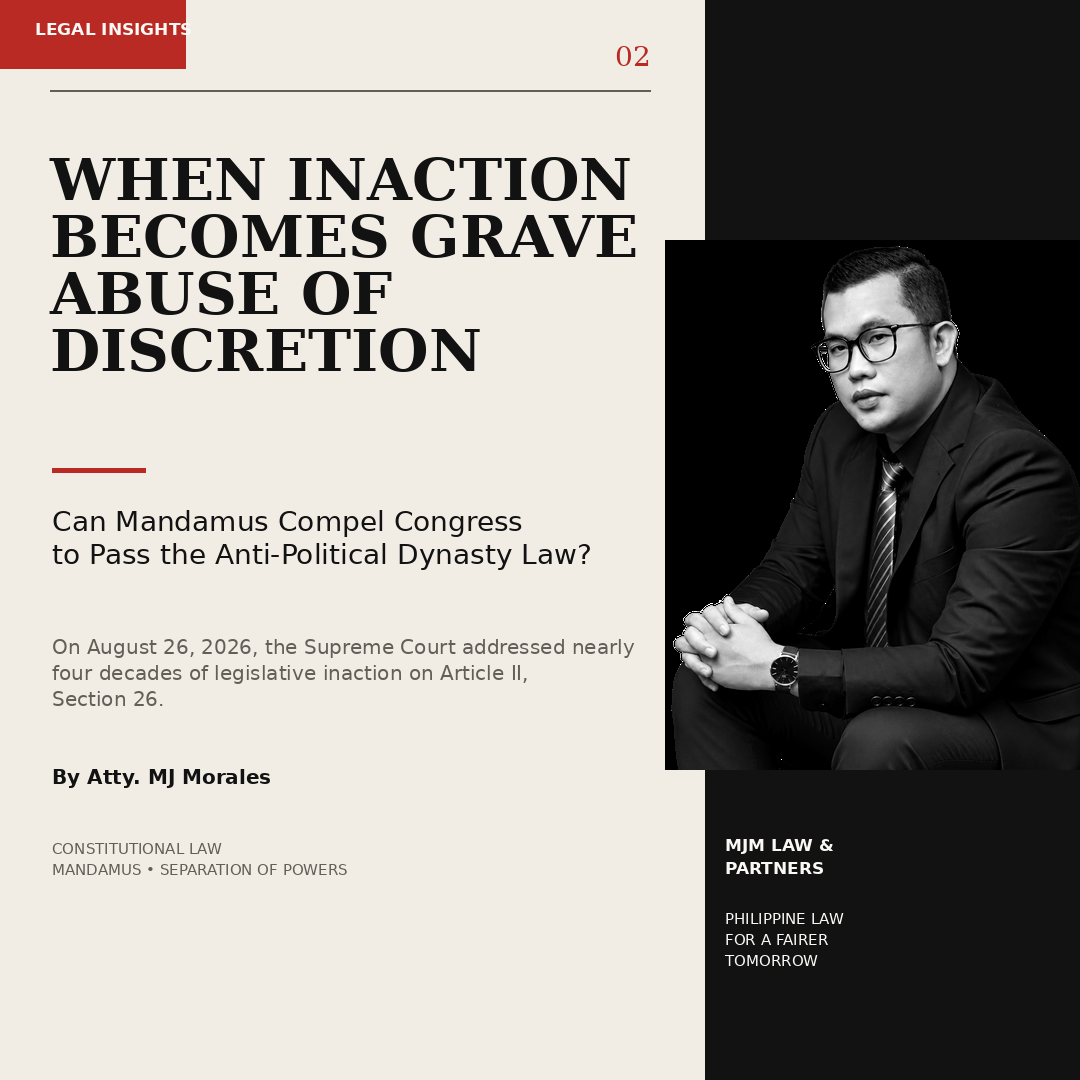
When Inaction Becomes Grave Abuse of Discretion: Can Mandamus Compel Congress to Pass the Anti-Political Dynasty Law?
The article examines whether the Supreme Court may compel Congress through mandamus to fulfill Article II, Section 26 of the 1987 Constitution, which directs the State to prohibit political dynasties “as may be defined by law.” Its central argument is that the Constitution imposes a mandatory duty on Congress to enact the necessary anti-political dynasty law, while Congress retains discretion over the law’s specific content, scope, and enforcement mechanisms. The article weighs this position against the separation of powers concern that legislation is inherently deliberative and discretionary, and therefore may not be a proper subject of mandamus. It ultimately frames the 2026 ruling as part of a broader constitutional question: whether prolonged governmental inaction can itself constitute grave abuse of discretion, while still preserving the Judiciary’s duty to enforce the Constitution without assuming Congress’ legislative function.
Read More