Strategic Planning & Business Model Innovation

Introduction
In an age of rapid disruption, resting on yesterday’s business model can be a recipe for obsolescence. Strategic planning and business model innovation empower organizations to look beyond incremental improvements and reimagine how they create, deliver, and capture value.
Why Strategic Planning Matters
Strategic planning is not just an annual exercise in number‑crunching. It involves:
1. Environmental Scanning – Monitoring market trends, emerging technologies, and competitive moves.
2. Vision & Objectives – Defining where you want to be in 3–5 years and the milestones on the path there.
3. Resource Alignment – Ensuring people, capital, and technology are deployed to highest‑value initiatives.
Business Model Innovation Defined
Business model innovation goes deeper than product R&D. It asks:
- Can we deliver our core value in a new format? (e.g., product‑as‑a‑service)
- Are there untapped customer segments?
- Could partnerships or platform models unlock network effects?
Case in Point
- A mid‑sized equipment supplier retooled from outright sales to a subscription‑based “equipment fleet management” service. This shift:
- Smoothed revenue volatility
- Increased customer lock‑in via integrated maintenance
- Opened data‑driven upsell channels
Five Steps to Innovate Your Model
1. Map Your Current Model: Revenue streams, cost structure, partners, channels.
2. Identify Pain Points & Gaps: Customer feedback, competitive benchmarking.
3. Brainstorm Alternatives: Lean canvas workshops; cross‑functional ideation.
4. Prototype & Test: Pilot new pricing, service bundles, or delivery channels on a small scale.
5. Scale & Refine: Roll out successful pilots; phase out underperformers.
Conclusion
Embedding strategic planning and model innovation into your operating rhythm transforms disruption from threat into opportunity. By continuously scanning your environment and experimenting with new value propositions, you’ll build a resilient business ready for whatever comes next.
Atty. Mark Joseph Morales, CPA, MBA, JD
Founder and Managing Partner, MJM Law & Partners
Full professional profileYou Might Also Like

“No Return, No Exchange”: When Can a Buyer Demand a Refund or Replacement?
A store policy cannot automatically defeat a consumer’s remedies for defective goods. This guide explains the distinction between a genuine defect and a change of mind, the repair and replacement framework under the Consumer Act, and the records and steps that help buyers pursue an appropriate remedy.
Read More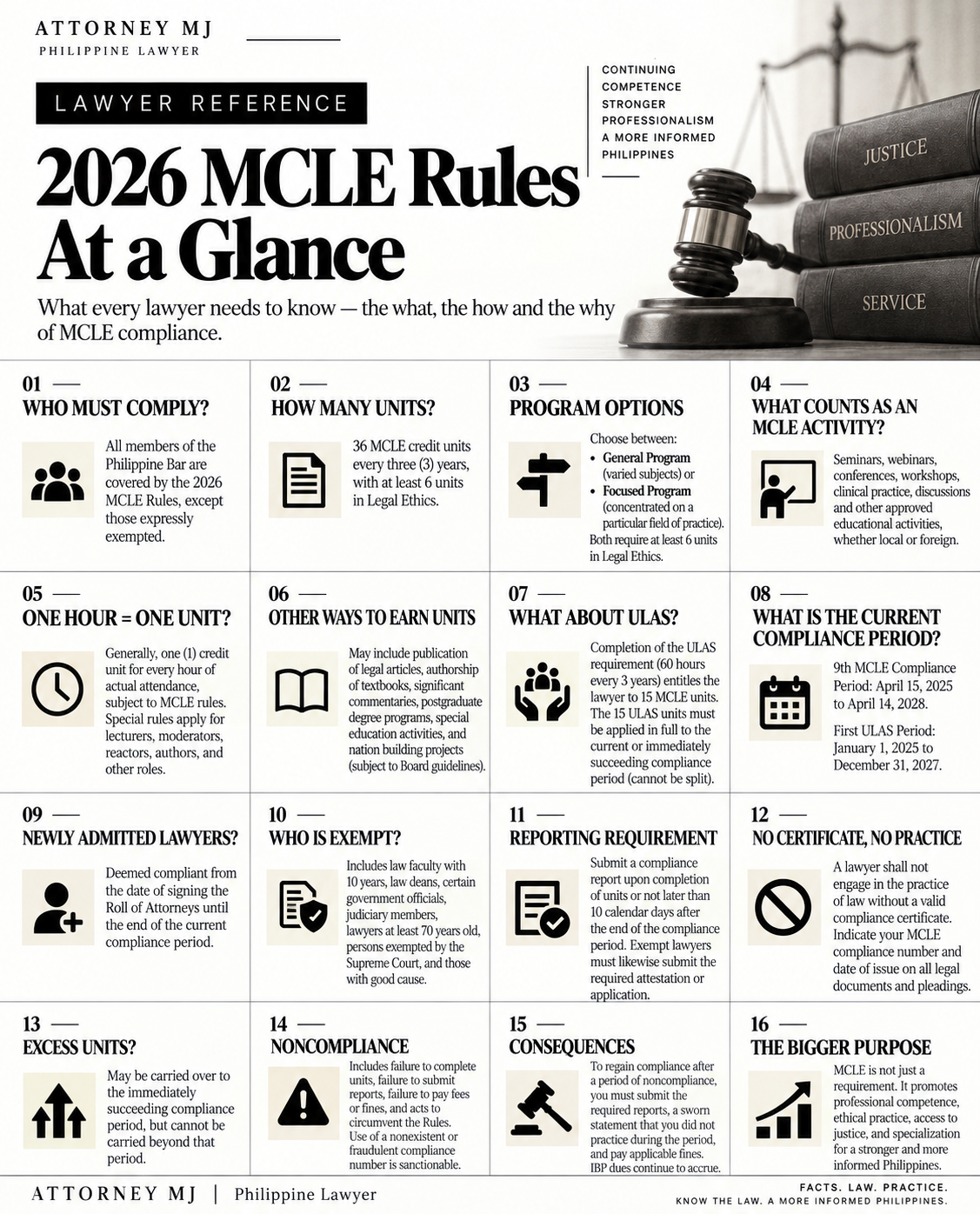
DEMYSTIFYING THE NEW 2026 RULES ON MANDATORY CONTINUING LEGAL EDUCATION
The 2026 Rules on Mandatory Continuing Legal Education introduce a more flexible and practice oriented framework for Philippine lawyers. While the core requirement remains 36 MCLE units every three years, including at least 6 units in Legal Ethics, lawyers may now choose between a General Program and a Focused Program. The Rules also recognize broader educational activities, provide for possible MCLE credit from ULAS, postgraduate studies, legal publications and other qualifying activities, and establish a framework for legal specialization. More importantly, compliance is directly tied to the authority to practice law, making proper completion, documentation, reporting, and maintenance of a valid MCLE compliance certificate essential for every practicing lawyer.
Read More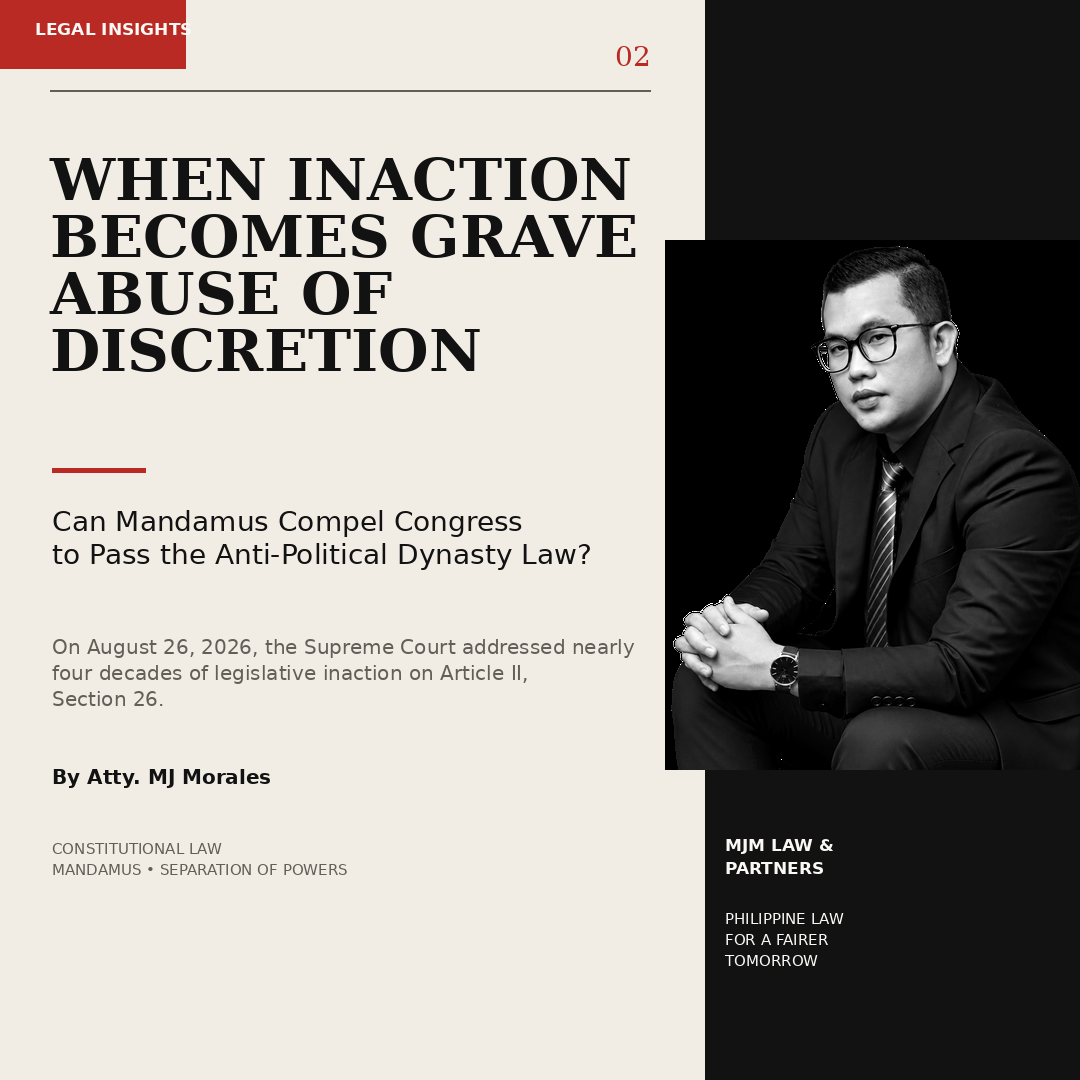
When Inaction Becomes Grave Abuse of Discretion: Can Mandamus Compel Congress to Pass the Anti-Political Dynasty Law?
The article examines whether the Supreme Court may compel Congress through mandamus to fulfill Article II, Section 26 of the 1987 Constitution, which directs the State to prohibit political dynasties “as may be defined by law.” Its central argument is that the Constitution imposes a mandatory duty on Congress to enact the necessary anti-political dynasty law, while Congress retains discretion over the law’s specific content, scope, and enforcement mechanisms. The article weighs this position against the separation of powers concern that legislation is inherently deliberative and discretionary, and therefore may not be a proper subject of mandamus. It ultimately frames the 2026 ruling as part of a broader constitutional question: whether prolonged governmental inaction can itself constitute grave abuse of discretion, while still preserving the Judiciary’s duty to enforce the Constitution without assuming Congress’ legislative function.
Read More