Bail Amount for Attempted Rape and RA 7610 in the Philippines: A Legal Guide
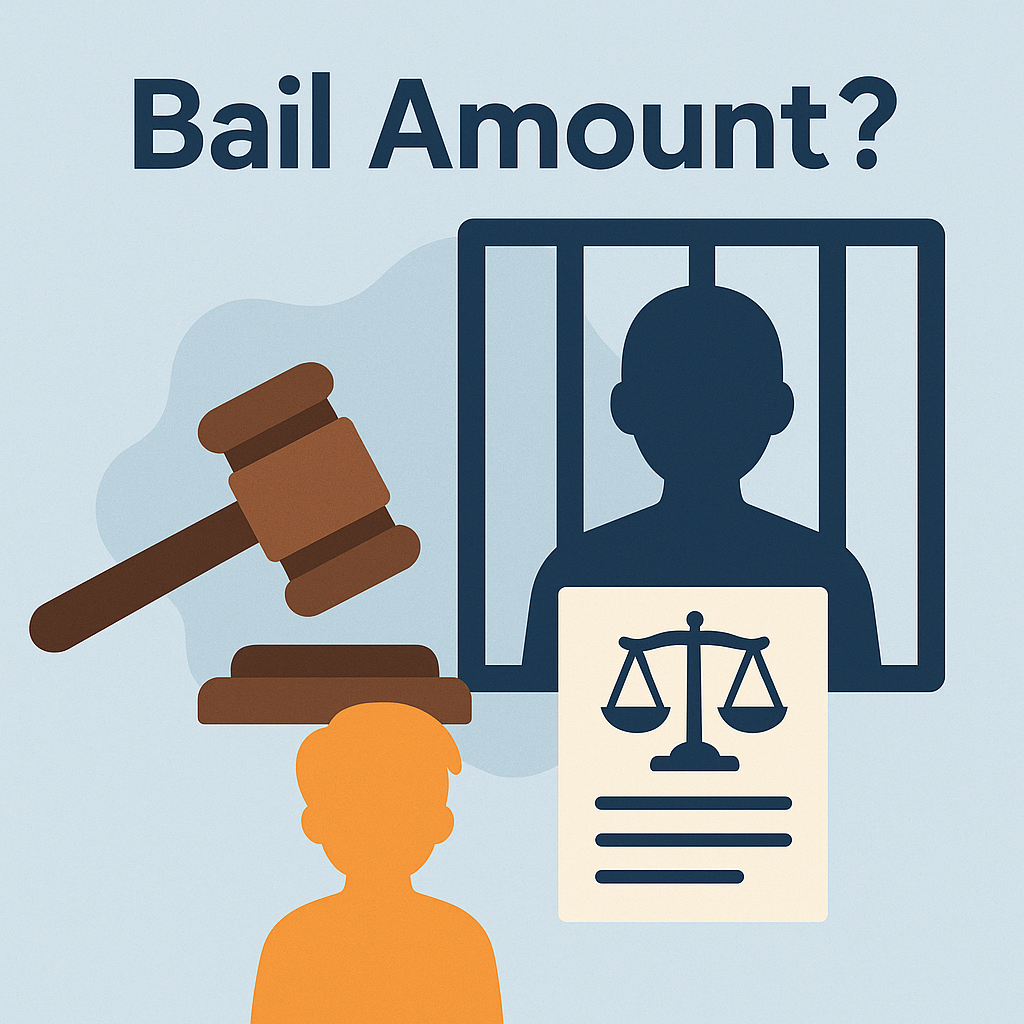
Understanding your rights and responsibilities—whether as a complainant or the accused—is vital. Always consult a qualified Philippine lawyer when dealing with serious criminal allegations involving children.
Attempted Rape Under the Revised Penal Code
Legal Definition
Under Article 266-A of the Revised Penal Code (RPC), rape is committed in several forms, including through force, threat, or intimidation. Attempted rape arises when the accused begins overt acts toward committing rape but fails to complete them due to outside intervention, not voluntary desistance.
Penalty
Attempted rape is penalized two degrees lower than consummated rape. Where consummated rape is penalized with reclusion perpetua, attempted rape generally carries the penalty of prisión mayor (6 years and 1 day to 12 years), subject to modification based on circumstances.
R.A. 7610 and its Relationship to Attempted Rape
Scope and Coverage
RA 7610 protects minors (under 18) from abuse and sexual exploitation. It criminalizes both completed and attempted sexual acts against minors, even absent actual penetration.
Additional Liability
When the victim is a child, the accused may face charges under both the RPC (for attempted rape) and RA 7610 (for child abuse or lascivious conduct). Courts often treat these cases more severely due to the vulnerability of the victim.
Bail in the Philippine Legal System
Constitutional Right
The 1987 Constitution, Article III, Section 13, guarantees the right to bail, except for offenses punishable by reclusion perpetua or life imprisonment, when the evidence of guilt is strong.
Rule 114, Rules of Court
Bail is a matter of right in cases not punishable by reclusion perpetua. Attempted rape, carrying a lighter penalty, is generally bailable. Courts follow DOJ or Supreme Court bail bond guides but retain judicial discretion.
Recommended Bail Amounts
Attempted Rape
The recommended bail for attempted rape generally ranges from PHP 120,000 to PHP 200,000, depending on the presence of aggravating factors.
Aggravating Factors under R.A. 7610
When the victim is a minor, especially under 12 or 16 years old, and the act involves force or threat, the court may:
- Require a higher bail than the schedule suggests
- Order a bail hearing, especially if there’s overlap with other serious offenses
Key Considerations for Judges
- Age of the victim
- Criminal record of the accused
- Use of threat or force
- Probability of flight
- Financial capacity of the accused
Dual Prosecution and Penalties
Filing of Charges
Prosecutors may file charges for both attempted rape (RPC) and child abuse (RA 7610). Courts will assess if each statute punishes different elements.
No Double Jeopardy
Charging under both laws does not violate double jeopardy when distinct legal elements are alleged and proven.
Sentencing
If convicted under both laws, the court may order the penalties served successively, depending on the judgment.
Practical Reminders
Seek Legal Counsel Immediately: Whether you are the complainant or accused, legal guidance is essential.
Court Attendance: Posting bail requires you to appear at all court hearings.
Coordinate with Authorities: In RA 7610 cases, involve social workers and child protection units for proper handling.
Attempted rape is generally a bailable offense, but if the victim is a child, RA 7610 may elevate the seriousness and increase bail amounts. Courts are empowered to exercise discretion based on the facts, the gravity of the offense, and the protection of the child. The recommended bail range (PHP 120,000–PHP 200,000) may be adjusted in light of these concerns.
Understanding your rights and responsibilities, whether as a complainant or the accused, is vital. Always consult a qualified Philippine lawyer when dealing with serious criminal allegations involving children.
Atty. Mark Joseph Morales, CPA, MBA, JD
Founder and Managing Partner, MJM Law & Partners
Full professional profileYou Might Also Like

“No Return, No Exchange”: When Can a Buyer Demand a Refund or Replacement?
A store policy cannot automatically defeat a consumer’s remedies for defective goods. This guide explains the distinction between a genuine defect and a change of mind, the repair and replacement framework under the Consumer Act, and the records and steps that help buyers pursue an appropriate remedy.
Read More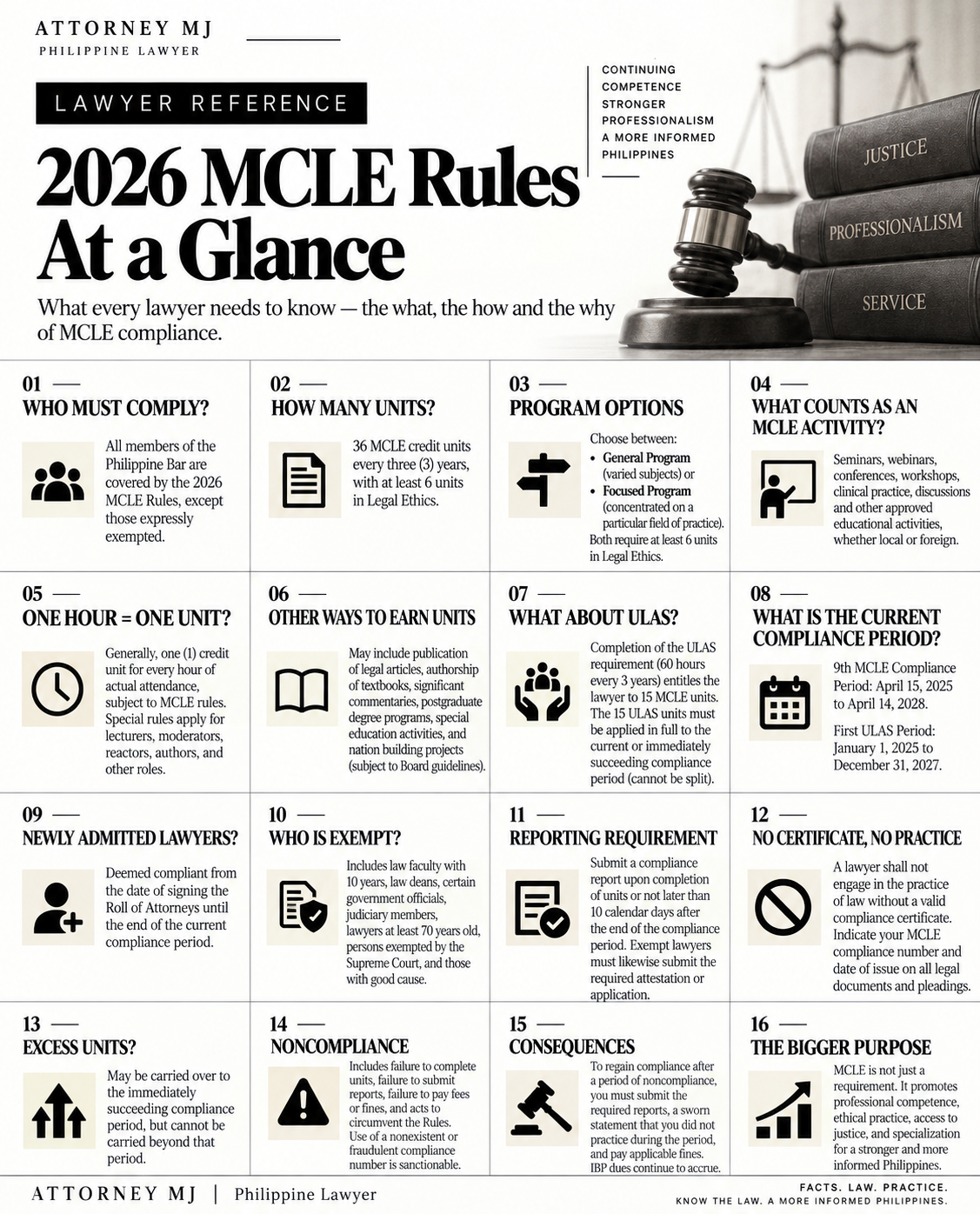
DEMYSTIFYING THE NEW 2026 RULES ON MANDATORY CONTINUING LEGAL EDUCATION
The 2026 Rules on Mandatory Continuing Legal Education introduce a more flexible and practice oriented framework for Philippine lawyers. While the core requirement remains 36 MCLE units every three years, including at least 6 units in Legal Ethics, lawyers may now choose between a General Program and a Focused Program. The Rules also recognize broader educational activities, provide for possible MCLE credit from ULAS, postgraduate studies, legal publications and other qualifying activities, and establish a framework for legal specialization. More importantly, compliance is directly tied to the authority to practice law, making proper completion, documentation, reporting, and maintenance of a valid MCLE compliance certificate essential for every practicing lawyer.
Read More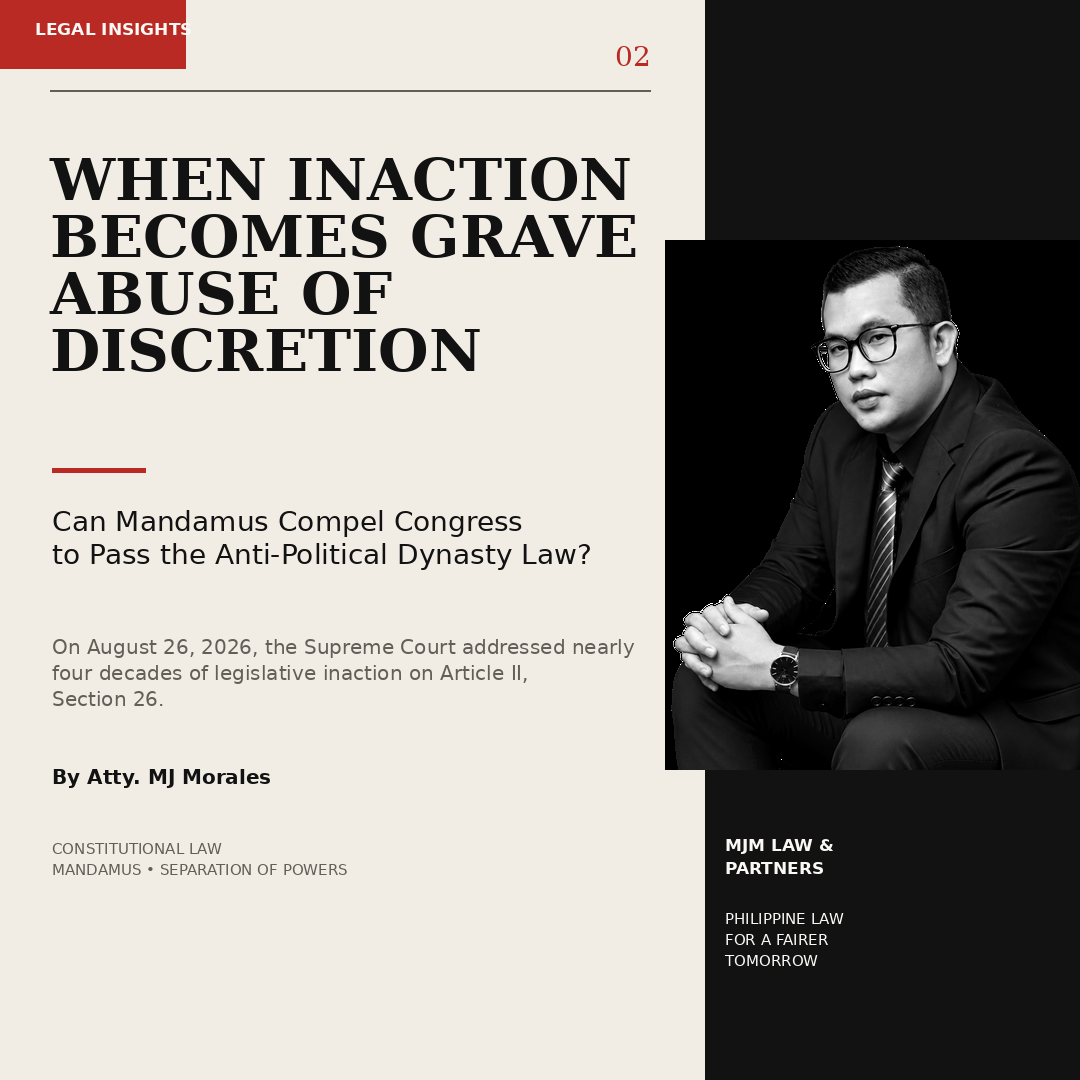
When Inaction Becomes Grave Abuse of Discretion: Can Mandamus Compel Congress to Pass the Anti-Political Dynasty Law?
The article examines whether the Supreme Court may compel Congress through mandamus to fulfill Article II, Section 26 of the 1987 Constitution, which directs the State to prohibit political dynasties “as may be defined by law.” Its central argument is that the Constitution imposes a mandatory duty on Congress to enact the necessary anti-political dynasty law, while Congress retains discretion over the law’s specific content, scope, and enforcement mechanisms. The article weighs this position against the separation of powers concern that legislation is inherently deliberative and discretionary, and therefore may not be a proper subject of mandamus. It ultimately frames the 2026 ruling as part of a broader constitutional question: whether prolonged governmental inaction can itself constitute grave abuse of discretion, while still preserving the Judiciary’s duty to enforce the Constitution without assuming Congress’ legislative function.
Read More