DEMYSTIFYING THE NEW 2026 RULES ON MANDATORY CONTINUING LEGAL EDUCATION
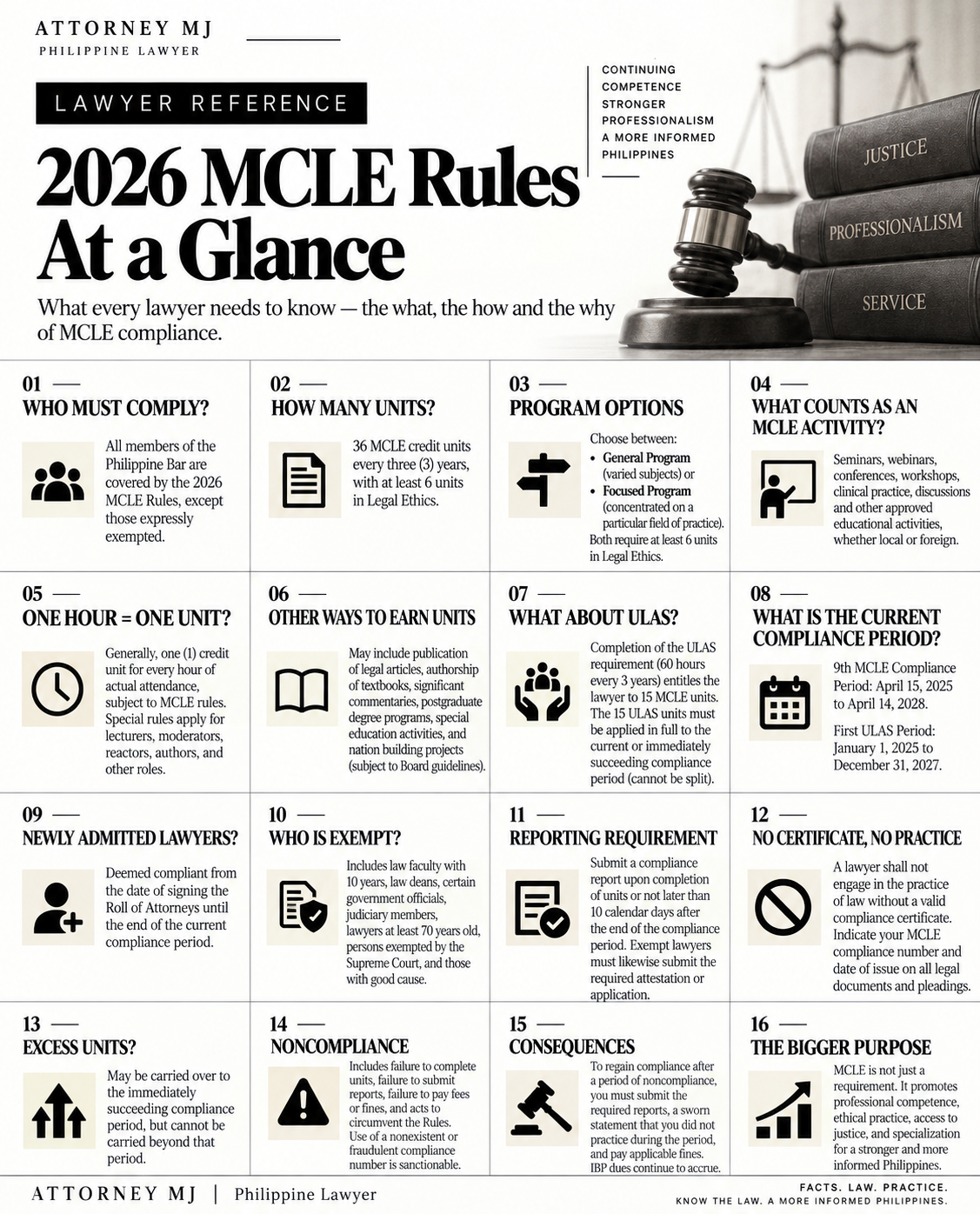
The Supreme Court's 2026 Rules on Mandatory Continuing Legal Education, B.M. No. 850, April 22, 2026, substantially reorganize the framework governing continuing legal education for Philippine lawyers.
At first glance, the change may appear modest because the familiar 36 unit requirement every three years remains. But the structure underneath that requirement has changed. The new Rules give lawyers greater flexibility in choosing what they study, formally recognize focused continuing legal education and legal specialization, broaden the activities that may generate MCLE credit, strengthen the role of technology and accessibility, and impose significant compliance responsibilities on both lawyers and MCLE providers.
More importantly, MCLE compliance is not merely a matter of collecting seminar certificates. The Rules expressly provide that a lawyer may not engage in the practice of law without a valid compliance certificate, and they require the compliance number and date of issue to appear on legal documents and pleadings.
For lawyers trying to understand the new system, the essential questions are therefore:
What exactly must I complete?
How do I earn the required units?
What activities count?
What exemptions are available?
How does ULAS interact with MCLE?
What happens if I fail to comply?
And, most importantly, what should I be doing now?
This article breaks down the 2026 Rules from that practical perspective.
I. The legal basis and purpose of the new Rules
The Supreme Court adopted the 2026 Rules in B.M. No. 850 on April 22, 2026. The Rules were developed against the backdrop of the Supreme Court's Strategic Plan for Judicial Innovations 2022 to 2027, which emphasizes judicial innovation, technological advancement, accessibility, professionalism, ethical practice, continuing education and specialization.
The Rules expressly identify several objectives:
- updating lawyers on developments in law;
- cultivating conscientious legal service and administration of justice;
- promoting continuous improvement and modernization of the Philippine legal system;
- promoting specialization in different fields of legal practice;
- aligning MCLE with public and private initiatives that promote effective, efficient and conscientious legal service;
- consolidating the rulings and practices of the MCLE Governing Board;
- building upon existing good practices; and
establishing sustainable and forward looking structures and policies.
The philosophy is therefore broader than "attend seminars because the Supreme Court requires it."
The underlying objective is continuing professional competence.
A lawyer is expected to keep learning because law itself changes, jurisprudence changes, technology changes, professional standards change, and the practice of law changes.
II. Who is covered?
The starting rule is simple:
The Rules apply to all members of the Philippine Bar.
The Rules then establish specific exemptions, which are discussed below.
Thus, the proper approach is not to ask, "Am I actively litigating?"
The proper question is:
"Am I a member of the Philippine Bar, and do I fall within an applicable exemption?"
This matters because MCLE is a continuing requirement attached to membership and the privilege to practice, rather than something limited only to litigators or lawyers appearing in court.
III. The basic requirement remains 36 MCLE units every three years
The 36 unit requirement has not disappeared.
The new Rules continue to require lawyers to complete a program consisting of 36 credit units during the applicable compliance period.
The important change is how those 36 units may be structured.
There are now two principal approaches:
General Program: 36 units from varied subjects and activities
Focused Program: 36 units concentrated on subjects within a particular field of legal practice
Both programs require at least 6 units of Legal Ethics.
So the numerical requirement remains: 36 units every three years
But the system is considerably more flexible.
IV. General Program versus Focused Program
A. General Program
The General Program allows a lawyer to acquire 36 units from varied subjects and activities.
This is essentially the traditional approach, but under a more flexible framework.
A lawyer who handles several kinds of work, for example, may find this approach more compatible with an evolving or multidisciplinary practice.
B. Focused Program
The Focused Program allows the lawyer to concentrate MCLE activities within a particular field of legal practice.
This is a major conceptual change.
Under the old system, lawyers were largely expected to collect units across prescribed categories. Under the new framework, MCLE can be deliberately aligned with a lawyer's professional practice.
The new approach therefore allows a lawyer to think of MCLE as professional development rather than merely regulatory compliance.
A lawyer developing a practice in a particular field can structure continuing education around that field, while still satisfying the mandatory 6 unit Legal Ethics component.
The Rules separately establish a framework for legal specialization credentialing, which means focused MCLE should be understood as part of a broader movement toward specialization, although completing a focused MCLE program does not by itself mean that the lawyer has obtained a formal specialty credential.
V. Legal Ethics remains mandatory
Whatever program you choose, at least 6 of the 36 units must be in Legal Ethics.
This is significant.
A lawyer cannot satisfy all 36 units simply by attending substantive law seminars.
The continuing professional responsibility component remains an express requirement.
In practical terms:
36 total MCLE units
At least 6 Legal Ethics units
Up to 30 additional units in other permissible areas
The 6 unit requirement is a floor, not a ceiling. A lawyer may take more than 6 ethics units.
VI. What counts as an MCLE activity?
The new Rules use a broad concept of "activity."
An activity may include lectures, discussions, seminars, workshops, clinical practice and other educational experiences designed to provide lawyers opportunities to acquire knowledge, skills and competencies relevant to the practice of law.
The Rules also recognize "special education activities," including seminars, webinars, conferences, conventions, symposia, in house education programs, workshops, dialogues, roundtable discussions, certificate courses, summer programs, short courses and similar legal education activities, whether conducted locally or abroad.
The result is a much broader conception of continuing legal education.
VII. One hour generally means one MCLE unit
The basic crediting rule is straightforward: One credit unit for every hour of actual attendance.
The attendance must be documented and submitted in accordance with MCLE procedures.
There are special rules for lecturers, reactors, commentators, moderators, coordinators, facilitators, resource persons, authors and other participants who perform roles beyond ordinary attendance.
The precise crediting rules for those activities may be governed by implementing regulations.
This is an important distinction. Lawyers should not automatically assume that every hour spent speaking or writing results in one hour of MCLE credit.
VIII. The new Rules recognize activities beyond seminars
One of the most interesting changes is the express recognition of activities other than ordinary lectures and seminars.
These may include:
- significant legal articles;
- Textbooks;
- significant legal commentaries;
- postgraduate degree programs;
- special education activities; and
- nation building projects.
This opens the door to a much more professional-development-oriented MCLE system.
For example, a lawyer who is pursuing postgraduate legal education or publishing substantive legal material may potentially receive MCLE credit for those activities, subject to the applicable standards.
The important qualification is that the 2026 Rules do not themselves provide every detailed crediting formula for these activities. The MCLE Governing Board is authorized to establish implementing regulations.
Therefore, a lawyer should not assume that completing an LL.M., writing an article or publishing a textbook automatically generates a specific number of units until the applicable implementing rules establish the credit.
IX. ULAS can generate 15 MCLE units
This is one of the most important developments lawyers should understand.
The Unified Legal Aid Service, or ULAS, operates separately from MCLE, but the two systems are deliberately connected.
The ULAS Rules require covered lawyers to render at least 60 hours of pro bono legal aid services during a three year compliance period. The Supreme Court's ULAS materials state that completion of the 60 hour minimum entitles the lawyer to 15 MCLE credit units.
The first ULAS compliance period is: January 1, 2025 to December 31, 2027.
The Supreme Court specifically designed this period to synchronize with the ninth MCLE compliance period so that full ULAS compliance can be credited as 15 MCLE units.
Under the 2026 MCLE Rules, ULAS credits are subject to an important limitation:
The 15 ULAS units must be applied in full either to the current MCLE compliance period or to the immediately succeeding compliance period.
They cannot be divided between two MCLE compliance periods.
Is there a "4 hours = 1 MCLE unit" rule?
Not as a standalone MCLE conversion rule.
The ULAS system requires 60 hours, and completion of the minimum entitles the lawyer to 15 MCLE units. That produces a mathematical equivalent of four ULAS hours per MCLE unit, but lawyers should not assume that 4 hours of ULAS service automatically generates 1 MCLE unit on a prorated basis.
The better way to understand the rule is: Complete the applicable ULAS requirement, then receive the corresponding 15 MCLE units.
The ULAS Manual also provides that lawyers issued Certificates of Exclusion under the ULAS framework may receive the 15 MCLE units for the corresponding period, subject to the applicable ULAS rules.
Is 60 hours of ULAS service really mandatory?
For a lawyer covered by ULAS, yes. The general requirement is 60 hours every three years.
There are, however, mechanisms under ULAS allowing certain hours to be substituted through financial contribution, limited aggregation through registered organizations, and exclusions for specified lawyers. Those matters are governed by the ULAS Rules and Manual and should not be confused with MCLE itself.
In other words: MCLE and ULAS are separate obligations.
But: Proper ULAS compliance can produce 15 MCLE units.
That distinction is crucial.
X. The current MCLE compliance period
The MCLE compliance cycle continues on the established three year cycle beginning April 15, 2001.
Based on that cycle, the current period is the ninth compliance period: April 15, 2025 to April 14, 2028.
Therefore, as of September 23, 2026, lawyers who are subject to the current cycle are presently within the ninth compliance period.
The next period will run: April 15, 2028 to April 14, 2031.
The ULAS cycle is different: January 1, 2025 to December 31, 2027.
The Supreme Court intentionally aligned the first ULAS cycle with the ninth MCLE period so that the 15 ULAS units can be credited toward MCLE.
XI. You do not have to earn the 36 units evenly every year
The 2026 Rules impose a 36 unit requirement for the compliance period. They do not state that a lawyer must complete exactly 12 units every year.
Thus, 12 units per year is a sensible planning target, but it is not itself the legal requirement.
A lawyer could theoretically complete more units in one year and fewer in another, provided the applicable rules concerning timing, validity, carryover and reporting are followed.
A practical approach, however, is to avoid waiting until the final months.
MCLE is much easier to manage when treated as a three year professional development plan.
XII. Excess units can be carried over
The Rules permit excess MCLE credit units to be carried over to the immediately succeeding compliance period.
But they cannot be carried indefinitely.
Therefore: Excess units may move forward one compliance period.
They are not a lifetime MCLE bank.
The ULAS 15 units have an even more specific rule, because those units must be applied in full to one compliance period and cannot be split.
XIII. Newly admitted lawyers receive special treatment
The 2026 Rules expressly provide that newly admitted lawyers are deemed compliant from the date they sign the Roll of Attorneys until the end of the current MCLE compliance period.
This is important because a newly admitted lawyer does not suddenly acquire a 36 unit MCLE burden immediately upon taking the oath.
The Rule effectively recognizes that the lawyer has just entered the profession.
However, MCLE treatment and ULAS treatment should be analyzed separately.
The ULAS Rules have their own exclusion for new lawyers admitted after the effectivity of the ULAS Rules with respect to the compliance period in which they were admitted.
Therefore: Newly admitted lawyer for MCLE purposes does not automatically mean the same answer for ULAS purposes.
Each regulatory framework must be examined separately.
XIV. Who is exempt from MCLE?
The exemptions under the 2026 Rules are considerably detailed.
They include:
- Certain law faculty, bar reviewers and supervising lawyers: Faculty members, bar reviewers, or supervising lawyers with 10 continuous academic years of teaching and/or supervisory experience under the Law Student Practice Rule in accredited law schools may qualify, provided the required 10 year period falls within the applicable compliance period and the other conditions are satisfied.
- Law deans: Law deans are exempt during their incumbency.
- Persons otherwise exempted by the Supreme Court: Persons expressly exempted through Supreme Court issuances may also qualify.
- Lawyers at least 70 years old: The Rules expressly recognize lawyers who are at least 70 years of age.
- Specified government officials: The Rules list a large number of governmental offices, including the President, Vice President, Senators, Members of the House of Representatives, Cabinet officials, Solicitor General, government counsel, Constitutional Commission officials, Ombudsman officials, heads of quasi judicial agencies, Governors, Mayors, members of the Judicial and Bar Council and members of the MCLE Governing Board, among others.
They also cover specified lawyers in the judiciary, courts and tribunals.
There are conditions relating to prior MCLE compliance and maintaining current knowledge of law and jurisprudence. Thus, an exemption should not simply be interpreted as "I no longer need to keep myself updated."
- Incumbent and retired members of the Judiciary: The Rules expressly exempt incumbent and retired members of the Judiciary, subject to the specific language of the Rule.
- Lawyers with good cause: A lawyer may also seek exemption by establishing good cause through a verified request.
This is important for situations that do not fall neatly within the enumerated categorical exemptions.
XV. An exemption is not automatically permanent
The Rules require an exempt lawyer to notify the MCLE Office within 15 calendar days when the basis of exemption ceases.
Compliance then resumes beginning on the first day of the month following cessation of the exemption.
The remaining requirement is prorated based on the months remaining in the compliance period.
For planning purposes, lawyers should therefore track the beginning and end of an exemption just as carefully as they track their compliance certificate.
XVI. Compliance is more than attending seminars
This is one of the biggest practical lessons from the new Rules.
A lawyer has several compliance obligations.
First, complete the units.
You must complete the required MCLE units within the applicable period.
Second, keep the records.
You need documentary evidence of the activities and credits.
Third, submit the compliance report.
The Rules require lawyers to submit a compliance report upon completion of the required units, or not later than 10 calendar days after the end of the compliance period.
Fourth, obtain a valid compliance certificate.
The MCLE Office issues the compliance certificate after verification of the relevant compliance documentation.
Fifth, use the correct compliance number.
Your compliance number and date of issue must be properly reflected on legal documents as required by the Rules.
XVII. Your MCLE compliance number is now a document control issue
The new Rules require the lawyer to inscribe the compliance number and date of issue below the lawyer's full name in legal documents.
This means MCLE compliance is no longer something that exists solely between the lawyer and the MCLE Office.
It becomes visible in the lawyer's professional documentation.
For litigation lawyers, this has an immediate impact.
The written entry of appearance must contain the required MCLE information in the signature block.
Pleadings filed with courts and quasi judicial bodies must likewise contain the required information.
After the previous certificate expires, the lawyer must file a manifestation informing the court or quasi judicial body of the new compliance number and date of issue.
For law firms, this means MCLE information should be incorporated into document templates rather than manually remembered by individual lawyers.
XVIII. Do not use a nonexistent or fraudulent MCLE number
The Rules expressly provide that use of a nonexistent or fraudulent compliance number is sanctionable.
Failure to properly indicate the compliance number may likewise result in sanctions.
This is why law offices should treat MCLE information like other professional credentials.
A wrong MCLE number on a pleading is not merely an embarrassing clerical mistake if it results in a false certification or representation.
XIX. What constitutes MCLE noncompliance?
The Rules identify several forms of noncompliance.
They include:
1. failure to complete the required MCLE units before expiration of the compliance certificate;
2. failure to submit compliance reports and supporting documents;
3. failure to settle applicable fees or fines; and
4. other acts or omissions designed to circumvent or evade compliance.
This is a useful reminder that compliance consists of both substance and procedure.
You could attend sufficient educational activities but still have a compliance problem if you fail to properly document or report those activities.
XX. MCLE noncompliance has consequences beyond the MCLE Office
The Rules provide that failure to comply with MCLE does not stop the accrual of IBP membership dues.
More importantly, the Rules expressly state: No lawyer shall engage in the practice of law without a valid compliance certificate.
This makes MCLE compliance part of the lawyer's professional authorization framework.
It is therefore dangerous to think of the noncompliance fee simply as a "late payment."
The regulatory framework is much more serious.
XXI. What happens if a lawyer becomes noncompliant?
When a lawyer seeks to recover compliance after a period of noncompliance, the Rules contemplate submission of:
- the required compliance reports and supporting documents;
- a sworn statement that the lawyer refrained from practicing law during the period of
- noncompliance, together with an explanation of the circumstances; and
- proof of payment of applicable fines and fees or other requirements prescribed by the Board.
That sworn statement is particularly important.
The Rules do not simply say:
"Pay the deficiency and continue practicing."
Instead, the lawyer is required to account for the noncompliant period.
If subsequent proceedings establish that the lawyer actually practiced law despite making the sworn declaration that no practice occurred, the contradiction may itself become a disciplinary problem under the MCLE framework and the Code of Professional Responsibility and Accountability.
This is one of the provisions lawyers should take most seriously.
XXII. The new Rules move toward legal specialization
A major structural feature of the new framework is the creation of a formal architecture for legal specialization.
The Rules establish credentialing for lawyers who demonstrate expertise in a specified field of law.
A Committee on Legal Specialization is tasked with helping develop standards concerning:
- specialized MCLE programs;
- legal certification;
- specialty credentialing;
- subject offerings;
- evaluation standards; and
- certification programs offered by accredited legal organizations.
This represents a shift in philosophy.
The question is no longer merely: "How many seminars did I attend?"
It increasingly becomes: "What kind of lawyer am I becoming?"
A focused MCLE program may therefore become an important component of a lawyer's long term professional identity.
XXIII. MCLE is becoming interdisciplinary
The new Rules expressly recognize nonlawyer resource persons.
A resource person may provide specialized knowledge outside traditional legal education, including areas such as medicine, technology and other fields requiring interdisciplinary expertise.
However, the nonlawyer resource person must operate under the direct supervision of an accredited lecturer, who supplies the necessary legal context and retains responsibility for the overall delivery and integrity of the activity.
This is highly relevant to modern legal practice.
A lawyer handling technology law, cybersecurity, AI, tax, accounting, intellectual property, medicine or forensic issues cannot realistically obtain all relevant knowledge from lawyers alone.
The MCLE system now expressly accommodates that reality.
XXIV. Technology is part of the new MCLE architecture
The Rules require providers to use effective delivery methods appropriate to the course, subject matter and learning styles of participants.
They also recognize accessibility through technology and reasonable accommodation for lawyers regardless of location or disability.
This provides formal support for online and technology assisted legal education.
For lawyers who work remotely, practice outside Metro Manila, or work across jurisdictions, this is particularly significant.
XXV. What should lawyers know about MCLE providers?
Lawyers are not the only regulated participants.
The new Rules establish detailed requirements for providers, lecturers, resource persons and monitors.
A general provider generally needs a track record of legal education activities and must maintain qualified lecturers, records, evaluation systems and appropriate resources.
There are also limited and specialized providers.
Providers must maintain accurate records, including attendance, course outlines and evaluations, generally for at least five years, and must submit required reports to the MCLE Office.
A lawyer attending an activity should therefore develop the habit of checking not only whether the event is advertised as MCLE, but whether the activity and provider have the required approval or accreditation.
XXVI. MCLE activities must be approved before they are conducted
The Rules require applications for activity approval to be submitted at least 45 calendar days before the scheduled activity.
This is relevant to lawyers who organize:
- bar associations;
- law firm education programs;
- legal conferences;
- certificate courses;
- professional training; or
- specialized legal programs.
One should not assume that an educational activity becomes MCLE simply because it is legally relevant.
It must satisfy the accreditation system.
XXVII. Lecturers have qualification requirements
An accredited lecturer must be:
- a member in good standing of the Philippine Bar;
- MCLE compliant;
- engaged in at least five years of legal practice; and
- demonstrably knowledgeable in the subject through teaching, publications, books or other scholarly work.
This is an important quality control mechanism.
Not every lawyer who happens to be familiar with a topic automatically qualifies as an accredited MCLE lecturer.
XXVIII. The MCLE system is backed by sanctions
The Rules provide a range of sanctions for providers and lecturers, including:
- warning;
- forfeiture of security;
- fine;
- suspension of accreditation or approval;
- revocation;
- perpetual ban; and
- other penalties approved by the Supreme Court.
For lawyers, the Rules provide for fines and other sanctions approved by the Supreme Court.
Violations may also be referred for appropriate disciplinary action under existing laws, rules and issuances.
Thus, the MCLE system is not merely an administrative database.
It is an enforceable component of professional regulation.
XXIX. The MCLE Governing Board has substantial regulatory authority
The MCLE Governing Board is empowered to:
- implement the Rules;
- issue implementing regulations, subject to Supreme Court approval;
- manage the MCLE Fund;
- prescribe fees and penalties, subject to Court approval;
- act on requests to update compliance status;
- recommend sanctions;
- approve or deny provider accreditation;
- approve or deny exemptions;
- approve activities;
- approve credentialing; and
- modify program requirements and activity criteria.
This is important because the 2026 Rules should be viewed as the governing framework, not necessarily the last word on every administrative detail.
Several matters remain subject to implementing regulations.
XXX. The practical significance of the implementing regulations
Lawyers should be careful not to treat every provision of the 2026 Rules as though it already supplies every operational detail.
The Supreme Court intentionally leaves various matters to the Board's implementing regulations.
These include matters concerning:
- precise crediting of nontraditional activities;
- accreditation procedures;
- lecturer and resource person treatment;
- fees;
- penalties;
- monitoring;
- exemption procedures;
- specialization; and
- other administrative requirements.
The Rules expressly authorize the Board to issue additional implementing regulations.
That means lawyers should monitor official MCLE Office issuances instead of relying exclusively on summaries, social media announcements or old MCLE FAQs.
XXXI. The 2026 Rules repeal the old MCLE framework
The new Rules expressly repeal the Revised Rules on Continuing Legal Education adopted in 2000 and amended in 2001.
Administrative circulars and issuances inconsistent with the new Rules are likewise amended or repealed.
This matters when reviewing older MCLE advice.
A document explaining the old allocation system should not automatically be treated as describing the current legal regime.
XXXII. What happened to the old subject allocation system?
This is one of the most visible changes.
Under the prior regime, lawyers were accustomed to seeing MCLE organized through prescribed subject categories and corresponding allocations.
The 2026 Rules shift the organizational concept toward:
General Program or Focused Program
while retaining the mandatory minimum of 6 Legal Ethics units.
This gives the lawyer greater freedom to design an educational program around actual professional needs.
The policy direction is clear: continuing legal education should become more useful to the lawyer's actual practice.
XXXIII. The Rules also recognize good compliance management
A lawyer should therefore maintain a personal MCLE compliance file.
At minimum, that file should contain:
- Current compliance period: Establishes your deadline
- Compliance certificate: Evidence of authority to practice
- Compliance number and date: Required for legal documents
- MCLE certificates: Evidence of credits
- Attendance records: Supports credit claims
- ULAS records: May support 15 MCLE units
- Exemption documents: Supports exempt status
- Compliance reports: Demonstrates procedural compliance
- Proof of fees/fines, if applicable: Supports clearance
- Copies of special activity documentation: Supports nontraditional credit claims
A lawyer should not wait until the end of the compliance period to discover that one seminar certificate was never issued or that an activity did not actually carry the number of units advertised.
XXXIV. A practical three year MCLE strategy
Although the Rules do not require equal annual completion, a practical lawyer can manage the ninth compliance period this way:
Target: approximately 12 units per year.
For the current cycle:
2025 to 2026, approximately 12 units
2026 to 2027, approximately 12 units
2027 to 2028, approximately 12 units
This is merely a planning strategy, not a statutory annual requirement.
A lawyer intending to claim 15 ULAS units should separately track ULAS compliance and avoid treating the 15 units as ordinary seminar credits.
A particularly efficient strategy is to integrate professional development with MCLE.
For example, instead of attending a random seminar solely to earn units, a lawyer might deliberately select:
Legal Ethics + core practice area + emerging issue + professional specialization
and build the 36 unit requirement around the lawyer's actual practice.
That is much closer to the philosophy of the new Rules.
XXXV. What should a litigation lawyer do?
A litigation lawyer should particularly focus on document compliance.
Update the standard:
- entry of appearance;
- pleadings;
- motions;
- manifestations;
- memoranda;
- signature blocks; and
- other lawyer signed court filings.
The compliance number and date must be correctly reflected as required by the Rules.
Law firms should also establish a central system for tracking each lawyer's compliance number and certificate validity rather than relying exclusively on individual lawyers.
XXXVI. What should a law firm do?
A law firm should consider MCLE a compliance function.
A basic internal MCLE policy can require:
- every lawyer to maintain a current MCLE tracker;
- copies of certificates to be submitted to a central administrative file;
- MCLE numbers to be updated in document templates when a new certificate is issued;
- monthly or quarterly monitoring of remaining units;
- verification of MCLE accreditation before lawyers enroll in programs;
- centralized monitoring of exemption periods; and
- separate tracking of ULAS hours.
For larger firms, the firm's HR or professional responsibility team can treat MCLE similarly to IBP dues, professional identification and other lawyer compliance requirements.
XXXVII. What should a lawyer do right now?
For the current ninth MCLE compliance period, the practical checklist is:
- What period am I in? April 15, 2025 to April 14, 2028
- How many MCLE units? 36
- Minimum Ethics units? 6
- Program choice? General or Focused
- Can ULAS count? Yes, 15 units upon applicable ULAS compliance
- Current ULAS period: January 1, 2025 to December 31, 2027
- Can excess MCLE be carried over? Yes, to the immediately succeeding period
- Can ULAS 15 units be split? No
- When should compliance be reported? Upon completion or within 10 calendar days after period end
- Can I practice without a valid certificate? No
- Must my MCLE number appear in legal documents? Yes, as required by the Rules
- What if I become exempt? Notify MCLE Office within 15 calendar days after cessation of exemption
- What if I become noncompliant? Compliance, reporting, fines and sworn requirements may follow
The Supreme Court's current ULAS materials confirm the 60 hour pro bono requirement and the first ULAS compliance period of 2025 to 2027.
XXXVIII. One provision lawyers should watch carefully
There is a wording issue in Rule 2 concerning the duration of the compliance certificate.
The Rules state that the compliance certificate is valid for the compliance period for which it is issued and also state that it shall remain effective until the end of the immediately succeeding compliance period. At the same time, lawyers must complete the required units before expiration of the validity of their certificates.
The operational implications of that language should be clarified through the implementing regulations or an official MCLE Office interpretation rather than resolved by assumption.
For purposes of practice management, the safe approach is to continue treating the designated compliance period and required 36 units as firm obligations, rather than interpreting the wording as allowing indefinite deferral.
XXXIX. The bigger picture: MCLE is becoming professional development
The most important way to understand the 2026 Rules is this:
The Supreme Court is moving away from MCLE as a purely numerical attendance requirement and toward continuing professional development.
The structure now recognizes:
general legal education,
focused practice based education,
legal ethics,
specialization,
interdisciplinary learning,
postgraduate education,
legal writing,
technology enabled education,
accessibility,
pro bono legal assistance through ULAS,
and more formal professional credentialing.
That is a significant philosophical change.
The 36 units are still mandatory, but the lawyer now has greater latitude to determine what professional development actually makes sense.
XL. Final takeaway
The 2026 Rules do not eliminate the familiar MCLE obligation.
They modernize it.
The core obligation remains:
36 MCLE units every three years, including at least 6 units of Legal Ethics.
But the lawyer now has greater flexibility through the General and Focused Programs, broader potential avenues for credit, formal recognition of specialization, recognition of technology and interdisciplinary education, and integration of ULAS into MCLE.
At the same time, the Rules make compliance more consequential.
A lawyer must not merely attend activities. The lawyer must document them, report them, maintain a valid compliance certificate, properly indicate the compliance information on legal documents and avoid practicing during a period of noncompliance.
For the present ninth MCLE cycle, the working timetable is:
MCLE: April 15, 2025 to April 14, 2028
ULAS: January 1, 2025 to December 31, 2027
MCLE requirement: 36 units
Legal Ethics: minimum 6 units
ULAS incentive: 15 MCLE units upon satisfaction of the applicable ULAS requirement.
The practical lesson for every practicing lawyer is simple: stop treating MCLE as something to fix at the end of the three year period. Build it into your professional calendar from the beginning.
The 2026 Rules were promulgated by the Supreme Court on April 22, 2026. The text itself provides that the Rules take effect 15 calendar days following publication in two newspapers of general circulation. The Supreme Court subsequently published the 2026 Rules on its website on September 15, 2026.
For lawyers, however, the more important point is what comes after the promulgation: the MCLE Governing Board's implementing regulations. Those regulations will determine many of the details concerning crediting, accreditation, specialized programs and administrative compliance.
The new MCLE system is therefore best understood not as another seminar requirement, but as a continuing professional responsibility system for the Philippine Bar.
Sources: B.M. No. 850, 2026 Rules on Mandatory Continuing Legal Education, April 22, 2026, particularly Rules 1 to 8. The Supreme Court's official ULAS materials and ULAS Rules Manual were also consulted for the interaction between ULAS and MCLE.
#MCLE2026 #MCLE #MandatoryContinuingLegalEducation #PhilippineLawyer #LawyersPH #PhilippineBar #LegalEducation #ContinuingLegalEducation #LegalPractice #LegalProfession #LawPractice #LawyersOfThePhilippines #BarMatter #LegalEthics #ULAS #UnifiedLegalAidService #LegalUpdates #LawUpdates #SupremeCourtPH #BM850 #LegalCompliance #LawyerCompliance #LegalProfessionalDevelopment #LegalSpecialization #FocusedMCLE #GeneralMCLE #KnowTheLaw #LawStudentsPH #BarReviewPH #LawyerLife #Attorney #PhilippineLaw #LegalKnowledge #LegalAwareness #LawAndPractice #MJCares #AttorneyMJ #LawyerReacts #FactsLawPractice
Atty. Mark Joseph Morales, CPA, MBA, JD
Founder and Managing Partner, MJM Law & Partners
Full professional profileYou Might Also Like
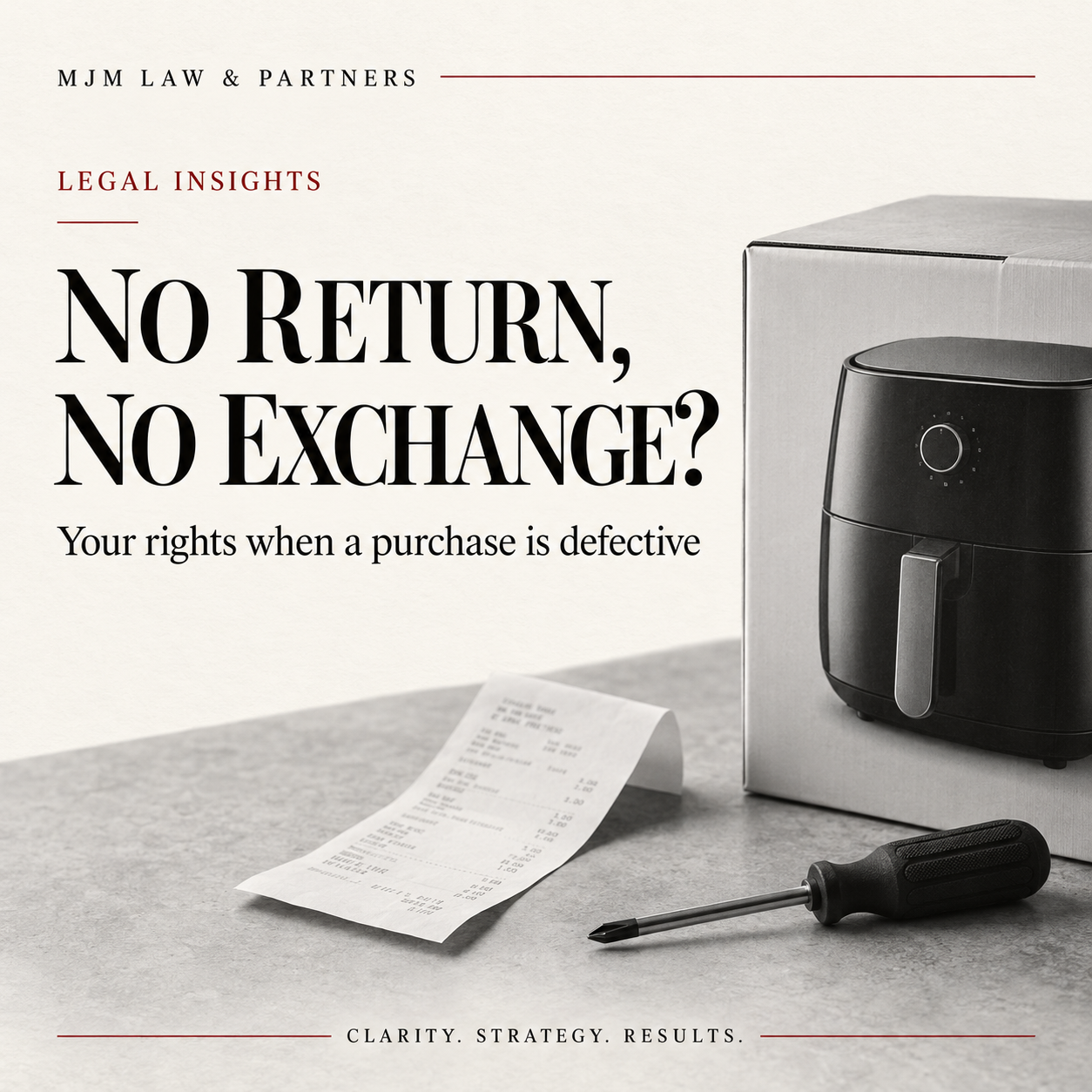
“No Return, No Exchange”: When Can a Buyer Demand a Refund or Replacement?
A store policy cannot automatically defeat a consumer’s remedies for defective goods. This guide explains the distinction between a genuine defect and a change of mind, the repair and replacement framework under the Consumer Act, and the records and steps that help buyers pursue an appropriate remedy.
Read More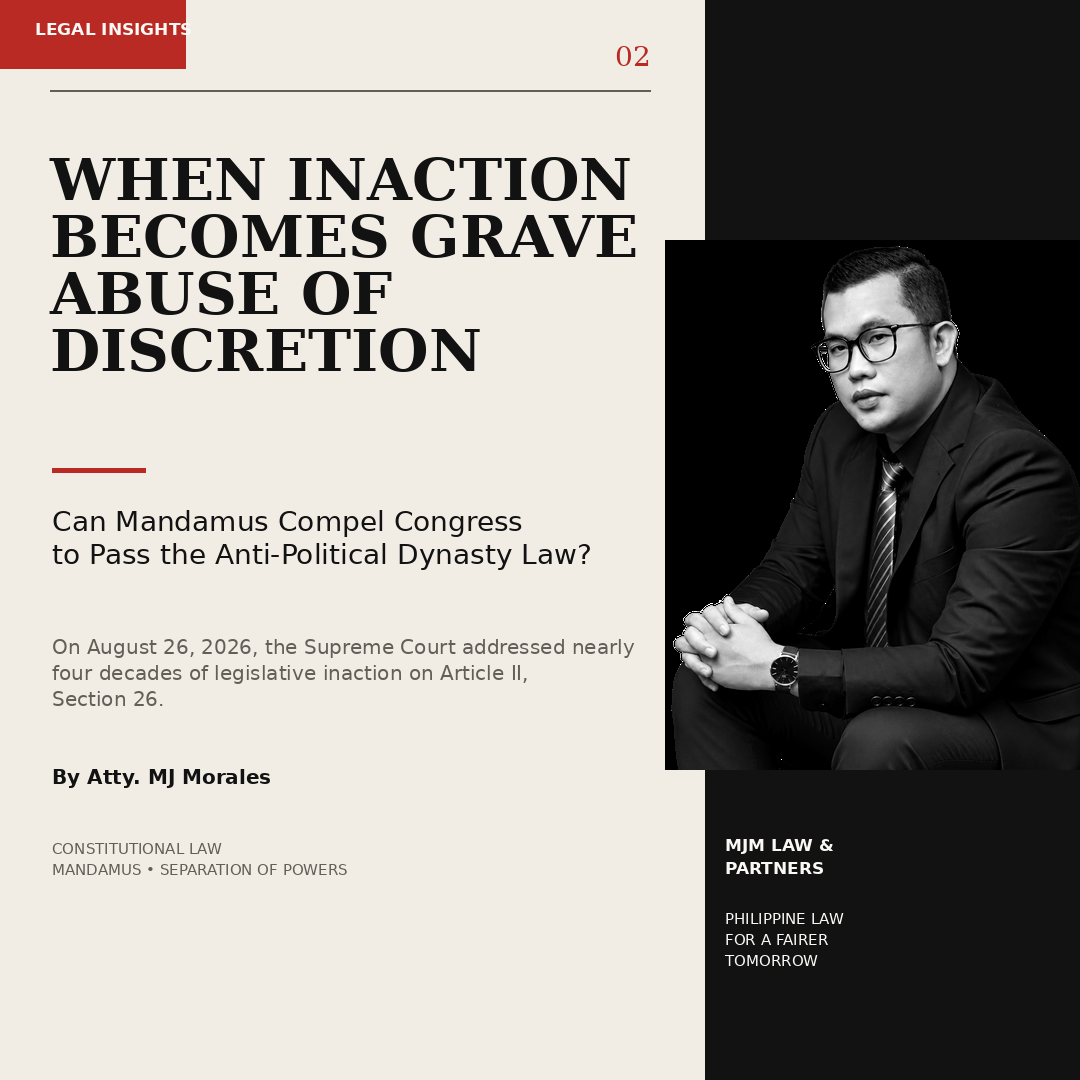
When Inaction Becomes Grave Abuse of Discretion: Can Mandamus Compel Congress to Pass the Anti-Political Dynasty Law?
The article examines whether the Supreme Court may compel Congress through mandamus to fulfill Article II, Section 26 of the 1987 Constitution, which directs the State to prohibit political dynasties “as may be defined by law.” Its central argument is that the Constitution imposes a mandatory duty on Congress to enact the necessary anti-political dynasty law, while Congress retains discretion over the law’s specific content, scope, and enforcement mechanisms. The article weighs this position against the separation of powers concern that legislation is inherently deliberative and discretionary, and therefore may not be a proper subject of mandamus. It ultimately frames the 2026 ruling as part of a broader constitutional question: whether prolonged governmental inaction can itself constitute grave abuse of discretion, while still preserving the Judiciary’s duty to enforce the Constitution without assuming Congress’ legislative function.
Read More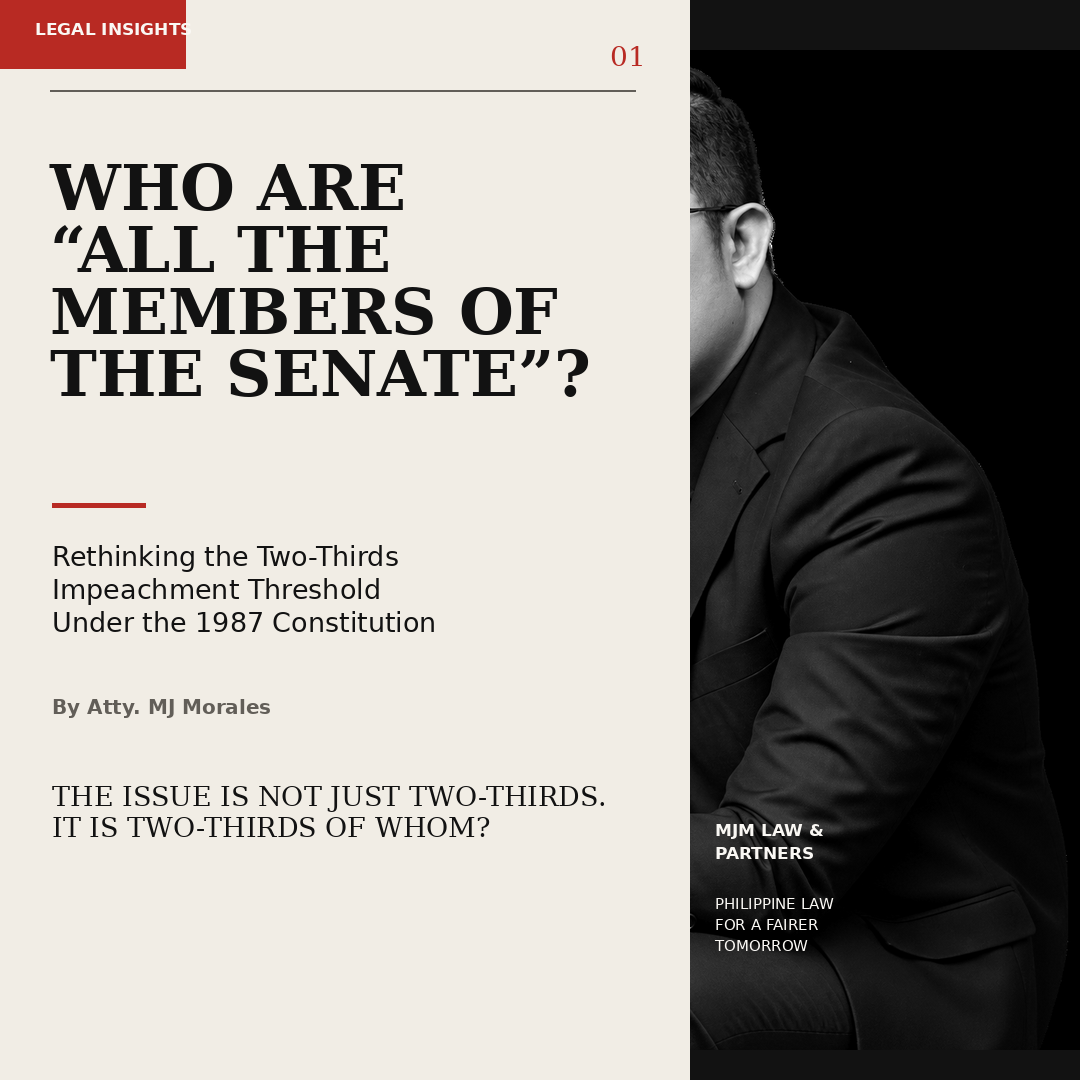
Who Are “All the Members of the Senate”?
The impeachment of a Vice-President presents a constitutional question that appears mathematical on its face but is, in reality, fundamentally a question of constitutional interpretation: What exactly does the Constitution mean when it requires “the concurrence of two-thirds of all the Members of the Senate” for a conviction in an impeachment case?
Read More