The Chain of Custody Rule: Ensuring the Integrity of Evidence

What is the Chain of Custody?
The chain of custody refers to the chronological documentation or paper trail showing the seizure, custody, control, transfer, analysis, and disposition of evidence from the moment it is discovered until its presentation in court.
Its purpose is to prevent tampering, loss, or substitution, and to maintain the evidentiary value and integrity of the item.
Each transfer of evidence—from collection at the scene, submission for analysis, and storage, to courtroom presentation—must be properly documented, noting the date, time, person responsible, and the circumstances of the transfer.
Legal Standards and Requirements
The rule is strictly applied in crimes like illegal drug and firearms cases because these items are fungible or easily swapped or tampered with, making them susceptible to police abuses such as "planting" evidence.
In the Philippines, Section 21 of R.A. No. 9165 (Comprehensive Dangerous Drugs Act of 2002) and its jurisprudence provide a clear structure for this process, but the principle applies to all physical evidence.
For evidence to be admissible, every custodian must testify (or be accounted for) that the evidence remained intact and untampered during its custody. If the chain is broken, doubts arise as to the authenticity and reliability of the evidence, making it inadmissible or reducing its probative value.
Steps in Maintaining the Chain
The typical steps required to maintain a valid chain of custody include:
Seizure and Marking: Immediately after seizure, the object is marked, labeled, and documented to distinguish it from other similar items. (e.g., drugs, firearms)
Inventory and Photography: Inventory and photography must be conducted at the place of seizure or the nearest police station, in the presence of the accused, their representative, an elected public official, and a representative from the prosecution or the media.
Transfer of Custody: Each transfer—from the apprehending officer to the investigating officer, then to the forensic chemist, evidence custodian, and up to presentation in court—must be logged, with the person receiving signing off and noting any changes in condition.
Storage and Security: Proper packaging with tamper-evident seals and secure storage further protect evidence.
Presentation in Court: Prosecutors must prove by testimony or records that the item shown in court is the same one originally seized—untainted, unaltered, or that deviations are explained and do not affect its integrity.
Practical and Jurisprudential Applications
If the prosecution fails to strictly follow chain-of-custody requirements, courts may acquit the accused due to reasonable doubt. This was seen in Benjamin Togado y Pailan v. People, where the Supreme Court reversed a conviction for illegal firearms possession because police failed to mark the firearm, and officers couldn’t confirm if the firearm presented was the same as the one seized. The Court ruled that actual presentation of the weapon was mandatory, and breaks in the chain of custody raised serious doubt.
In Ignacio Balicanta III v. People, the accused was acquitted after it was shown that the seized firearm was not properly inventoried or turned over for safekeeping, raising the possibility of substitution or tampering. The Supreme Court reiterated that evidence from unlawful search, or with a broken chain, is inadmissible.
Case law recognizes that chain of custody is even more critical when the object is non-unique or susceptible to alteration (drugs, gun parts, generic items). When the object is unique and resistant to change (e.g., a weapon with a serial number), testimony may suffice, but chain documentation is always preferred.
Exceptions and Saving Provisions
Courts may relax strict compliance where there are justified reasons for deviation, as long as the integrity and evidentiary value of the seized items are properly preserved and documented. However, "substantial gaps" in the chain remain fatal to prosecution, especially where evidence could have been tampered with or is not uniquely identifiable.
Conclusion
The chain of custody rule is more than a procedural technicality—it is a safeguard against wrongful convictions and police abuses, designed to ensure that only untainted and authentic evidence influences judicial outcomes. Strict adherence to this rule protects the accused's right to due process, upholds the credibility of the justice system, and maintains public trust in the rule of law.
Atty. Mark Joseph Morales, CPA, MBA, JD
Founder and Managing Partner, MJM Law & Partners
Full professional profileYou Might Also Like

“No Return, No Exchange”: When Can a Buyer Demand a Refund or Replacement?
A store policy cannot automatically defeat a consumer’s remedies for defective goods. This guide explains the distinction between a genuine defect and a change of mind, the repair and replacement framework under the Consumer Act, and the records and steps that help buyers pursue an appropriate remedy.
Read More
DEMYSTIFYING THE NEW 2026 RULES ON MANDATORY CONTINUING LEGAL EDUCATION
The 2026 Rules on Mandatory Continuing Legal Education introduce a more flexible and practice oriented framework for Philippine lawyers. While the core requirement remains 36 MCLE units every three years, including at least 6 units in Legal Ethics, lawyers may now choose between a General Program and a Focused Program. The Rules also recognize broader educational activities, provide for possible MCLE credit from ULAS, postgraduate studies, legal publications and other qualifying activities, and establish a framework for legal specialization. More importantly, compliance is directly tied to the authority to practice law, making proper completion, documentation, reporting, and maintenance of a valid MCLE compliance certificate essential for every practicing lawyer.
Read More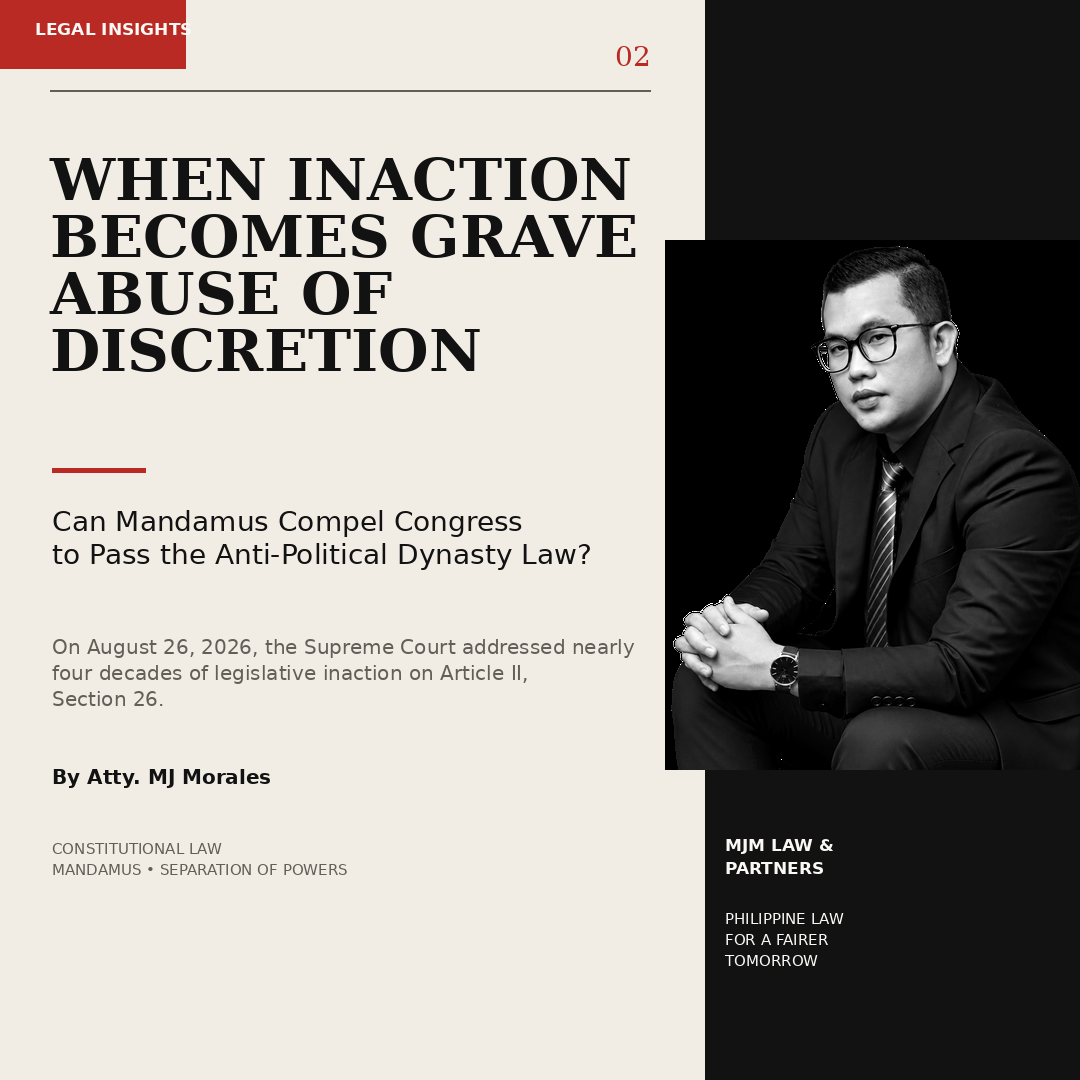
When Inaction Becomes Grave Abuse of Discretion: Can Mandamus Compel Congress to Pass the Anti-Political Dynasty Law?
The article examines whether the Supreme Court may compel Congress through mandamus to fulfill Article II, Section 26 of the 1987 Constitution, which directs the State to prohibit political dynasties “as may be defined by law.” Its central argument is that the Constitution imposes a mandatory duty on Congress to enact the necessary anti-political dynasty law, while Congress retains discretion over the law’s specific content, scope, and enforcement mechanisms. The article weighs this position against the separation of powers concern that legislation is inherently deliberative and discretionary, and therefore may not be a proper subject of mandamus. It ultimately frames the 2026 ruling as part of a broader constitutional question: whether prolonged governmental inaction can itself constitute grave abuse of discretion, while still preserving the Judiciary’s duty to enforce the Constitution without assuming Congress’ legislative function.
Read More