CAN THE GOVERNMENT BLOCK REDDIT OR DISCORD?
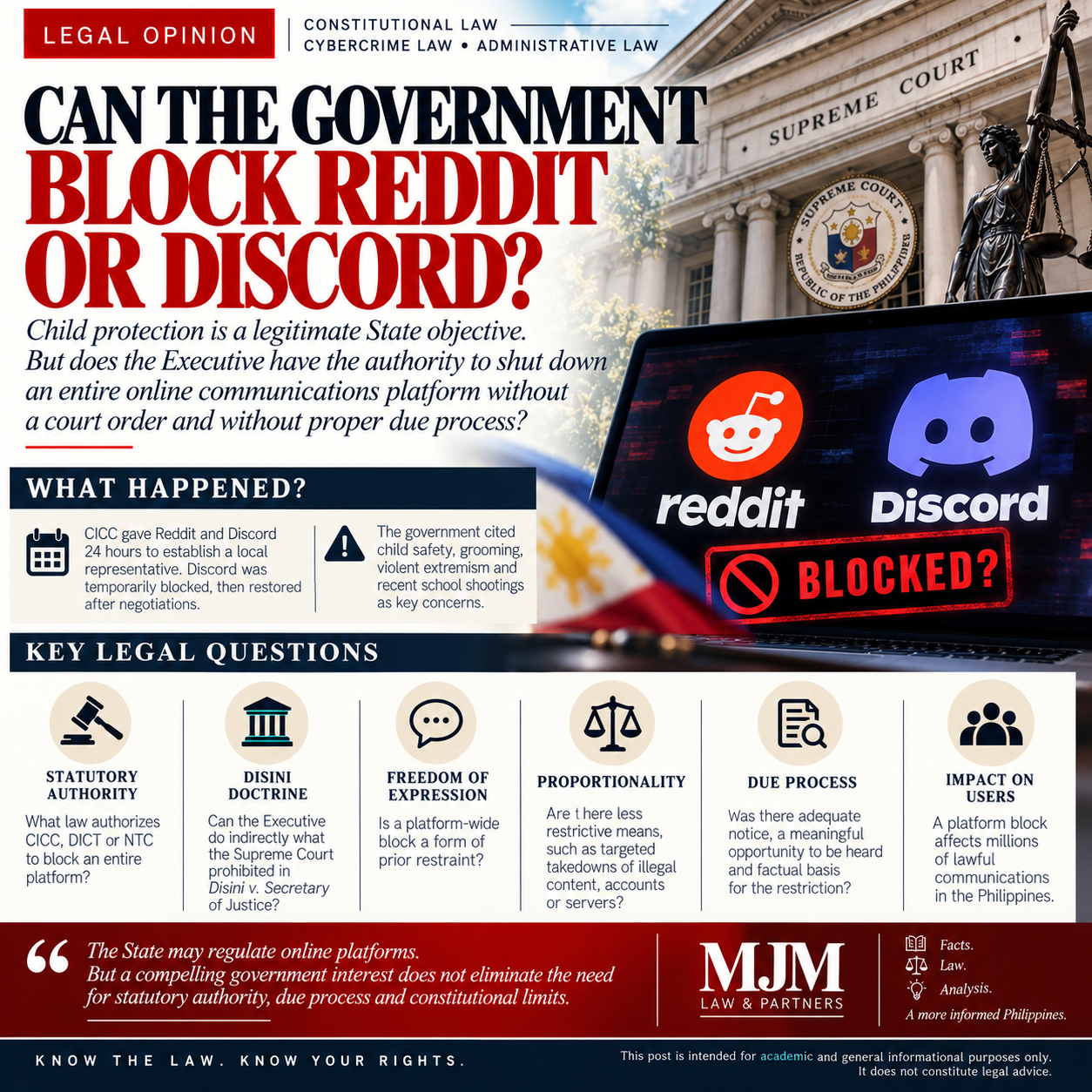
⚖️ 𝐋𝐄𝐆𝐀𝐋 𝐎𝐏𝐈𝐍𝐈𝐎𝐍 | 𝐂𝐎𝐍𝐒𝐓𝐈𝐓𝐔𝐓𝐈𝐎𝐍𝐀𝐋 𝐋𝐀𝐖 • 𝐂𝐘𝐁𝐄𝐑𝐂𝐑𝐈𝐌𝐄 𝐋𝐀𝐖 • 𝐀𝐃𝐌𝐈𝐍𝐈𝐒𝐓𝐑𝐀𝐓𝐈𝐕𝐄 𝐋𝐀𝐖
𝑪𝒉𝒊𝒍𝒅 𝒑𝒓𝒐𝒕𝒆𝒄𝒕𝒊𝒐𝒏, 𝒆𝒙𝒆𝒄𝒖𝒕𝒊𝒗𝒆 𝒑𝒐𝒘𝒆𝒓, 𝒅𝒖𝒆 𝒑𝒓𝒐𝒄𝒆𝒔𝒔, 𝒂𝒏𝒅 𝒕𝒉𝒆 𝒄𝒐𝒏𝒔𝒕𝒊𝒕𝒖𝒕𝒊𝒐𝒏𝒂𝒍 𝒍𝒊𝒎𝒊𝒕𝒔 𝒐𝒇 𝒑𝒍𝒂𝒕𝒇𝒐𝒓𝒎-𝒘𝒊𝒅𝒆 𝒊𝒏𝒕𝒆𝒓𝒏𝒆𝒕 𝒃𝒍𝒐𝒄𝒌𝒊𝒏𝒈 𝒊𝒏 𝒕𝒉𝒆 𝑷𝒉𝒊𝒍𝒊𝒑𝒑𝒊𝒏𝒆𝒔
The recent confrontation between the Philippine government and global online platforms Reddit and Discord presents a difficult constitutional question.
The government undoubtedly has a legitimate interest in protecting children from online sexual exploitation, grooming, violent extremism, and other forms of digital harm. Philippine law does not require the State to remain passive while online platforms are used to facilitate criminal activity.
But there is a second question, separate from the legitimacy of that objective:
𝐇𝐨𝐰 𝐟𝐚𝐫 𝐦𝐚𝐲 𝐭𝐡𝐞 𝐄𝐱𝐞𝐜𝐮𝐭𝐢𝐯𝐞 𝐠𝐨 𝐢𝐧 𝐩𝐮𝐫𝐬𝐮𝐢𝐧𝐠 𝐢𝐭?
More particularly, may an executive agency require a foreign communications platform to establish a Philippine representative within 24 hours, and upon noncompliance cause the entire platform to become inaccessible to users in the Philippines?
That question requires us to distinguish between two propositions that are sometimes treated as though they were the same.
The first is whether government may regulate online platforms.
The second is whether government may 𝐛𝐥𝐨𝐜𝐤 𝐚𝐧 𝐞𝐧𝐭𝐢𝐫𝐞 𝐩𝐥𝐚𝐭𝐟𝐨𝐫𝐦.
Philippine statutes provide substantial support for the first proposition.
The constitutional and statutory basis for the second is considerably more complicated.
𝐈. 𝐖𝐡𝐚𝐭 𝐡𝐚𝐩𝐩𝐞𝐧𝐞𝐝?
On September 21, 2026, the Cybercrime Investigation and Coordinating Center, or CICC, sent separate letters to Reddit and Discord requiring them to designate a resident agent or local representative in the Philippines within 24 hours.
According to CICC, the objective was to ensure that Philippine authorities had a direct channel through which they could coordinate with the platforms concerning child exploitation, violent extremist content, grooming, age assurance, and related online threats. The directive followed several school shooting incidents, including the September 18 shooting at Banga National High School in South Cotabato.
CICC warned that failure or refusal to comply could result, in coordination with other government authorities, in restrictions on the platforms' operations or access in the Philippines.
Reddit subsequently communicated with government authorities and was given additional time.
Discord was temporarily blocked.
DICT later confirmed that the restriction had been implemented through the National Telecommunications Commission, with telecommunications companies and internet service providers beginning to exclude access to Discord. The block was lifted on September 24 after Discord committed to cooperate with Philippine authorities and discussed mechanisms for responding to lawful requests, child-safety concerns, and potentially dangerous activity.
DICT Secretary Henry Aguda defended the government's intervention by invoking the State's protective responsibility toward children under the doctrine of 𝒑𝒂𝒓𝒆𝒏𝒔 𝒑𝒂𝒕𝒓𝒊𝒂𝒆.
Those facts create several distinct legal questions.
𝐈𝐈. 𝐏𝐫𝐨𝐭𝐞𝐜𝐭𝐢𝐧𝐠 𝐜𝐡𝐢𝐥𝐝𝐫𝐞𝐧 𝐢𝐬 𝐚 𝐥𝐞𝐠𝐢𝐭𝐢𝐦𝐚𝐭𝐞 𝐒𝐭𝐚𝐭𝐞 𝐨𝐛𝐣𝐞𝐜𝐭𝐢𝐯𝐞
There should be little controversy over the proposition that government may investigate online criminal activity and require cooperation from internet intermediaries when authorized by law.
Congress itself has enacted unusually strong legislation addressing precisely these problems.
Under 𝐑𝐞𝐩𝐮𝐛𝐥𝐢𝐜 𝐀𝐜𝐭 𝐍𝐨. 𝟏𝟏𝟗𝟑𝟎, the Anti-Online Sexual Abuse or Exploitation of Children and Anti-Child Sexual Abuse or Exploitation Materials Act, internet intermediaries have affirmative obligations to prevent and respond to OSAEC and CSAEM.
Among other things, Section 9 requires an internet intermediary, upon sufficiently specific notice, to:
𝑖𝑚𝑚𝑒𝑑𝑖𝑎𝑡𝑒𝑙𝑦 𝑏𝑙𝑜𝑐𝑘 𝑎𝑐𝑐𝑒𝑠𝑠 𝑡𝑜, 𝑟𝑒𝑚𝑜𝑣𝑒, 𝑜𝑟 𝑡𝑎𝑘𝑒 𝑑𝑜𝑤𝑛 𝑎𝑛 𝑖𝑛𝑡𝑒𝑟𝑛𝑒𝑡 𝑎𝑑𝑑𝑟𝑒𝑠𝑠, 𝑈𝑅𝐿, 𝑤𝑒𝑏𝑠𝑖𝑡𝑒, 𝑜𝑟 𝑐𝑜𝑛𝑡𝑒𝑛𝑡 𝑐𝑜𝑛𝑡𝑎𝑖𝑛𝑖𝑛𝑔 𝐶𝑆𝐴𝐸𝑀 𝑜𝑟 𝑖𝑛𝑣𝑜𝑙𝑣𝑖𝑛𝑔 𝑂𝑆𝐴𝐸𝐶 𝑤𝑖𝑡ℎ𝑖𝑛 𝑡𝑤𝑒𝑛𝑡𝑦-𝑓𝑜𝑢𝑟 ℎ𝑜𝑢𝑟𝑠.
The law also imposes evidence-preservation, reporting, and cooperation obligations.
Likewise, 𝐑𝐞𝐩𝐮𝐛𝐥𝐢𝐜 𝐀𝐜𝐭 𝐍𝐨. 𝟏𝟏𝟖𝟔𝟐, the Expanded Anti-Trafficking in Persons Act, specifically requires internet intermediaries to cooperate with law enforcement and authorizes requests from the DOJ, PNP, NBI, and DICT-CICC involving child trafficking, CSAEM, sexual exploitation, and related evidence.
It even expressly authorizes CICC to require the blocking or removal of identified unlawful internet addresses, URLs, websites, or content connected with trafficking and child exploitation.
The significance of these laws should not be understated.
CICC is not merely asking private companies for voluntary favors.
Congress has imposed real obligations upon internet intermediaries.
The government therefore has substantial statutory authority to demand cooperation concerning specifically identified unlawful material and criminal activity.
But those statutes also reveal something else.
They show 𝐡𝐨𝐰 𝐂𝐨𝐧𝐠𝐫𝐞𝐬𝐬 𝐜𝐡𝐨𝐬𝐞 𝐭𝐨 𝐫𝐞𝐠𝐮𝐥𝐚𝐭𝐞 𝐨𝐧𝐥𝐢𝐧𝐞 𝐜𝐨𝐧𝐭𝐞𝐧𝐭.
And that distinction is critical.
𝐈𝐈𝐈. 𝐂𝐨𝐧𝐠𝐫𝐞𝐬𝐬 𝐚𝐮𝐭𝐡𝐨𝐫𝐢𝐳𝐞𝐝 𝐭𝐚𝐫𝐠𝐞𝐭𝐞𝐝 𝐛𝐥𝐨𝐜𝐤𝐢𝐧𝐠
R.A. No. 11930 does not simply say:
If an online platform contains harmful material, government may shut down the platform.
Instead, Congress created a considerably more specific mechanism.
The law refers to blocking or removing:
- an internet address;
- a URL;
- a website; or
- particular content containing CSAEM or involving OSAEC.
The notice must ordinarily contain sufficient information identifying the offending content and its source.
R.A. No. 11862 follows a similar structure.
Internet intermediaries must block or remove specified online locations or material connected with trafficking, child sexual abuse, or exploitation. The law also requires that relevant evidence to be preserved be expressly identified and specified.
This produces an important statutory distinction:
𝐓𝐚𝐫𝐠𝐞𝐭𝐞𝐝 𝐭𝐚𝐤𝐞𝐝𝐨𝐰𝐧 𝐢𝐬 𝐞𝐱𝐩𝐫𝐞𝐬𝐬𝐥𝐲 𝐚𝐮𝐭𝐡𝐨𝐫𝐢𝐳𝐞𝐝.
Whether 𝐩𝐥𝐚𝐭𝐟𝐨𝐫𝐦-𝐰𝐢𝐝𝐞 𝐛𝐥𝐨𝐜𝐤𝐢𝐧𝐠 𝐟𝐨𝐫 𝐫𝐞𝐠𝐮𝐥𝐚𝐭𝐨𝐫𝐲 𝐧𝐨𝐧𝐜𝐨𝐦𝐩𝐥𝐢𝐚𝐧𝐜𝐞 is equally authorized is a different question.
Discord itself is not a single piece of content.
Neither is Reddit.
They are communications infrastructures containing millions of separate communications, communities, users, and activities, most of which are presumptively lawful.
Blocking particular criminal material and blocking the entire medium through which that material passes are therefore not necessarily equivalent exercises of governmental power.
𝐈𝐕. 𝐓𝐡𝐞𝐧 𝐭𝐡𝐞𝐫𝐞 𝐢𝐬 𝐃𝐢𝐬𝐢𝐧𝐢 𝐯. 𝐒𝐞𝐜𝐫𝐞𝐭𝐚𝐫𝐲 𝐨𝐟 𝐉𝐮𝐬𝐭𝐢𝐜𝐞
Any legal analysis of an executive internet-blocking power in the Philippines must confront 𝐃𝐢𝐬𝐢𝐧𝐢 𝐯. 𝐒𝐞𝐜𝐫𝐞𝐭𝐚𝐫𝐲 𝐨𝐟 𝐉𝐮𝐬𝐭𝐢𝐜𝐞, G.R. No. 203335, February 18, 2014.
The controversy involved Section 19 of the Cybercrime Prevention Act, R.A. No. 10175.
That provision expressly stated:
“When a computer data is prima facie found to be in violation of the provisions of this Act, the DOJ shall issue an order to restrict or block access to such computer data.”
That was an explicit statutory grant of blocking power.
The Supreme Court declared it unconstitutional.
The Court was concerned that Section 19 allowed an executive official to determine that particular computer data violated the law and then administratively suppress access to it without prior judicial intervention.
The Court recognized that computer data may contain constitutionally protected speech and characterized the provision as an impermissible mechanism for administrative censorship.
That precedent creates a serious doctrinal question in the present controversy.
Congress once expressly gave the DOJ authority to restrict or block computer data under the Cybercrime Prevention Act.
The Supreme Court invalidated that authority.
It therefore becomes necessary to identify the precise statutory basis upon which another executive agency may order an ISP-level restriction affecting an entire communications platform.
That does not by itself establish that the Discord action was unconstitutional.
It does mean, however, that Disini cannot be avoided merely by characterizing the measure as cybersecurity regulation.
𝐕. 𝐈𝐬 𝐛𝐥𝐨𝐜𝐤𝐢𝐧𝐠 𝐚𝐧 𝐞𝐧𝐭𝐢𝐫𝐞 𝐩𝐥𝐚𝐭𝐟𝐨𝐫𝐦 𝐚 𝐟𝐨𝐫𝐦 𝐨𝐟 𝐩𝐫𝐢𝐨𝐫 𝐫𝐞𝐬𝐭𝐫𝐚𝐢𝐧𝐭?
Article III, Section 4 of the 1987 Constitution provides:
“No law shall be passed abridging the freedom of speech, of expression, or of the press…”
The traditional doctrine of 𝐩𝐫𝐢𝐨𝐫 𝐫𝐞𝐬𝐭𝐫𝐚𝐢𝐧𝐭 concerns governmental restrictions imposed before expression reaches its intended audience.
In 𝐂𝐡𝐚𝐯𝐞𝐳 𝐯. 𝐆𝐨𝐧𝐳𝐚𝐥𝐞𝐬, G.R. No. 168338, February 15, 2008, the Supreme Court emphasized that governmental prior restraint carries a heavy presumption against constitutional validity and that the State bears a substantial burden when restricting protected expression.
Disini subsequently applied prior-restraint principles directly to internet data and administrative blocking.
A nationwide platform restriction therefore presents an unusual problem.
Suppose a Discord server is being used to groom children or encourage violence.
Government action against that server or the offending users concerns identifiable harmful activity.
But blocking Discord altogether affects much more:
lawful conversations between friends;
professional and educational communities;
software-development groups;
gaming communities;
business communications;
political discussions;
religious discussions;
student organizations;
and ordinary private correspondence.
The constitutional question therefore becomes one of fit.
How closely does the government's remedy correspond to the identified harm?
𝐕𝐈. 𝐓𝐡𝐞 𝐠𝐨𝐯𝐞𝐫𝐧𝐦𝐞𝐧𝐭 𝐡𝐚𝐬 𝐚 𝐬𝐮𝐛𝐬𝐭𝐚𝐧𝐭𝐢𝐚𝐥 𝐜𝐨𝐮𝐧𝐭𝐞𝐫𝐚𝐫𝐠𝐮𝐦𝐞𝐧𝐭
There is another side to that analysis.
The government could argue that the Discord measure was not imposed because officials disagreed with any particular political, religious, or ideological message.
Its stated objective was regulatory and protective: securing platform cooperation to address grooming, child exploitation, violent extremism, and threats associated with recent school violence.
That distinction matters because not every governmental action affecting speech is necessarily a content-based restriction.
The State can also point to 𝐑.𝐀. 𝐍𝐨. 𝟏𝟎𝟖𝟒𝟒, which created DICT as the primary executive entity responsible for national ICT policy, planning, implementation, cybersecurity, and coordination.
It can further rely on R.A. Nos. 11862 and 11930 as evidence of an unmistakable legislative policy requiring internet intermediaries to cooperate with Philippine authorities in preventing online exploitation of children.
The government might therefore characterize the Discord restriction not as censorship of speech but as a temporary compliance measure imposed against an intermediary that had allegedly failed to establish mechanisms necessary for Philippine law enforcement.
The short duration of the restriction is also relevant.
The ban was lifted after discussions with Discord and commitments concerning cooperation and child-safety mechanisms.
Those facts would likely form part of any defense of the government's action.
But even if the objective is regulatory rather than ideological, another question remains:
𝐖𝐡𝐚𝐭 𝐬𝐭𝐚𝐭𝐮𝐭𝐞 𝐚𝐮𝐭𝐡𝐨𝐫𝐢𝐳𝐞𝐬 𝐭𝐡𝐞 𝐩𝐚𝐫𝐭𝐢𝐜𝐮𝐥𝐚𝐫 𝐫𝐞𝐦𝐞𝐝𝐲 𝐜𝐡𝐨𝐬𝐞𝐧?
𝐕𝐈𝐈. 𝐀𝐝𝐦𝐢𝐧𝐢𝐬𝐭𝐫𝐚𝐭𝐢𝐯𝐞 𝐚𝐠𝐞𝐧𝐜𝐢𝐞𝐬 𝐜𝐚𝐧𝐧𝐨𝐭 𝐜𝐫𝐞𝐚𝐭𝐞 𝐮𝐧𝐥𝐢𝐦𝐢𝐭𝐞𝐝 𝐫𝐞𝐦𝐞𝐝𝐢𝐞𝐬 𝐟𝐫𝐨𝐦 𝐠𝐞𝐧𝐞𝐫𝐚𝐥 𝐦𝐚𝐧𝐝𝐚𝐭𝐞𝐬
Philippine administrative law recognizes that executive agencies possess not only powers expressly granted by Congress but also powers necessarily implied from their statutory functions.
But implied powers are not unlimited.
There is an important difference between:
𝐚𝐮𝐭𝐡𝐨𝐫𝐢𝐭𝐲 𝐭𝐨 𝐫𝐞𝐠𝐮𝐥𝐚𝐭𝐞 𝐚𝐧 𝐢𝐧𝐝𝐮𝐬𝐭𝐫𝐲
and
𝐚𝐮𝐭𝐡𝐨𝐫𝐢𝐭𝐲 𝐭𝐨 𝐢𝐦𝐩𝐨𝐬𝐞 𝐚 𝐩𝐚𝐫𝐭𝐢𝐜𝐮𝐥𝐚𝐫 𝐜𝐨𝐞𝐫𝐜𝐢𝐯𝐞 𝐬𝐚𝐧𝐜𝐭𝐢𝐨𝐧 𝐚𝐟𝐟𝐞𝐜𝐭𝐢𝐧𝐠 𝐜𝐨𝐧𝐬𝐭𝐢𝐭𝐮𝐭𝐢𝐨𝐧𝐚𝐥 𝐫𝐢𝐠𝐡𝐭𝐬.
DICT possesses broad ICT responsibilities.
CICC possesses broad cybercrime coordination and investigative responsibilities.
NTC possesses extensive regulatory authority over telecommunications carriers and communications facilities.
But the existence of broad regulatory jurisdiction does not automatically answer whether Congress delegated the specific authority to disable access to an entire foreign communications platform.
That question becomes especially significant where Congress has separately enacted statutes such as R.A. Nos. 11862 and 11930 that carefully identify particular takedown mechanisms.
If Congress expressly prescribed targeted removal of identified unlawful material, courts could be asked whether a much broader platform-wide sanction may properly be inferred from general regulatory clauses.
Conversely, government could argue that those targeted statutes supplement, rather than exhaust, the Executive's regulatory powers.
Ultimately, that is a question of statutory construction.
𝐕𝐈𝐈𝐈. 𝐏𝐚𝐫𝐞𝐧𝐬 𝐩𝐚𝐭𝐫𝐢𝐚𝐞 𝐞𝐱𝐩𝐥𝐚𝐢𝐧𝐬 𝐭𝐡𝐞 𝐒𝐭𝐚𝐭𝐞'𝐬 𝐢𝐧𝐭𝐞𝐫𝐞𝐬𝐭, 𝐛𝐮𝐭 𝐝𝐨𝐞𝐬 𝐢𝐭 𝐝𝐞𝐟𝐢𝐧𝐞 𝐭𝐡𝐞 𝐫𝐞𝐦𝐞𝐝𝐲?
Secretary Aguda publicly invoked 𝒑𝒂𝒓𝒆𝒏𝒔 𝒑𝒂𝒕𝒓𝒊𝒂𝒆 in explaining the government's action.
The doctrine recognizes the State's special responsibility to protect those who cannot fully protect themselves, particularly children.
In the context of online grooming, exploitation, and violence, the doctrine supplies a powerful justification for governmental intervention.
But its function should be carefully understood.
Parens patriae explains 𝐰𝐡𝐲 𝐭𝐡𝐞 𝐒𝐭𝐚𝐭𝐞 𝐡𝐚𝐬 𝐚 𝐥𝐞𝐠𝐢𝐭𝐢𝐦𝐚𝐭𝐞 𝐢𝐧𝐭𝐞𝐫𝐞𝐬𝐭 𝐢𝐧 𝐚𝐜𝐭𝐢𝐧𝐠.
It does not necessarily determine:
which government official possesses jurisdiction;
what sanction may be imposed;
what procedure must be observed;
whether judicial authorization is required;
or how broadly constitutionally protected activity may be burdened.
Those questions still depend upon statutes and the Constitution.
Thus, the real debate is not between “child safety” and “freedom of expression.”
The legal question is narrower:
𝐖𝐡𝐚𝐭 𝐦𝐞𝐚𝐬𝐮𝐫𝐞𝐬 𝐡𝐚𝐬 𝐏𝐡𝐢𝐥𝐢𝐩𝐩𝐢𝐧𝐞 𝐥𝐚𝐰 𝐚𝐮𝐭𝐡𝐨𝐫𝐢𝐳𝐞𝐝 𝐭𝐡𝐞 𝐒𝐭𝐚𝐭𝐞 𝐭𝐨 𝐞𝐦𝐩𝐥𝐨𝐲 𝐢𝐧 𝐩𝐫𝐨𝐭𝐞𝐜𝐭𝐢𝐧𝐠 𝐜𝐡𝐢𝐥𝐝𝐫𝐞𝐧, 𝐚𝐧𝐝 𝐰𝐡𝐚𝐭 𝐜𝐨𝐧𝐬𝐭𝐢𝐭𝐮𝐭𝐢𝐨𝐧𝐚𝐥 𝐥𝐢𝐦𝐢𝐭𝐚𝐭𝐢𝐨𝐧𝐬 𝐚𝐜𝐜𝐨𝐦𝐩𝐚𝐧𝐲 𝐭𝐡𝐨𝐬𝐞 𝐦𝐞𝐚𝐬𝐮𝐫𝐞𝐬?
𝐈𝐗. 𝐓𝐡𝐞 𝟐𝟒-𝐡𝐨𝐮𝐫 𝐮𝐥𝐭𝐢𝐦𝐚𝐭𝐮𝐦 𝐫𝐚𝐢𝐬𝐞𝐬 𝐚 𝐬𝐞𝐩𝐚𝐫𝐚𝐭𝐞 𝐝𝐮𝐞-𝐩𝐫𝐨𝐜𝐞𝐬𝐬 𝐢𝐬𝐬𝐮𝐞
The government's initial directive gave Reddit and Discord 24 hours to establish local representation or face possible restrictions.
That necessarily raises questions of procedural due process.
But here caution is necessary.
A 24-hour deadline is not automatically unconstitutional simply because it is short.
Philippine administrative law does not invariably require a full judicial-type hearing before regulatory action.
Under the doctrine originating in 𝐀𝐧𝐠 𝐓𝐢𝐛𝐚𝐲 𝐯. 𝐂𝐨𝐮𝐫𝐭 𝐨𝐟 𝐈𝐧𝐝𝐮𝐬𝐭𝐫𝐢𝐚𝐥 𝐑𝐞𝐥𝐚𝐭𝐢𝐨𝐧𝐬, administrative due process principally demands fairness: notice of the matter involved, an opportunity to present one's position, consideration of the evidence, a decision supported by evidence, and an explanation of the reasons for governmental action. Later cases reiterate that administrative due process fundamentally requires a meaningful opportunity to explain or defend one's position.
So the more useful inquiry is not:
“𝐖𝐚𝐬 𝟐𝟒 𝐡𝐨𝐮𝐫𝐬 𝐢𝐧𝐡𝐞𝐫𝐞𝐧𝐭𝐥𝐲 𝐢𝐥𝐥𝐞𝐠𝐚𝐥?”
It is:
𝐖𝐚𝐬 𝐭𝐡𝐞 𝐩𝐫𝐨𝐜𝐞𝐬𝐬 𝐦𝐞𝐚𝐧𝐢𝐧𝐠𝐟𝐮𝐥 𝐢𝐧 𝐥𝐢𝐠𝐡𝐭 𝐨𝐟 𝐭𝐡𝐞 𝐬𝐚𝐧𝐜𝐭𝐢𝐨𝐧 𝐭𝐡𝐫𝐞𝐚𝐭𝐞𝐧𝐞𝐝?
Among the relevant questions would be:
Was Discord informed of the statutory basis for the proposed block?
Was it informed of the specific acts or omissions constituting noncompliance?
Was it given a realistic opportunity to answer those allegations?
Were its explanations considered?
Did the government make factual findings?
Was there an identifiable legal standard governing whether blocking would occur?
Was reconsideration or judicial review available?
These questions become more important as the magnitude of the deprivation increases.
A government request to nominate a local contact person is one thing.
A nationwide order preventing millions of users from accessing an online communications service is another.
𝐗. 𝐓𝐡𝐞𝐫𝐞 𝐢𝐬 𝐚𝐥𝐬𝐨 𝐚 𝐝𝐢𝐬𝐭𝐢𝐧𝐜𝐭𝐢𝐨𝐧 𝐛𝐞𝐭𝐰𝐞𝐞𝐧 𝐚 𝐥𝐨𝐜𝐚𝐥-𝐫𝐞𝐩𝐫𝐞𝐬𝐞𝐧𝐭𝐚𝐭𝐢𝐨𝐧 𝐫𝐞𝐪𝐮𝐢𝐫𝐞𝐦𝐞𝐧𝐭 𝐚𝐧𝐝 𝐭𝐡𝐞 𝐩𝐞𝐧𝐚𝐥𝐭𝐲 𝐟𝐨𝐫 𝐯𝐢𝐨𝐥𝐚𝐭𝐢𝐧𝐠 𝐢𝐭
The CICC's demand for local representation should itself be separated from the question of blocking.
Philippine law frequently requires foreign corporations engaging in business here to appoint local representatives or resident agents.
There are legitimate governmental reasons for such requirements.
A resident agent provides someone within Philippine jurisdiction upon whom legal process may be served and through whom regulators and courts may communicate.
It does not follow, however, that every valid regulatory obligation carries every conceivable sanction.
Even assuming Reddit or Discord was legally required to establish a Philippine presence, a separate inquiry remains:
𝐖𝐡𝐚𝐭 𝐬𝐭𝐚𝐭𝐮𝐭𝐞 𝐩𝐫𝐞𝐬𝐜𝐫𝐢𝐛𝐞𝐬 𝐭𝐡𝐞 𝐜𝐨𝐧𝐬𝐞𝐪𝐮𝐞𝐧𝐜𝐞 𝐟𝐨𝐫 𝐟𝐚𝐢𝐥𝐮𝐫𝐞 𝐭𝐨 𝐜𝐨𝐦𝐩𝐥𝐲?
Possible sanctions could include administrative penalties, registration consequences, judicial proceedings, fines, targeted enforcement orders, or access restrictions.
Which remedy applies depends upon the law creating the duty.
The validity of the obligation and the validity of the enforcement mechanism therefore should be analyzed separately.
𝐗𝐈. 𝐓𝐚𝐫𝐠𝐞𝐭𝐞𝐝 𝐫𝐞𝐠𝐮𝐥𝐚𝐭𝐢𝐨𝐧 𝐯𝐞𝐫𝐬𝐮𝐬 𝐩𝐥𝐚𝐭𝐟𝐨𝐫𝐦-𝐰𝐢𝐝𝐞 𝐛𝐥𝐨𝐜𝐤𝐢𝐧𝐠
This may ultimately be the most important constitutional distinction.
Consider two hypothetical government orders.
The first says:
“Remove Discord Server X because competent evidence establishes that it contains child sexual abuse material.”
The second says:
“Discord has not complied with our regulatory demand. Block Discord throughout the Philippines.”
The first targets allegedly unlawful activity.
The second affects the entire communications environment through which both lawful and unlawful activity takes place.
Congress clearly contemplated the first mechanism in R.A. Nos. 11862 and 11930.
Whether Congress also authorized the second, under the circumstances presented here, requires a separate legal basis.
That distinction becomes even more significant because the availability of less restrictive enforcement mechanisms often affects constitutional analysis.
Authorities could potentially pursue:
specific servers;
specific accounts;
particular URLs;
identified unlawful content;
preservation requests;
lawful data demands;
criminal investigation;
subpoenas where authorized;
court orders;
age-assurance requirements;
or expedited law-enforcement channels.
Discord itself reportedly discussed its Kodex law-enforcement request system, Family Center tools, age-assurance mechanisms, and other safety measures with CICC.
The existence of such alternatives does not automatically make a platform-wide block invalid.
But it is highly relevant to whether such a block was necessary and proportionate to the government's objective.
𝐗𝐈𝐈. 𝐓𝐡𝐞 𝐫𝐢𝐠𝐡𝐭𝐬 𝐢𝐧𝐯𝐨𝐥𝐯𝐞𝐝 𝐚𝐫𝐞 𝐧𝐨𝐭 𝐨𝐧𝐥𝐲 𝐭𝐡𝐨𝐬𝐞 𝐨𝐟 𝐃𝐢𝐬𝐜𝐨𝐫𝐝 𝐨𝐫 𝐑𝐞𝐝𝐝𝐢𝐭
Another important point can be lost when the controversy is framed simply as:
“𝐃𝐢𝐬𝐜𝐨𝐫𝐝 𝐯𝐞𝐫𝐬𝐮𝐬 𝐭𝐡𝐞 𝐏𝐡𝐢𝐥𝐢𝐩𝐩𝐢𝐧𝐞 𝐠𝐨𝐯𝐞𝐫𝐧𝐦𝐞𝐧𝐭.”
An internet platform is also a medium through which Filipino users communicate.
A platform-wide block therefore affects not merely the foreign corporation operating the service but also Philippine users who employ it for lawful expression and communication.
This distinction may become significant in any future constitutional litigation.
A teacher using Discord for a study group, a programmer collaborating on software, a Filipino gamer speaking with friends abroad, or a professional organization maintaining a private server may have no connection whatsoever to the harmful communities identified by authorities.
Yet all lose access when the entire platform is blocked.
That is precisely why platform-level intervention creates constitutional questions different from targeted removal of unlawful material.
𝐗𝐈𝐈𝐈. 𝐑𝐞𝐝𝐝𝐢𝐭 𝐚𝐧𝐝 𝐃𝐢𝐬𝐜𝐨𝐫𝐝 𝐬𝐡𝐨𝐮𝐥𝐝 𝐧𝐨𝐭 𝐛𝐞 𝐭𝐫𝐞𝐚𝐭𝐞𝐝 𝐚𝐬 𝐢𝐦𝐦𝐮𝐧𝐞 𝐟𝐫𝐨𝐦 𝐏𝐡𝐢𝐥𝐢𝐩𝐩𝐢𝐧𝐞 𝐥𝐚𝐰
Nothing in this analysis means that global platforms should be entitled to operate within the Philippines without accountability.
They are not sovereign enclaves.
Where Philippine statutes validly apply, platforms serving Filipino users may have legal obligations involving:
child protection;
data protection;
preservation of evidence;
law-enforcement cooperation;
corporate registration;
privacy;
and removal of unlawful material.
R.A. Nos. 11862 and 11930 demonstrate Congress' willingness to impose substantial responsibilities on internet intermediaries.
Nor does freedom of expression immunize criminal activity.
Child sexual exploitation, trafficking, genuine criminal solicitation, threats, and other punishable conduct do not become constitutionally protected merely because a computer or social-media platform is used.
The constitutional problem therefore should not be overstated as a supposed right of technology companies to ignore Philippine law.
The issue is instead one of 𝐥𝐞𝐠𝐚𝐥 𝐚𝐮𝐭𝐡𝐨𝐫𝐢𝐭𝐲, 𝐩𝐫𝐨𝐜𝐞𝐝𝐮𝐫𝐞, 𝐬𝐜𝐨𝐩𝐞, 𝐚𝐧𝐝 𝐩𝐫𝐨𝐩𝐨𝐫𝐭𝐢𝐨𝐧𝐚𝐥𝐢𝐭𝐲.
𝐗𝐈𝐕. 𝐍𝐨𝐫 𝐬𝐡𝐨𝐮𝐥𝐝 “𝐩𝐮𝐛𝐥𝐢𝐜 𝐬𝐚𝐟𝐞𝐭𝐲” 𝐛𝐞𝐜𝐨𝐦𝐞 𝐚 𝐬𝐮𝐛𝐬𝐭𝐢𝐭𝐮𝐭𝐞 𝐟𝐨𝐫 𝐥𝐞𝐠𝐚𝐥 𝐚𝐮𝐭𝐡𝐨𝐫𝐢𝐭𝐲
The opposite proposition is equally important.
The seriousness of the government's objective does not necessarily dispense with statutory authorization.
This is one of the enduring principles of constitutional government.
The State frequently acts for legitimate reasons.
Crime prevention is legitimate.
National security is legitimate.
Child protection is legitimate.
Public order is legitimate.
But constitutional analysis asks not merely:
“𝐈𝐬 𝐭𝐡𝐞 𝐨𝐛𝐣𝐞𝐜𝐭𝐢𝐯𝐞 𝐢𝐦𝐩𝐨𝐫𝐭𝐚𝐧𝐭?”
It also asks:
“𝐖𝐡𝐨 𝐦𝐚𝐲 𝐞𝐱𝐞𝐫𝐜𝐢𝐬𝐞 𝐭𝐡𝐞 𝐩𝐨𝐰𝐞𝐫?”
“𝐔𝐧𝐝𝐞𝐫 𝐰𝐡𝐚𝐭 𝐥𝐚𝐰?”
“𝐔𝐬𝐢𝐧𝐠 𝐰𝐡𝐚𝐭 𝐩𝐫𝐨𝐜𝐞𝐝𝐮𝐫𝐞?”
“𝐀𝐠𝐚𝐢𝐧𝐬𝐭 𝐰𝐡𝐨𝐦?”
“𝐅𝐨𝐫 𝐡𝐨𝐰 𝐥𝐨𝐧𝐠?”
“𝐒𝐮𝐛𝐣𝐞𝐜𝐭 𝐭𝐨 𝐰𝐡𝐚𝐭 𝐬𝐚𝐟𝐞𝐠𝐮𝐚𝐫𝐝𝐬?”
and
“𝐇𝐨𝐰 𝐦𝐮𝐜𝐡 𝐩𝐫𝐨𝐭𝐞𝐜𝐭𝐞𝐝 𝐚𝐜𝐭𝐢𝐯𝐢𝐭𝐲 𝐦𝐚𝐲 𝐛𝐞 𝐛𝐮𝐫𝐝𝐞𝐧𝐞𝐝 𝐢𝐧 𝐚𝐜𝐜𝐨𝐦𝐩𝐥𝐢𝐬𝐡𝐢𝐧𝐠 𝐭𝐡𝐚𝐭 𝐨𝐛𝐣𝐞𝐜𝐭𝐢𝐯𝐞?”
Those questions become especially important when government controls access to a medium used for expression.
𝐗𝐕. 𝐓𝐡𝐞 𝐝𝐞𝐞𝐩𝐞𝐫 𝐜𝐨𝐧𝐬𝐭𝐢𝐭𝐮𝐭𝐢𝐨𝐧𝐚𝐥 𝐢𝐬𝐬𝐮𝐞 𝐚𝐟𝐭𝐞𝐫 𝐃𝐢𝐬𝐢𝐧𝐢
The most difficult question raised by the Discord controversy may therefore be stated this way:
𝐂𝐚𝐧 𝐭𝐡𝐞 𝐄𝐱𝐞𝐜𝐮𝐭𝐢𝐯𝐞 𝐚𝐜𝐜𝐨𝐦𝐩𝐥𝐢𝐬𝐡 𝐭𝐡𝐫𝐨𝐮𝐠𝐡 𝐠𝐞𝐧𝐞𝐫𝐚𝐥 𝐚𝐝𝐦𝐢𝐧𝐢𝐬𝐭𝐫𝐚𝐭𝐢𝐯𝐞 𝐚𝐮𝐭𝐡𝐨𝐫𝐢𝐭𝐲 𝐰𝐡𝐚𝐭 𝐭𝐡𝐞 𝐒𝐮𝐩𝐫𝐞𝐦𝐞 𝐂𝐨𝐮𝐫𝐭 𝐫𝐞𝐟𝐮𝐬𝐞𝐝 𝐭𝐨 𝐩𝐞𝐫𝐦𝐢𝐭 𝐮𝐧𝐝𝐞𝐫 𝐚𝐧 𝐞𝐱𝐩𝐫𝐞𝐬𝐬 𝐬𝐭𝐚𝐭𝐮𝐭𝐨𝐫𝐲 𝐛𝐥𝐨𝐜𝐤𝐢𝐧𝐠 𝐩𝐫𝐨𝐯𝐢𝐬𝐢𝐨𝐧?
That question should not be answered too quickly.
There are meaningful distinctions.
Section 19 of R.A. No. 10175 authorized DOJ to determine that computer data violated the Cybercrime Law and directly order that data blocked.
The 2026 Discord action appears to have been presented instead as a regulatory response to platform cooperation, child safety, and local representation.
Those distinctions may matter.
But Disini remains relevant because the ultimate governmental effect is similar:
executive action causes computer-mediated communication to become inaccessible.
And in Disini, the Supreme Court treated administrative censorship of computer data with considerable constitutional skepticism.
A future court examining the Discord controversy would therefore have to determine whether the differences in statutory source, regulatory purpose, and scope meaningfully distinguish the present situation from Disini.
𝐗𝐕𝐈. 𝐖𝐡𝐞𝐫𝐞 𝐭𝐡𝐞 𝐥𝐞𝐠𝐚𝐥 𝐪𝐮𝐞𝐬𝐭𝐢𝐨𝐧𝐬 𝐩𝐫𝐞𝐬𝐞𝐧𝐭𝐥𝐲 𝐬𝐭𝐚𝐧𝐝
No Supreme Court decision has yet adjudicated the constitutionality of the September 2026 Discord restriction itself.
It would therefore be premature to state categorically that the action either was constitutional or unconstitutional.
What can be said is that the episode raises several substantial questions under existing Philippine law:
𝐅𝐢𝐫𝐬𝐭, 𝐬𝐭𝐚𝐭𝐮𝐭𝐨𝐫𝐲 𝐚𝐮𝐭𝐡𝐨𝐫𝐢𝐭𝐲.
What specific provision authorizes CICC, DICT, or NTC to impose a nationwide platform block for failure to designate a resident agent or satisfy a regulatory directive?
𝐒𝐞𝐜𝐨𝐧𝐝, 𝐭𝐡𝐞 𝐞𝐟𝐟𝐞𝐜𝐭 𝐨𝐟 𝐃𝐢𝐬𝐢𝐧𝐢.
How does the invalidation of Section 19 of R.A. No. 10175 affect claims of implied executive blocking authority?
𝐓𝐡𝐢𝐫𝐝, 𝐟𝐫𝐞𝐞𝐝𝐨𝐦 𝐨𝐟 𝐞𝐱𝐩𝐫𝐞𝐬𝐬𝐢𝐨𝐧.
When a platform contains enormous quantities of lawful expression, what constitutional standard applies to disabling access to the whole medium?
𝐅𝐨𝐮𝐫𝐭𝐡, 𝐩𝐫𝐨𝐩𝐨𝐫𝐭𝐢𝐨𝐧𝐚𝐥𝐢𝐭𝐲 𝐚𝐧𝐝 𝐧𝐚𝐫𝐫𝐨𝐰 𝐭𝐚𝐢𝐥𝐨𝐫𝐢𝐧𝐠.
Were targeted enforcement tools available that could address the identified harms without burdening unrelated lawful communications?
𝐅𝐢𝐟𝐭𝐡, 𝐝𝐮𝐞 𝐩𝐫𝐨𝐜𝐞𝐬𝐬.
Did the affected platform receive legally adequate notice, explanation, opportunity to respond, factual findings, and access to meaningful review?
𝐒𝐢𝐱𝐭𝐡, 𝐥𝐞𝐠𝐢𝐬𝐥𝐚𝐭𝐢𝐯𝐞 𝐝𝐞𝐬𝐢𝐠𝐧.
What should courts infer from the fact that Congress expressly created targeted online blocking procedures in R.A. Nos. 11862 and 11930?
These are not merely technological questions.
They go to the constitutional allocation of governmental power.
𝐗𝐕𝐈𝐈. 𝐂𝐡𝐢𝐥𝐝 𝐬𝐚𝐟𝐞𝐭𝐲 𝐚𝐧𝐝 𝐜𝐨𝐧𝐬𝐭𝐢𝐭𝐮𝐭𝐢𝐨𝐧𝐚𝐥 𝐠𝐨𝐯𝐞𝐫𝐧𝐦𝐞𝐧𝐭 𝐚𝐫𝐞 𝐧𝐨𝐭 𝐦𝐮𝐭𝐮𝐚𝐥𝐥𝐲 𝐞𝐱𝐜𝐥𝐮𝐬𝐢𝐯𝐞
Perhaps the most important lesson from this controversy is that the debate need not be reduced to two extreme positions.
One need not choose between:
“𝐆𝐨𝐯𝐞𝐫𝐧𝐦𝐞𝐧𝐭 𝐦𝐮𝐬𝐭 𝐛𝐞 𝐩𝐨𝐰𝐞𝐫𝐥𝐞𝐬𝐬 𝐚𝐠𝐚𝐢𝐧𝐬𝐭 𝐝𝐚𝐧𝐠𝐞𝐫𝐨𝐮𝐬 𝐨𝐧𝐥𝐢𝐧𝐞 𝐩𝐥𝐚𝐭𝐟𝐨𝐫𝐦𝐬”
And
“𝐆𝐨𝐯𝐞𝐫𝐧𝐦𝐞𝐧𝐭 𝐦𝐚𝐲 𝐬𝐡𝐮𝐭 𝐝𝐨𝐰𝐧 𝐚𝐧𝐲 𝐩𝐥𝐚𝐭𝐟𝐨𝐫𝐦 𝐰𝐡𝐞𝐧𝐞𝐯𝐞𝐫 𝐩𝐮𝐛𝐥𝐢𝐜 𝐬𝐚𝐟𝐞𝐭𝐲 𝐢𝐬 𝐢𝐧𝐯𝐨𝐤𝐞𝐝.”
Philippine law already demonstrates a middle path.
Congress has authorized rapid responses to online child exploitation.
It permits preservation of evidence.
It requires cooperation from internet intermediaries.
It authorizes takedowns.
It permits blocking.
It can require action within as little as twenty-four hours.
But those statutes also identify the prohibited activity, specify who may issue requests, prescribe obligations, and generally direct enforcement toward particular illegal material.
That framework recognizes both realities:
𝐓𝐡𝐞 𝐢𝐧𝐭𝐞𝐫𝐧𝐞𝐭 𝐜𝐚𝐧 𝐟𝐚𝐜𝐢𝐥𝐢𝐭𝐚𝐭𝐞 𝐝𝐞𝐯𝐚𝐬𝐭𝐚𝐭𝐢𝐧𝐠 𝐜𝐫𝐢𝐦𝐞𝐬.
And:
𝐆𝐨𝐯𝐞𝐫𝐧𝐦𝐞𝐧𝐭𝐚𝐥 𝐩𝐨𝐰𝐞𝐫 𝐨𝐯𝐞𝐫 𝐜𝐨𝐦𝐦𝐮𝐧𝐢𝐜𝐚𝐭𝐢𝐨𝐧 𝐫𝐞𝐪𝐮𝐢𝐫𝐞𝐬 𝐥𝐞𝐠𝐚𝐥 𝐛𝐨𝐮𝐧𝐝𝐚𝐫𝐢𝐞𝐬.
𝐂𝐎𝐍𝐂𝐋𝐔𝐒𝐈𝐎𝐍
The controversy involving Reddit and Discord should not ultimately be understood as a contest between technological freedom and child safety.
The government's concern over grooming, online sexual exploitation, extremist recruitment, and threats to children involves genuine public interests. Congress has expressly empowered Philippine authorities to demand substantial cooperation from internet intermediaries in confronting those harms.
But a nationwide platform block presents a separate legal question.
Philippine law clearly authorizes targeted measures against identified unlawful online content in particular circumstances. Whether CICC, DICT, or NTC also possesses authority to disable an entire communications platform as a consequence of regulatory noncompliance requires examination of the statute invoked, the procedure followed, the scope of the restriction, and the constitutional protections implicated.
Disini v. Secretary of Justice makes that inquiry particularly important because the Supreme Court has already rejected an express statutory provision that permitted executive officials to order computer data blocked without adequate judicial safeguards.
At the same time, R.A. Nos. 11862 and 11930 demonstrate that the Constitution does not leave government helpless in cyberspace. Congress has supplied powerful mechanisms for rapid intervention against trafficking, online child exploitation, and illegal digital material.
The unresolved issue is therefore not whether the State may act.
𝐈𝐭 𝐩𝐥𝐚𝐢𝐧𝐥𝐲 𝐦𝐚𝐲.
The harder question is 𝐡𝐨𝐰 𝐭𝐡𝐞 𝐒𝐭𝐚𝐭𝐞 𝐦𝐚𝐲 𝐚𝐜𝐭 𝐰𝐡𝐞𝐧 𝐭𝐡𝐞 𝐜𝐡𝐨𝐬𝐞𝐧 𝐫𝐞𝐦𝐞𝐝𝐲 𝐬𝐮𝐩𝐩𝐫𝐞𝐬𝐬𝐞𝐬 𝐚𝐜𝐜𝐞𝐬𝐬 𝐧𝐨𝐭 𝐦𝐞𝐫𝐞𝐥𝐲 𝐭𝐨 𝐮𝐧𝐥𝐚𝐰𝐟𝐮𝐥 𝐜𝐨𝐧𝐭𝐞𝐧𝐭, 𝐛𝐮𝐭 𝐭𝐨 𝐚𝐧 𝐞𝐧𝐭𝐢𝐫𝐞 𝐜𝐨𝐦𝐦𝐮𝐧𝐢𝐜𝐚𝐭𝐢𝐨𝐧𝐬 𝐩𝐥𝐚𝐭𝐟𝐨𝐫𝐦 𝐜𝐨𝐧𝐭𝐚𝐢𝐧𝐢𝐧𝐠 𝐥𝐚𝐰𝐟𝐮𝐥 𝐞𝐱𝐩𝐫𝐞𝐬𝐬𝐢𝐨𝐧 𝐚𝐬 𝐰𝐞𝐥𝐥.
In constitutional government, the importance of an objective does not eliminate the need to identify the legal source and limits of the power used to pursue it.
That principle protects more than Reddit or Discord.
It protects the structure under which governmental power itself remains governed by law.
𝐋𝐄𝐆𝐀𝐋 𝐎𝐏𝐈𝐍𝐈𝐎𝐍 | 𝐏𝐡𝐢𝐥𝐢𝐩𝐩𝐢𝐧𝐞 𝐂𝐨𝐧𝐬𝐭𝐢𝐭𝐮𝐭𝐢𝐨𝐧𝐚𝐥 𝐋𝐚𝐰, 𝐂𝐲𝐛𝐞𝐫𝐜𝐫𝐢𝐦𝐞 𝐋𝐚𝐰 & 𝐀𝐝𝐦𝐢𝐧𝐢𝐬𝐭𝐫𝐚𝐭𝐢𝐯𝐞 𝐋𝐚𝐰
𝑇ℎ𝑖𝑠 𝑎𝑟𝑡𝑖𝑐𝑙𝑒 𝑖𝑠 𝑖𝑛𝑡𝑒𝑛𝑑𝑒𝑑 𝑓𝑜𝑟 𝑎𝑐𝑎𝑑𝑒𝑚𝑖𝑐 𝑎𝑛𝑑 𝑔𝑒𝑛𝑒𝑟𝑎𝑙 𝑖𝑛𝑓𝑜𝑟𝑚𝑎𝑡𝑖𝑜𝑛𝑎𝑙 𝑝𝑢𝑟𝑝𝑜𝑠𝑒𝑠. 𝐼𝑡 𝑑𝑜𝑒𝑠 𝑛𝑜𝑡 𝑐𝑜𝑛𝑠𝑡𝑖𝑡𝑢𝑡𝑒 𝑙𝑒𝑔𝑎𝑙 𝑎𝑑𝑣𝑖𝑐𝑒 𝑎𝑛𝑑 𝑑𝑜𝑒𝑠 𝑛𝑜𝑡 𝑝𝑟𝑒𝑗𝑢𝑑𝑔𝑒 𝑡ℎ𝑒 𝑙𝑒𝑔𝑎𝑙𝑖𝑡𝑦 𝑜𝑓 𝑎𝑛𝑦 𝑔𝑜𝑣𝑒𝑟𝑛𝑚𝑒𝑛𝑡 𝑎𝑐𝑡𝑖𝑜𝑛 𝑡ℎ𝑎𝑡 𝑚𝑎𝑦 𝑏𝑒𝑐𝑜𝑚𝑒 𝑡ℎ𝑒 𝑠𝑢𝑏𝑗𝑒𝑐𝑡 𝑜𝑓 𝑗𝑢𝑑𝑖𝑐𝑖𝑎𝑙 𝑝𝑟𝑜𝑐𝑒𝑒𝑑𝑖𝑛𝑔𝑠.
#LegalOpinion #PhilippineLaw #ConstitutionalLaw #CybercrimeLaw #AdministrativeLaw #FreedomOfExpression #FreedomOfSpeech #PriorRestraint #DueProcess #DigitalRights #InternetFreedom #PlatformRegulation #OnlinePlatforms #DiscordPH #RedditPH #DICT #CICC #NTC #CybercrimePreventionAct #RA10175 #RA11930 #RA11862 #DisiniVSecretaryOfJustice #ChavezVGonzales #DataPrivacy #OnlineSafety #ChildProtection #Cybersecurity #DigitalGovernance #RuleOfLaw #ConstitutionalRights #GovernmentAccountability #TechLaw #InternetLaw #SocialMediaLaw #LegalAnalysis #SupremeCourtPH #JurisprudencePH #LawyerPH #LawStudentPH #BarReview #MJMlaw #MJMlawPartners
Atty. Mark Joseph Morales, CPA, MBA, JD
Founder and Managing Partner, MJM Law & Partners
Full professional profileYou Might Also Like

“No Return, No Exchange”: When Can a Buyer Demand a Refund or Replacement?
A store policy cannot automatically defeat a consumer’s remedies for defective goods. This guide explains the distinction between a genuine defect and a change of mind, the repair and replacement framework under the Consumer Act, and the records and steps that help buyers pursue an appropriate remedy.
Read More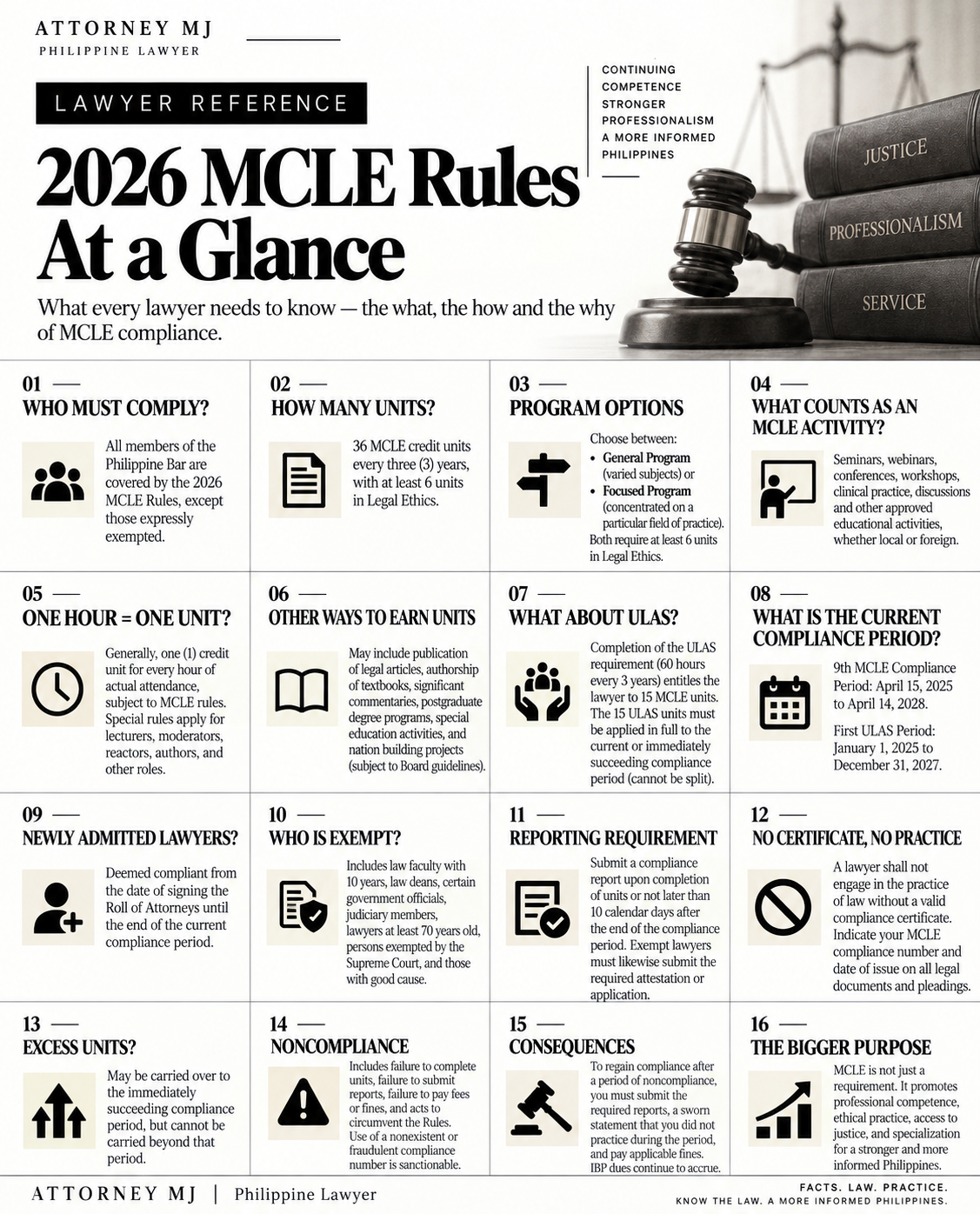
DEMYSTIFYING THE NEW 2026 RULES ON MANDATORY CONTINUING LEGAL EDUCATION
The 2026 Rules on Mandatory Continuing Legal Education introduce a more flexible and practice oriented framework for Philippine lawyers. While the core requirement remains 36 MCLE units every three years, including at least 6 units in Legal Ethics, lawyers may now choose between a General Program and a Focused Program. The Rules also recognize broader educational activities, provide for possible MCLE credit from ULAS, postgraduate studies, legal publications and other qualifying activities, and establish a framework for legal specialization. More importantly, compliance is directly tied to the authority to practice law, making proper completion, documentation, reporting, and maintenance of a valid MCLE compliance certificate essential for every practicing lawyer.
Read More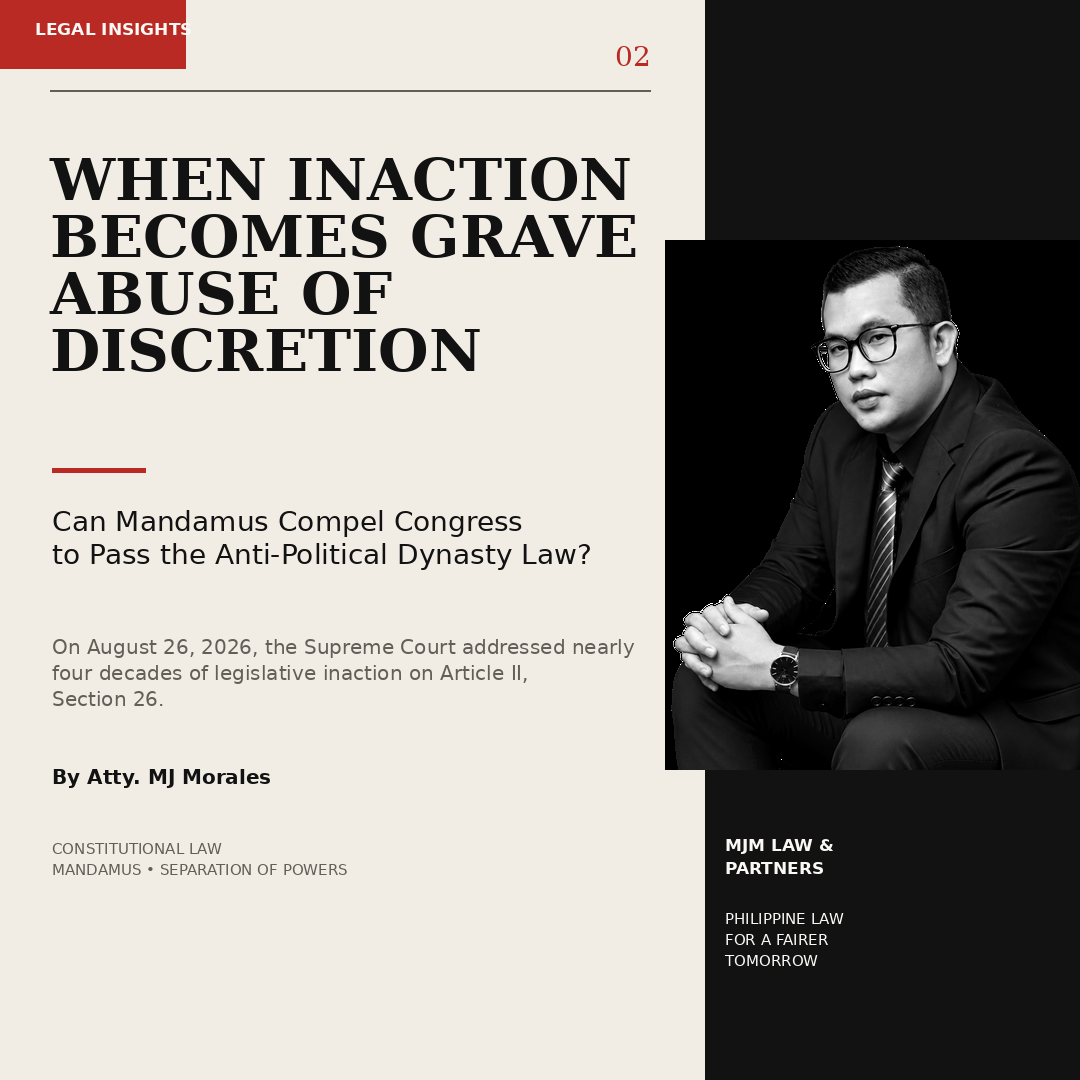
When Inaction Becomes Grave Abuse of Discretion: Can Mandamus Compel Congress to Pass the Anti-Political Dynasty Law?
The article examines whether the Supreme Court may compel Congress through mandamus to fulfill Article II, Section 26 of the 1987 Constitution, which directs the State to prohibit political dynasties “as may be defined by law.” Its central argument is that the Constitution imposes a mandatory duty on Congress to enact the necessary anti-political dynasty law, while Congress retains discretion over the law’s specific content, scope, and enforcement mechanisms. The article weighs this position against the separation of powers concern that legislation is inherently deliberative and discretionary, and therefore may not be a proper subject of mandamus. It ultimately frames the 2026 ruling as part of a broader constitutional question: whether prolonged governmental inaction can itself constitute grave abuse of discretion, while still preserving the Judiciary’s duty to enforce the Constitution without assuming Congress’ legislative function.
Read More