Before You Sign: Seven Contract Clauses Every Business Should Review
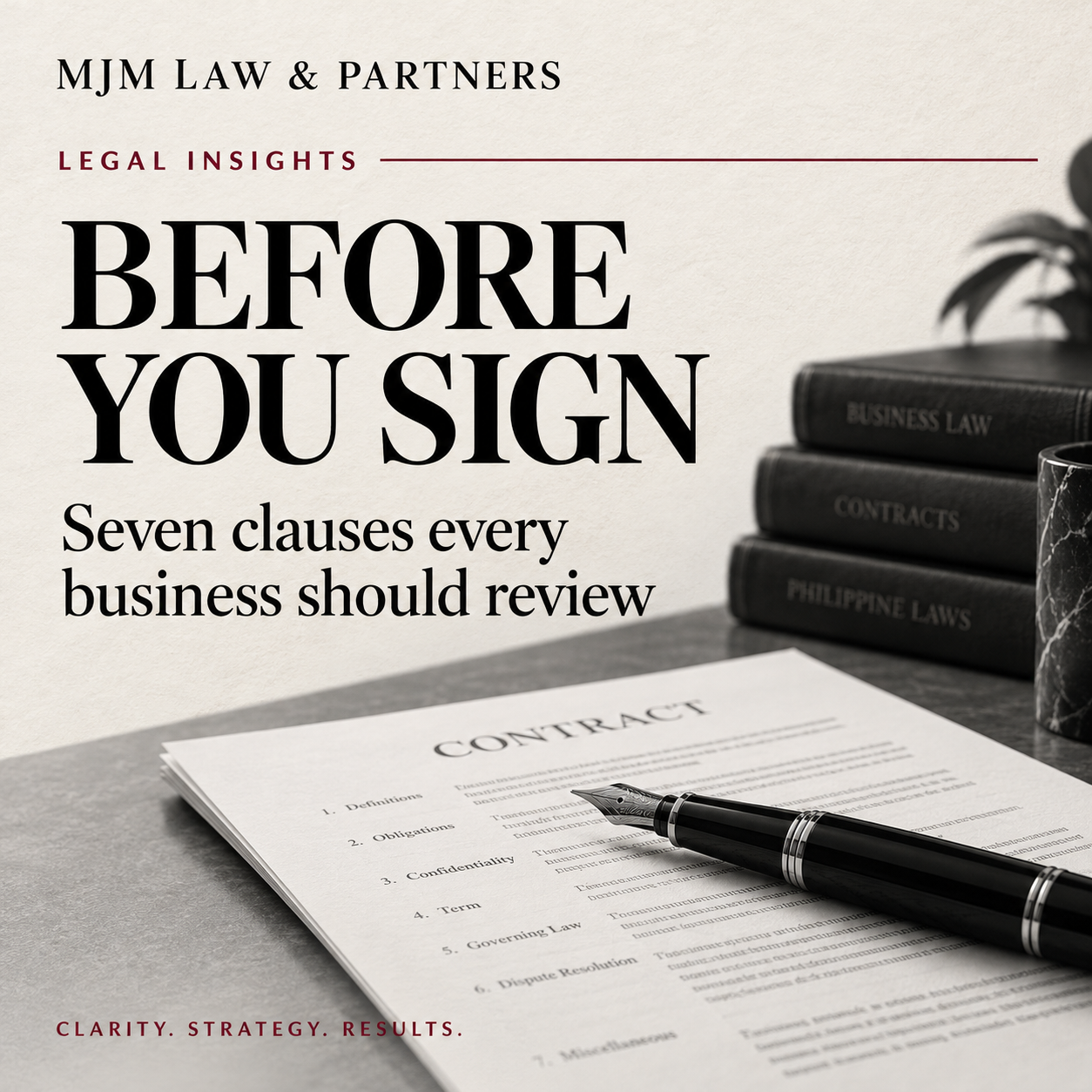
A supplier says the agreement is standard. The price looks acceptable, and the project needs to begin. It is tempting to sign first and resolve the details later.
Contract review should begin with what the business must do, what it will receive, and what happens when expectations are not met. The smallest-looking clause can change the commercial value of the entire agreement.
I. The legal foundation
The Civil Code recognizes contractual freedom within limits. Article 1306 permits parties to establish terms that are not contrary to law, morals, good customs, public order, or public policy. Article 1318 identifies consent, a certain object, and cause as essential requisites.
This does not mean every signed provision is automatically enforceable in every circumstance. Mandatory laws, authority to contract, consent issues, and the particular transaction may affect validity. A review should consider both the wording and the legal setting.
II. Seven areas that deserve attention
1. Scope and acceptance. What exactly must be delivered? Identify specifications, exclusions, milestones, acceptance criteria, and who approves completion. Avoid a payment obligation tied to a deliverable that nobody can objectively identify.
2. Price and payment. State the amount or calculation, billing requirements, due dates, currency, taxes, and approved reimbursable expenses. Explain how disputed invoices will be handled and whether the undisputed portion remains payable.
3. Changes and delays. Decide who can approve additional work and how the cost and schedule change. Clarify the consequences of delays caused by each party. An informal request should not quietly become an unlimited variation of the project.
4. Term and termination. Check the start date, renewal mechanism, notice period, grounds for ending the agreement, and any cure period. State what happens to unfinished work, advance payments, equipment, and records after termination.
5. Liability and remedies. Examine warranties, indemnities, exclusions, limits, penalties, and insurance requirements together. A cap may leave a major loss with your business; an uncapped obligation may create exposure beyond the contract price. Article 1171 also makes a waiver of an action for future fraud void.
6. Confidentiality, data, and ownership. Identify what information may be used, who owns work product, which rights are licensed, and how personal data is handled. Payment for a service should not be assumed to answer every intellectual-property question.
7. Disputes and notices. Check governing law, venue, any arbitration agreement, escalation steps, and the addresses and methods for formal notice. A dispute clause can affect the time and cost of enforcing the bargain.
III. Read the documents as one agreement
The signed page may incorporate quotations, website terms, purchase orders, technical annexes, or later schedules. Obtain and read those documents before signing. Check which one prevails when their terms conflict.
Confirm that the party named in the agreement is the entity you intend to deal with. Verify the signatory’s authority and the capacity in which each person signs. A personal guarantee should never be treated as routine company paperwork.
IV. Turn the review into concrete questions
- What event makes payment due?
- Who decides whether the work is acceptable?
- Can the other party change the price or terms unilaterally?
- What remains payable if the arrangement ends early?
- Which risks are insured, limited, or left with us?
- Can we comply with every promised deadline and obligation?
Keep agreed revisions in the final document. A reassuring conversation may be difficult to prove when it conflicts with the signed text. Retain a complete signed copy, including every annex.
V. The practical takeaway
The best time to clarify a contract is before performance begins. Review the obligations and failure scenarios with the same care as the price.
Sources and further reading
- Civil Code, particularly Articles 1171, 1306 and 1318: https://lexiquire.com/laws/RA%20386
This article provides general information on Philippine law. The appropriate advice and remedy depend on the facts, documents, and applicable rules.
For assistance reviewing your documents and legal options, contact MJM Law & Partners: https://www.mjmlawpartners.com/contact.
Clarity. Strategy. Results.
#Contracts #BusinessLaw #ContractReview #PhilippineLaw #MJMLawPartners
Atty. Mark Joseph Morales, CPA, MBA, JD
Founder and Managing Partner, MJM Law & Partners
Full professional profileYou Might Also Like

Co-Owned Property: Can One Owner Sell, Occupy, or Partition It?
Sharing ownership is different from owning a specific physical portion. This guide explains undivided shares, limits on use and alterations, sale of a share, and the right to seek partition under the Civil Code.
Read More
Who Really Owns the Company? Understanding Beneficial Ownership
A shareholder list may be only the beginning of an ownership review. This guide explains the distinction between registered ownership and the individuals behind an ownership or control structure, and how to prepare a coherent evidence file.
Read More
CCTV and Privacy: Recording an Incident Is Not Permission to Publish It
CCTV can serve legitimate security purposes while also processing personal data. This guide explains why a business needs a defined purpose, safeguards, a retention policy, and a separate review before disclosing or posting footage.
Read More