Bank Reconciliation: Why Your Bank Balance and Books Do Not Always Agree
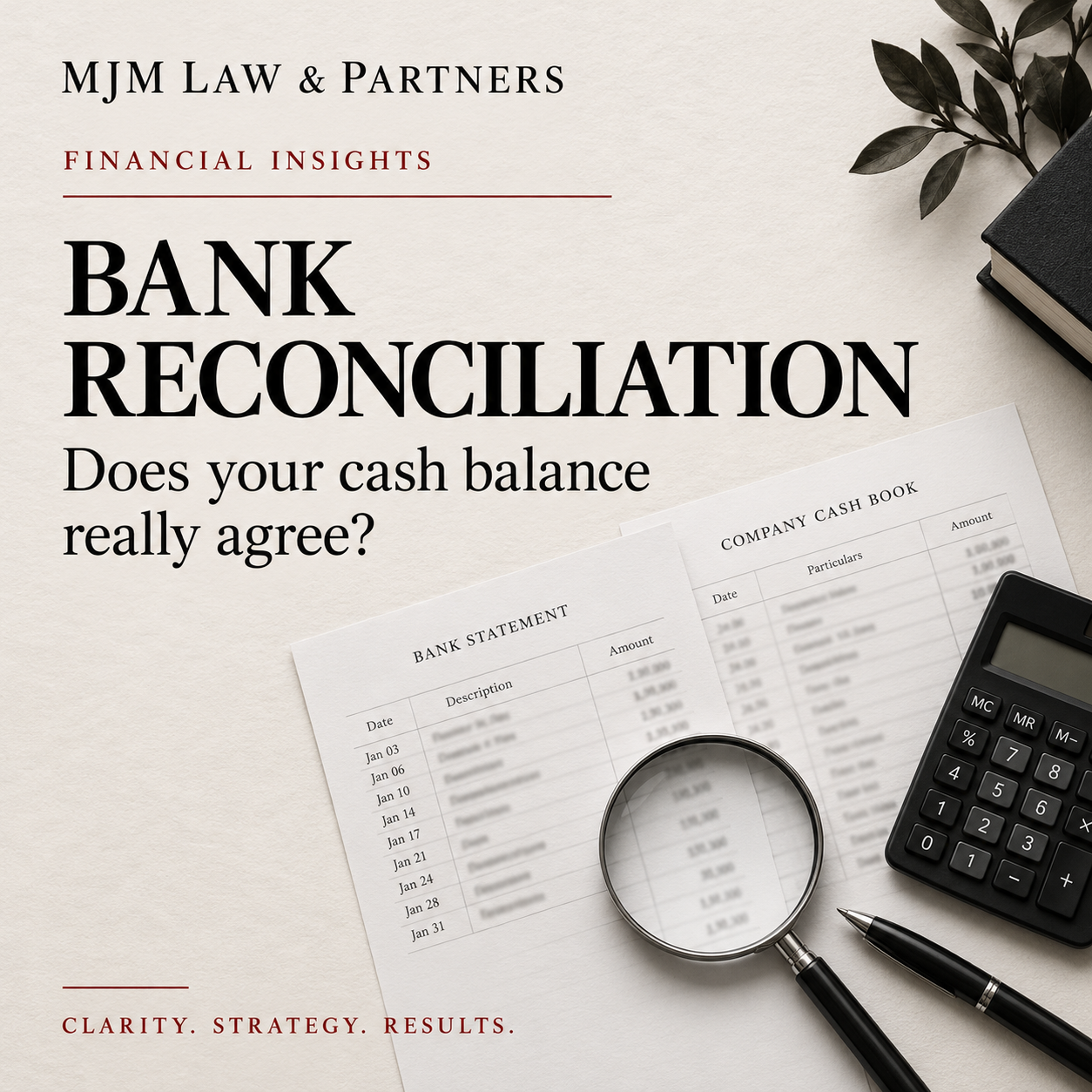
The bank shows ₱125,000. Your ledger shows ₱122,000. Which amount is correct? The answer requires a reconciliation, not a choice between the two screens.
Bank reconciliation explains the difference between the bank’s record and the business’s accounting record at a specific date. It also exposes missing transactions, duplicate entries, unauthorized payments, and old items that deserve attention.
I. Start with the same account and date
Obtain the bank statement directly from the bank and the cash ledger for the same period. Confirm the account number, currency, opening balance, and closing date. A current banking-app balance cannot be compared reliably with last month’s ledger without accounting for the intervening transactions.
Include all accounts: operating, payroll, savings, and payment settlement accounts. Reconcile each separately before combining totals. Transfers between your own accounts must be recorded on both sides without creating fictitious revenue or expense.
II. Separate timing differences from book adjustments
An outstanding check may have been recorded in the books but not yet debited by the bank. A deposit in transit may have been recorded before the bank credited it. These items ordinarily explain a difference in timing; they do not automatically require another entry to cash.
Bank charges, interest, and direct debits may appear first on the statement. If absent from the books, they require supported entries after their nature is established. An unidentified payment should remain under investigation rather than being casually assigned to miscellaneous expense.
A transaction clearing the bank proves movement of money. It does not, by itself, prove the appropriate accounting classification. The invoice, agreement, and business purpose remain relevant.
III. A simple numerical illustration
Assume the bank balance is ₱125,000, deposits in transit are ₱10,000, and outstanding checks total ₱15,000. The adjusted bank balance is ₱120,000.
If the ledger is ₱122,000 and an unrecorded bank charge is ₱2,000, the adjusted book balance is also ₱120,000. Record the supported bank-charge adjustment. Do not post the outstanding checks again merely to make the statement balance match the ledger.
This simplified example assumes every item is valid and that no other differences exist. A matching total is useful, but offsetting mistakes can still hide underneath it.
IV. Build a reviewable reconciliation
1. Match transactions individually. Use dates, references, amounts, and payees, rather than amount alone.
2. List unmatched items. Record their source, age, owner, and expected resolution.
3. Investigate exceptions. Obtain support for unfamiliar charges and duplicate transactions.
4. Post approved book corrections. Retain the entry number and supporting documents.
5. Recalculate both adjusted balances. Explain every remaining difference.
6. Have another person review. Date the approval and retain the evidence reviewed.
V. Watch the items that never clear
Old outstanding checks, repeated deposits in transit, negative settlement balances, and recurring unexplained adjustments are warning signs. Follow up on them; do not carry them forward indefinitely simply because the prior reconciliation included them.
Bank feeds help collect transactions, but a feed match is not a substitute for checking completeness or reviewing a reconciliation. Imported entries can also duplicate manually recorded payments.
VI. The practical takeaway
A useful reconciliation ends with an explained balance and an action list. The goal is reliable cash records, not merely a zero difference on a spreadsheet.
Sources and further reading
- IAS 7: cash flow reporting context: https://www.ifrs.org/issued-standards/list-of-standards/ias-7-statement-of-cash-flows/
- Small business financial management guidance: https://www.sba.gov/counseling/manage-your-business/
This article provides general accounting and financial management information. Examples are illustrative. The accounting treatment and compliance requirements depend on the entity’s applicable Philippine reporting framework and circumstances.
For help strengthening your reporting and financial management, contact MJM Law & Partners: https://www.mjmlawpartners.com/contact.
Clarity. Strategy. Results.
#BankReconciliation #Accounting #CashControls #SMEFinance #MJMLawPartners
Atty. Mark Joseph Morales, CPA, MBA, JD
Founder and Managing Partner, MJM Law & Partners
Full professional profileYou Might Also Like
Read the Financial Statements Together: Profit, Position, and Cash Flow
Profit tells only part of the business story. This guide shows how the income statement, balance sheet, and cash flow statement connect, and offers questions an owner can ask before relying on reported growth.
Read More
Protect Your Cash: Practical Internal Controls for a Small Business
Small teams can strengthen cash controls without building unnecessary bureaucracy. This guide proposes clear payment authority, independent checks, controlled vendor changes, and documented exception reviews.
Read More
Payroll Controls: From Earned Wages to Accurate Payment
A payroll total is only as reliable as its people, time, rate, and deduction records. This guide sets out practical checks for preparing, approving, paying, and reconciling payroll while protecting employee information.
Read More